

A federal AI pilot can meet its technical objectives and still fail to become a dependable mission capability. AI solutions for federal government must address an operational need, work within data and security boundaries, and connect to the systems and workflows teams already use.
That makes evaluation more complex than comparing model capabilities or choosing a promising demonstration. Agencies also need to assess data readiness, integration requirements, human oversight, and the resources needed to maintain a solution after deployment. This guide explains how to identify a bounded, high-value use case and compare solution approaches against mission and operational constraints.
We’ll outline a practical path from initial assessment through deployment and sustainment, including how custom AI, enterprise data automation, and existing architecture can work together. Athios connects custom AI development with data transformation, enterprise environments, and cybersecurity sustainment, helping agencies plan for operational integration rather than treating a pilot as the end state.
Key Takeaways
- Start with a defined mission outcome and workflow, then decide whether AI is the right way to support it.
- Assess the full capability, including data quality and access, infrastructure, applications, and oversight, rather than evaluating the model alone.
- Compare AI solutions for federal government by use-case fit, data and architecture needs, customization, integration effort, and operational ownership.
- Use decision gates from mission scoping through operational evaluation to test workflow quality, processing needs, user requirements, and oversight.
- Connect scoping, algorithm design, data transformation, and enterprise deployment to create a path from custom AI engineering to mission workflows.
AI Solutions for Federal Government: Start with the Mission and Workflow
Federal AI planning should begin with an operational need, not a technology label. AI solutions for federal government are coordinated capabilities designed to address a defined mission or operational requirement. Depending on the task, a capability may support information processing, service workflows, analysis, or enterprise data operations through machine learning, generative AI, automation, or a combination of methods.
Mission-aligned AI connects a defined workflow and governed data to appropriate oversight, producing an outcome that can be evaluated in operational terms. Choosing a model before understanding the work can lead to a technically capable tool that does not fit users’ decisions, systems, or responsibilities.
The broader Artificial intelligence in government overview describes applications across public administration and highlights considerations such as accountability and risk. For an agency, the practical starting point is narrower: identify a specific task, its place in the workflow, and the consequences of changing how it is performed.
Which federal workflows are suitable for AI assistance?
Bounded, repetitive, information-intensive tasks can be candidates for assessment, but they are not automatic candidates for deployment. Examples include extracting fields from documents for staff review, transforming data between operational formats, or helping employees retrieve information from internal knowledge resources. These tasks have defined inputs and outputs, making it easier to assess where assistance could fit and how results should be checked.
Suitability depends on mission context. A low-impact sorting task may tolerate a different error profile than analysis that informs a consequential decision. Identify who reviews outputs, how exceptions are handled, and what happens when the system is uncertain or wrong. Keep human responsibility clear, especially where AI-generated or classified information could influence downstream actions.
How should agencies define the mission problem?
Describe the work as it happens before specifying a solution. Identify the user, the current process, the point where delay or rework occurs, and the intended improvement. Replace broad aims such as “modernization” with an observable objective, such as reducing manual classification steps while maintaining review requirements. A precise baseline helps teams judge whether a proposed capability improves the workflow or simply adds another interface.
Include the operating conditions that shape feasibility and impact:
- Data access: Identify relevant sources, permissions, formats, and known quality limitations.
- Workflow ownership: Name the teams responsible for the process, output review, and exception handling.
- Decision impact: Trace how the output affects later actions, users, or mission decisions.
These inputs help define a bounded use case and expose assumptions early. With the mission problem defined, agencies can assess the data, infrastructure, and oversight required to make the capability reliable in its intended workflow.
What a Federal AI Solution Requires Beyond the Model
A model is one component of an operational capability, not the capability itself. A deployable solution connects data sources, infrastructure, a model or algorithm, an application, and oversight into a functioning system. Each component affects how information enters the system, how outputs are produced, who can use them, and how the work fits within existing agency processes.
Model performance alone does not establish operational readiness. Readiness depends on reliable data, secure and suitable infrastructure, workflow integration, and defined oversight. A model may perform well in a controlled test yet prove difficult to use if its inputs are incomplete, its outputs lack context, or staff must move results manually between systems.
How data, infrastructure, and models work together
Data ingestion determines which information reaches the system. Transformation converts it into a usable structure, while access controls determine which sources and users are permitted. Data quality, freshness, consistency, and provenance all shape whether model outputs are reliable enough for the intended task. For example, a document-processing workflow may need to preserve source references so a reviewer can trace an extracted value to its original record.
Infrastructure provides the operating environment for data, models, and applications. A cloud environment, an agency-managed environment, or a hybrid architecture can each support different technical arrangements. The appropriate design depends on mission needs, data sensitivity, existing architecture, and agency requirements. No single deployment pattern fits every use case.
Integration completes the chain. Model outputs should appear where authorized users can review and act on them, with relevant context and a defined route for exceptions. If staff must copy an output into another system by hand, the process can add friction and create new opportunities for error. Architecture and data engineering therefore belong in solution design from the outset, not as tasks deferred until after model selection.
Where human oversight and governance fit
Design oversight around the consequences of an output. A low-impact recommendation may require sampling and monitoring, while information that could influence a consequential decision or mission activity may require review before it proceeds. In either case, establish who is accountable, how uncertainty is handled, and when a result must be escalated or rejected.
Practical design considerations include:
- Access controls: Restrict data and system functions according to authorized roles.
- Logging: Record relevant inputs, outputs, actions, and review steps to support traceability.
- Evaluation: Test performance against representative data and continue monitoring for errors or changing conditions.
- Escalation: Define how users report questionable outputs and return cases to an appropriate review process.
The NIST AI Risk Management Framework can help teams organize risk identification and management. It is a resource, not a blanket certification or a substitute for agency-specific requirements. These principles can be applied alongside custom AI and enterprise data engineering to connect models, data, infrastructure, and oversight within the operating environment.
How to Compare Federal AI Solution Approaches
Three common approaches are configurable platforms, custom AI development, and workflow automation. The right choice depends on how closely the mission need matches existing capabilities, how much control is required over data and behavior, and how the solution must integrate with agency systems. Comparing AI solutions for federal government on these dimensions helps teams make a practical choice without assuming that one approach fits every workflow.
| Approach | Use-case fit | Data and architecture needs | Customization | Operational ownership |
|---|---|---|---|---|
| Configurable platform | Repeatable needs that align with established capabilities | Requires suitable data handling and integration pathways within the operating environment | Configuration within the platform’s available boundaries | Agency teams oversee use, configuration, access, and dependencies |
| Custom AI development | Distinct mission tasks or data workflows that do not map cleanly to standard capabilities | Requires deliberate design for data inputs, architecture, interfaces, and deployment | Tailored algorithms and application behavior | Teams plan for evaluation, maintenance, and continued technical ownership |
| Workflow automation | Defined processes involving repeatable steps, routing, or information handling | Requires process mapping and connections to relevant systems and data | Rules and AI components can be combined where appropriate | Process owners and technical teams maintain workflow logic and exceptions |
The matrix is a starting point, not a procurement decision. Compare each approach against the same mission requirements, including the consequences of error, available data, integration effort, and the team accountable for operations. A platform may reduce the need to build common functions, while still requiring configuration and integration work. Custom development can address a distinct workflow, but design and sustainment responsibilities should be explicit from the outset.
When a configurable platform may fit
A configurable platform may be appropriate when a recurring need aligns with its existing capabilities and its operating model fits agency requirements. Assess configuration limits, data handling, integration pathways, and dependencies such as platform updates or external services. The platform’s existence does not, by itself, establish that its security controls, data practices, or operating conditions meet an agency’s needs.
When custom AI or automation may fit
Custom development may suit a mission process with distinct data, decision-support needs, or system interfaces. The design should account for existing architecture, data readiness, evaluation, and ongoing operational ownership. Automation can combine an AI component, such as classifying incoming information, with deterministic rules that route cases, enforce process steps, or flag exceptions. This separates flexible interpretation from tasks that require consistent, predefined logic.
Manage risk through scope and controls, not by avoiding all customization. Bound the use case, test against representative conditions, define review and escalation points, and monitor performance as the workflow operates. Athios connects custom AI engineering with enterprise data and deployment, tailoring the work to project scope and operational needs. Learn about custom AI engineering for workflows that require tailored integration.
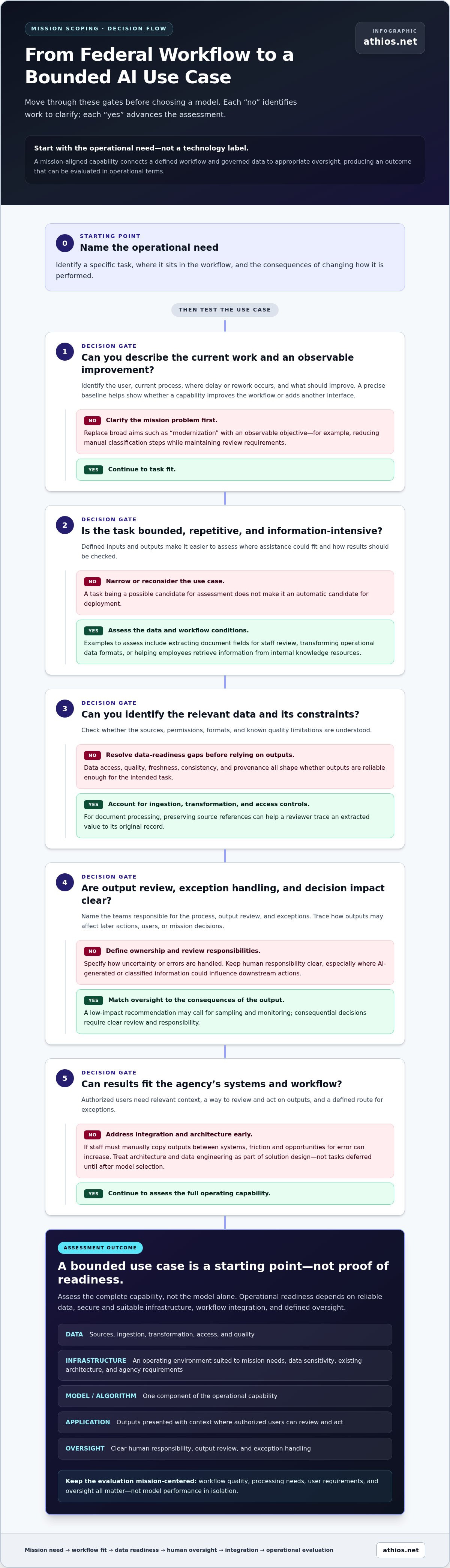
A Practical Federal AI Implementation Path from Scope to Operations
Implementation should proceed through defined stages, with a decision gate at each one. This structure helps agencies determine whether an effort is ready to advance, needs revision, or should stop before more resources are committed. For AI solutions for federal government, the objective is not simply to complete a pilot, but to establish whether the capability can operate reliably within its intended workflow.
What happens before development begins?
Document the workflow, users, intended outcome, operating constraints, and dependencies on existing systems. Assess whether relevant data is available, usable, and accessible under applicable permissions. Identify transformation work and likely limitations. Set evaluation criteria, assign human review responsibilities, and define conditions for pausing or revising the effort before development begins.
How does a pilot move toward sustained operations?
Test with representative data and users, record limitations and failure conditions, and use the findings to refine the design. Before deployment, plan integration into the target environment, operational controls, documentation, cybersecurity sustainment, and clear ownership for maintenance. After launch, monitor performance, user feedback, data changes, and emerging risks rather than treating the pilot as the endpoint.
A practical lifecycle can be organized into five stages:
- Scope the mission need. Define the workflow, users, intended improvement, and baseline process. Decision gate: Is the problem bounded, important to the mission, and measurable?
- Assess readiness. Examine data availability, quality, permissions, transformation needs, system dependencies, and applicable constraints. Decision gate: Can the necessary inputs and operating environment support a controlled evaluation?
- Design and develop. Specify solution components, workflow integration, controls, documentation, and human review points before building. Decision gate: Is there a feasible design with accountable owners and testable requirements?
- Evaluate in a representative setting. Test with representative data and users, recording expected results and failure conditions. Measure workflow quality, processing performance, user needs, and whether oversight works as intended. Decision gate: Do results meet established criteria without unacceptable operational limitations?
- Deploy and monitor. Integrate the approved capability into its target environment, document operating procedures, and assign responsibility for sustainment. Track performance, feedback, data changes, and emerging risks. Decision gate: Can the organization maintain and oversee the capability as conditions change?
Evaluation should reflect the task, not rely on a single model score. For document handling, teams might assess whether outputs are complete enough for the review process and how exceptions affect processing. For an internal knowledge workflow, they might examine usefulness to staff and the effort required to validate responses. Set criteria before testing so results can inform a clear decision.
Policy is another implementation input. Applicable Office of Management and Budget (OMB) guidance and agency policy can change, and requirements may vary by use case and environment. Verify current guidance during planning and again before deployment rather than treating an earlier review as permanent. Athios supports scoping, data transformation, enterprise deployment, and cybersecurity sustainment. Plan a custom AI implementation with Athios around the workflow and its operational ownership.
How Athios Connects Custom AI Engineering to Federal Workflows
Once an agency has defined a use case and its decision gates, the next challenge is translating the plan into an engineered capability that fits the operating environment. Athios provides custom AI-driven automation and enterprise data solutions, connecting technical development with the data, systems, and workflows the capability must serve. This makes the engineering work relevant to agencies assessing AI solutions for federal government beyond a standalone model or isolated demonstration.
What Athios brings to a custom AI engagement
Athios can support work from initial scoping through algorithm design, data transformation, and deployment into client enterprise environments. These activities align with the implementation stages above: scoping clarifies the mission workflow, data transformation prepares information for its intended use, and deployment connects the capability to an operational setting.
Architecture and infrastructure planning help establish how a solution relates to existing systems and networks. Systems administration and cybersecurity sustainment complement that engineering by supporting technology operations after initial development. Together, these disciplines help teams plan for integration, technical dependencies, and ongoing ownership as part of the project, rather than treating those needs as separate from AI development.
Engagement structure can be tailored to project scope, using defined deliverables and milestones or other suitable arrangements. For agencies, this provides a way to align work with practical stages such as assessment, design, development, integration, and sustainment without presuming a particular contract vehicle, authorization, or compliance outcome.
How to define a productive first engagement
A focused initial engagement starts with operational context rather than a broad request to “apply AI.” Bring forward the workflow under consideration, the users who perform or rely on it, the relevant data context, and the operational objective. Include known system dependencies and the decisions or activities that could be affected by generated outputs or automated steps.
These inputs help scope concrete work, such as mapping the process, assessing data transformation needs, designing an algorithm, or defining an enterprise deployment approach. Deliverables and milestones can reflect the technical and operational work required, while evaluation criteria help determine whether the effort is ready to advance. The agency’s workflow owners and technical stakeholders remain central to decisions about access, review, integration, and ongoing operations.
This approach keeps the engagement tied to mission needs and implementation realities. Athios connects custom AI engineering with enterprise data, architecture, infrastructure planning, and cybersecurity sustainment, tailoring the work to the project’s scope and deployment needs. Discuss a federal AI initiative with Athios.
Move from a Defined Use Case to an Operational Plan
The next step is to turn a selected use case into a decision-ready plan: identify the workflow owner, document the conditions for success, and establish how the capability will be reviewed and maintained. This gives teams a practical basis for determining whether AI solutions for federal government can advance from assessment into an operational setting.
A focused engagement can align technical work with agency priorities through scoped deliverables and milestones, with the structure tailored to project needs. Athios brings custom AI-driven automation together with enterprise data solutions and engineering expertise in architecture, cybersecurity sustainment, and systems administration, supporting work from scoping through deployment and ongoing operations.
Agencies can begin with a defined workflow, intended users, data context, and operational objective. From there, the scope can clarify the work required, the decision points, and the capabilities needed to support the target environment. Discuss a federal AI initiative with Athios and take the next step toward an implementation plan grounded in mission requirements.
Frequently Asked Questions
What are AI solutions for the federal government?
AI solutions for the federal government are engineered capabilities that use AI to support a defined agency function, with outputs delivered to an appropriate user or system. For example, a records team might use a capability to identify likely document categories, while staff retain responsibility for final classification. The solution includes the technical components and operating procedures needed to use outputs within the agency’s work, not just the underlying model.
How can federal agencies use AI?
Federal agencies can assess AI for tasks such as identifying patterns in large datasets, routing incoming requests, or supporting staff research across authorized information sources. The value depends on whether the task is well understood and whether outputs can be checked against source information or established procedures. Start by mapping the task and the user’s next action, then decide whether AI assistance adds useful capacity without obscuring accountability.
Is generative AI appropriate for federal government use?
Generative AI may be appropriate for bounded tasks such as drafting an internal summary or helping staff locate relevant passages, provided the agency can manage the information involved and review the output. It may be unsuitable where fluent but inaccurate content could be acted on without verification. Evaluate the intended use, data handling, access, and review process under current agency requirements before deciding how or whether to use it.
What is the difference between federal AI platforms and custom AI solutions?
A federal AI platform provides configurable capabilities intended to serve a range of users or tasks, while a custom AI solution is engineered around a particular workflow, data context, or system interface. A platform may suit a recurring need that fits its functions; custom development can address distinct requirements but demands explicit technical ownership. The decision should account for integration, configuration limits, data needs, and who will maintain the solution.
How do federal agencies evaluate AI risks?
Agencies evaluate AI risks by examining how errors, misuse, data exposure, or changing conditions could affect the mission and people relying on the output. A practical review can trace information from source to user, identify who can access it, and assess what happens when results are incomplete or incorrect. Document mitigations, accountable roles, and escalation procedures, using resources such as the NIST AI Risk Management Framework alongside applicable agency policy.
What should a federal AI pilot measure?
A pilot should measure whether the capability improves the intended task without creating unacceptable burdens or risks. Track output accuracy against reviewed examples, the time or steps required to complete the workflow, the frequency and handling of exceptions, and users’ ability to interpret results. Record failures as well as successful cases. These measures help decision-makers distinguish a useful operational fit from a demonstration that performs well only under narrow test conditions.
How can a federal AI solution integrate with existing systems?
Integration begins by identifying where inputs originate and where users need results, then selecting interfaces and data exchanges that fit the target architecture. For example, a capability might return a proposed classification to an existing review queue rather than requiring staff to work in a separate tool. Technical design should account for permissions, data formats, error handling, logging, and system ownership so integrations remain understandable and supportable.
What role does human oversight play in federal AI?
Human oversight assigns responsibility for reviewing, accepting, correcting, or escalating AI outputs. Its form should reflect the consequence of error: staff may sample low-impact outputs, while higher-impact recommendations may require review before they influence a decision. Agencies should also train users to recognize limitations and provide a route for reporting problematic results. Clear oversight prevents automated output from being mistaken for an authorized decision or verified fact.

Article by
Kevin Torres


