

What determines the value of enterprise data: where it is stored, or whether it can move between systems with its meaning intact? Enterprise data integration services coordinate data flows across applications, databases, and business units so teams can use information consistently for operations and decisions. The work goes beyond connecting systems. It also involves aligning data transformation, architecture, and deployment with how the organization needs to use its information.
When data is spread across formats and environments, teams can struggle to build a trusted view of what is happening. Connecting sources without addressing quality, security, and governance can carry inconsistencies into reports, workflows, and analytics. Integration is therefore an operating capability for managing reliable data flows, not simply a project to centralize information.
This guide explains the purpose and core components of enterprise data integration, including how pipelines, APIs, platforms, and data quality controls fit together. It compares common integration patterns and the needs they address, then outlines a practical approach to governance, security, and business outcomes. Athios supports this work with project-specific engineering across data transformation, architecture, custom automation, and deployment within client enterprise environments.
Key Takeaways
- Enterprise data integration services coordinate data across systems so teams can use information consistently, accounting for different formats, owners, workflows, and governance needs.
- Before selecting or building a pipeline, define each data flow’s source, destination, frequency, ownership, and permitted use.
- Compare batch, streaming, APIs, and ETL or ELT based on freshness requirements, data volume, transformation location, and operational dependencies.
- Build security and trust into integration planning through clear data ownership, access controls, classification, retention, and auditability.
- Connect architecture, data transformation, custom automation, and deployment to the business use case when planning integration work.
What Enterprise Data Integration Services Do for Distributed Business Data
Integration connects data across systems so people and applications can use it consistently. At enterprise scale, the work spans applications, databases, cloud and on-premises environments, data formats, owners, and operational workflows. Enterprise data integration services coordinate how information moves among these parts of an organization, while accounting for who is responsible for it and how it may be used.
Enterprise data integration is the coordinated process of connecting data from distributed systems, transforming it for defined uses, and delivering it to authorized users or applications. This is more than copying records. Moving data transfers it from a source; transforming it aligns structures, values, or identifiers; making it usable means delivering it with enough context and control for a downstream task. The concept of Enterprise Information Integration (EII) also focuses on presenting information across disparate sources through a unified view, without requiring every source to be consolidated in one location.
Why enterprise data becomes fragmented
Records accumulate in systems built for distinct functions. Finance may maintain supplier accounts, operations may track work orders, and customer teams may store interaction histories. These sources can run on different technologies or across cloud and on-premises environments, with separate teams defining field names, formats, and access practices. As a result, an entity may appear under different identifiers, dates may use inconsistent formats, and similar fields may have different meanings.
These mismatches complicate shared reporting and routine workflows. Staff may have to reconcile records manually, repeat data entry, or wait for separate teams to assemble a complete view. Integration coordinates how information is exchanged and mapped, but a sound design also requires decisions about definitions, ownership, and acceptable data quality.
What integration makes possible
Connected data can support analytics across multiple sources, operational workflows that pass relevant information between applications, and information exchange across teams. For example, an organization could align order records with inventory data so an authorized workflow can use both, even if each remains in its existing system. A unified view provides a consistent way to access and interpret related information; it does not require placing every record in one central database.
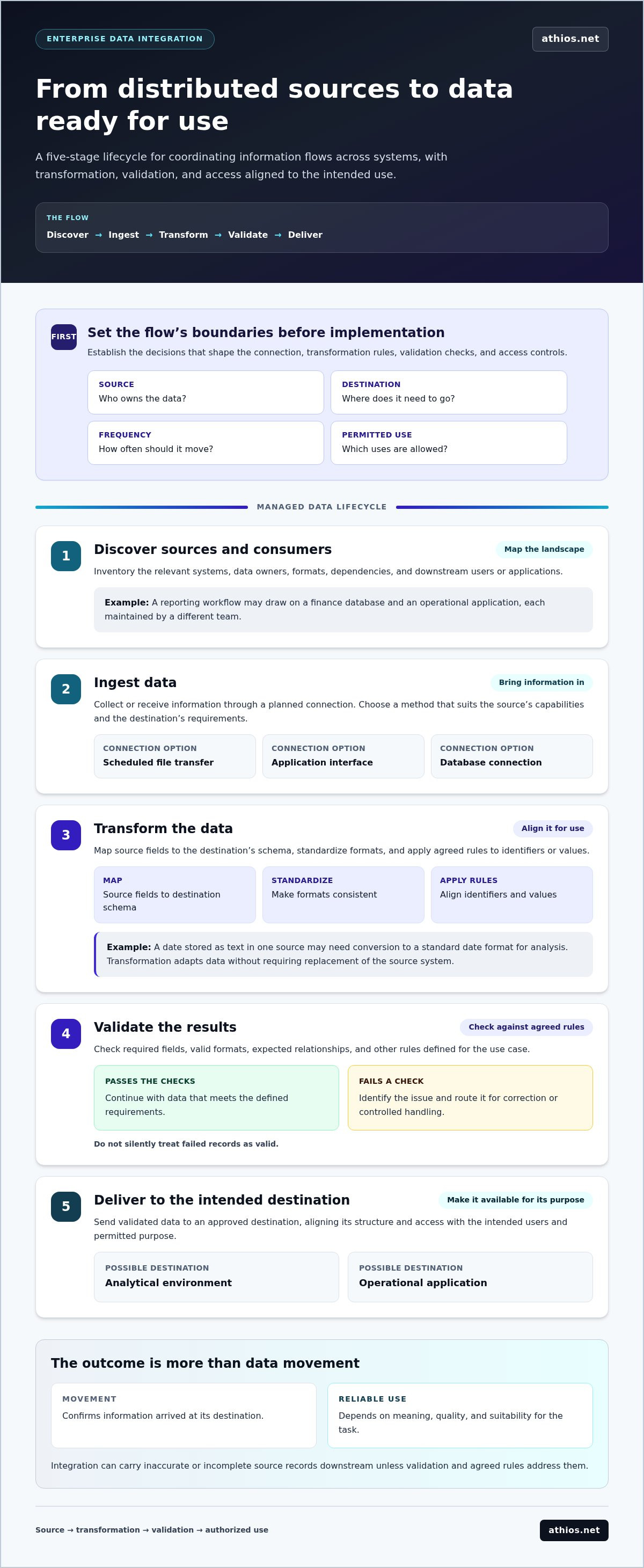
Integration does not make inaccurate or incomplete source records trustworthy by itself. If two systems use conflicting customer identifiers or one contains outdated information, a pipeline can carry that problem downstream unless validation and agreed rules address it. Teams should distinguish successful data movement from reliable data use: the first confirms that information arrived, while the second depends on its meaning, quality, and suitability for the task.
This distinction makes integration an ongoing operating capability rather than a one-time consolidation effort. Architecture, transformation rules, access decisions, and deployment all affect whether connected information remains useful as systems and workflows change.
How Enterprise Data Integration Moves Data from Source to Use
Enterprise data integration services turn an intended information exchange into a managed flow, from identifying source records to delivering data for a defined operational or analytical use. Before implementation, establish who owns each source, where the data needs to go, how often it should move, and which uses are permitted. These decisions shape the connection, transformation rules, validation checks, and access controls.
A practical lifecycle makes responsibilities visible at each stage:
- Discover sources and consumers. Inventory relevant systems, data owners, formats, dependencies, and downstream users or applications. For example, a reporting workflow may rely on records from a finance database and an operational application, each maintained by a different team.
- Ingest data. Collect or receive information through a planned connection, such as a scheduled file transfer, application interface, or database connection. Choose a method that fits the source’s capabilities and the destination’s requirements.
- Transform the data. Map source fields to the destination’s schema, standardize formats, and apply agreed rules to identifiers or values. A date stored as text in one source may need conversion to a standard date format for analysis. Transformation adapts data for use without requiring replacement of the source system.
- Validate the results. Check required fields, valid formats, expected relationships, and other rules defined for the use case. When records fail, identify the issue and route it for correction or controlled handling rather than silently treating it as valid.
- Deliver to the intended destination. Send validated data to an analytical environment, operational application, or another approved destination. Align access and structure with the intended users and permitted purpose.
- Monitor the flow. Track job failures, unexpected schema or data changes, and freshness against the agreed processing frequency. Monitoring helps teams identify and investigate issues as systems and source data evolve.
From source discovery to transformation
Discovery should document how a field is produced, who can explain its meaning, and which downstream processes depend on it. This context prevents teams from mapping fields by name alone: two systems may label a value “status” while representing different business states. Ingestion establishes a controlled route for receiving data, while transformation applies documented mappings and standardization rules to make records compatible with their intended use.
Validation, delivery, and operational monitoring
Validation and monitoring serve different purposes. Validation tests whether data meets defined rules as it moves through the flow; monitoring checks whether the flow continues to run as designed. Traceability records where data came from and how it was processed. Together, these controls help teams investigate exceptions and assess downstream effects. Athios delivers project-specific architecture, data transformation, custom automation, and deployment in client environments. Its enterprise data engineering work can be structured around the systems and workflows involved.
An enterprise data integration lifecycle discovers sources and consumers, ingests data, transforms and validates it, delivers it to an approved destination, and monitors the flow for failures and change. Defining ownership, destination, frequency, and permitted use before development keeps each technical step tied to an operational purpose.
Which Enterprise Data Integration Pattern Fits the Use Case?
The right integration pattern depends on what the data must support, how quickly it is needed, and where transformation can happen. A scheduled report may work well with periodic batch processing, while an operational workflow may need an API or a continuously updated stream. Enterprise data integration services can combine these patterns across an organization. Each flow should match its own freshness, volume, and architecture requirements.
| Pattern | Freshness need | Volume and transformation | Operational dependencies |
|---|---|---|---|
| Batch | Scheduled or grouped updates | Suitable for accumulated records; transformation can occur before or after loading | Depends on run schedules, processing windows, and recovery procedures |
| Streaming | Continuous or near-continuous updates | Processes ongoing events; transformation may occur in the flow or downstream | Requires ongoing monitoring and a destination ready to handle arriving data |
| APIs | Request-based or event-triggered exchange | Moves specific records or requests through defined interfaces | Depends on interface availability, access controls, and agreed request formats |
| ETL versus ELT | Depends on the load schedule or trigger | ETL transforms before loading; ELT loads first and transforms in the destination | Depends on source extraction, destination capabilities, and transformation ownership |
Batch and streaming for different freshness needs
Batch processing collects records and moves them at planned intervals, such as after a business-day close or on a recurring schedule. It can suit analysis that does not need immediate updates and gives teams a defined processing window for larger grouped transfers. The trade-off is that information may be less current between runs, and failures can delay the next usable update.
Streaming processes data continuously or near continuously, supporting workflows that depend on timely events. It also brings operational demands: teams need to monitor flow health, handle interruptions, and ensure downstream systems can accept and act on incoming records. Choose streaming when the use case benefits from that freshness. Faster arrival adds little value if the destination cannot process the data or users do not need it immediately.
APIs, ETL, and ELT in an integration architecture
APIs provide defined interfaces through which systems can exchange data or requests. They work well for structured, targeted application interactions, but depend on interface behavior, permissions, and the availability of the systems involved. ETL, or extract, transform, load, applies transformations before data reaches its destination. ELT, or extract, load, transform, loads data first and performs transformations in the destination environment.
ETL may fit architectures where data must be prepared before loading; ELT may suit analytical environments that support transformation after ingestion. These are not competing enterprise-wide choices. An organization can use APIs for application interactions, batch for scheduled reporting, streaming for time-sensitive events, and different ETL or ELT flows for distinct destinations. Compare freshness needs, data volume, transformation location, and operational dependencies to design for each use case instead of imposing one method on every flow.
How to Plan Enterprise Data Integration for Security and Trust
Reliable integration starts with a defined purpose and accountable ownership, not a technology choice. A phased plan connects each data flow to a business or mission need, establishes how information may be handled, and prepares teams to operate the flow in production. This gives enterprise data integration services a clear basis for design, review, and expansion.
Set scope, ownership, and measurable objectives
Start with one bounded use case and identify the decisions or workflow it must support. Map source systems, authoritative records, data owners, consumers, and dependencies before choosing an integration pattern. Then agree on practical indicators, such as required data freshness, completeness checks, acceptable error handling, and successful delivery to the intended destination. These criteria make testing meaningful and clarify accountability when results fall short.
Use these phases to move from initial scope to controlled production:
- Prioritize the use case. Define its intended users, purpose, and boundaries, including which records are in scope.
- Assign ownership. Identify who stewards each source and who approves definitions, mappings, and changes to data rules.
- Design the controls. Classify information, define permitted use, and set access, retention, and auditability requirements for the source, flow, and destination.
- Specify quality expectations. Document validation rules for completeness, format, and consistency, along with procedures for rejected or disputed records.
- Test the flow. Verify mappings, access, validation, error handling, and traceability with representative data before production use.
- Release and review. Deploy in a controlled manner, assign operational ownership, monitor agreed indicators, and review issues before expanding to additional flows.
Build security and quality controls into delivery
Limit access to the people and system components that need it for the approved purpose. Classification informs how data is handled, while retention rules define how long it is kept in relevant locations. Auditability requires enough documented history to understand access, movement, and processing. Stewardship makes these controls actionable: a named owner can assess whether a quality issue reflects a source defect, an unclear definition, or a transformation rule that needs revision.
Plan for exceptions as part of the design. For example, a record that fails a required-field check may need to be held for review rather than passed into a downstream workflow. Document who receives the issue, how it is resolved, and whether affected outputs need correction. Phased deployment gives teams an opportunity to test these procedures and confirm operational responsibilities before additional flows depend on them.
Governance, validation, and ongoing monitoring work together to make integrated data more trustworthy: they define permitted use, check data against agreed rules, and surface changes or failures for review. Athios’s architecture, data transformation, custom automation, and deployment services support project-specific integration engineering. Discuss your enterprise engineering requirements to align the design with your environment and intended use.
How Athios Supports Enterprise Data Integration Engineering
Enterprise integration is an engineering effort shaped by existing systems, data responsibilities, and the environment where information must be used. Athios supports this work through technical architecture, data transformation, custom enterprise data automation algorithms, and deployment within client enterprise environments. These activities help organizations develop integration flows around defined operational or mission needs rather than treating connectivity as a standalone platform purchase.
Connect architecture and custom data automation
Architecture provides the structure for aligning source systems, data flows, and target environments. It clarifies how information will move, where transformations belong, and how the design fits the organization’s technical environment. Custom algorithms address project-specific automation needs within that design, while data transformation prepares information for its intended use and deployment places the engineered work in the client environment.
The work can be scoped to the requirements of a particular flow. For example, a project may map data between existing systems, apply agreed transformation rules, and deploy the resulting process in the organization’s environment. The goal is not necessarily to replace source applications or standardize every integration at once. A focused engineering scope can address a defined need while accounting for the surrounding architecture and operational context.
Reliable operation also depends on the systems and security practices around the integration. Athios provides systems administration and cybersecurity sustainment to support integration work within enterprise environments. These services contribute to ongoing operational oversight, alongside clear ownership, maintenance procedures, and defined responsibilities for managing data-flow issues.
Move from an integration concept to a scoped engagement
A practical engagement begins with a bounded use case and a shared understanding of the records, systems, users, and decisions involved. A source map, ownership assignments, security and quality controls, target environment, and delivery stages provide a basis for defining the work. This groundwork distinguishes what needs to be designed, transformed, automated, tested, and deployed from what remains within existing systems or team responsibilities.
Enterprise data integration services can involve several engineering activities, so the scope should reflect the project’s needs and working arrangement. Athios engagements can use fixed-scope, time-and-materials, or retainer structures. Clear objectives and delivery stages help align the arrangement with the initiative, whether the work covers a targeted data flow or a broader set of connected engineering tasks.
Organizations defining an integration initiative can start by bringing together their priority use case, source-system map, and intended outcomes. Discuss your enterprise integration objectives with Athios to frame the architecture, transformation, automation, and deployment work around your environment.
Set a Clear Direction for Your Integration Initiative
Turn an integration need into a defined engineering objective. Identify the decision, workflow, or information exchange to support, then establish the systems and responsibilities involved. This focus keeps enterprise data integration services aligned with the organization’s operating environment as requirements develop.
Athios brings together technical architecture, custom data automation algorithm development, and data transformation and deployment within client enterprise environments. Architecture and cybersecurity sustainment services also support the work’s place in the broader technical context. The scope depends on the initiative, its source systems, and the intended use of connected data.
Start with the objective your teams need to support, then develop the engineering path from there. Plan your enterprise integration initiative with Athios to frame the work around your environment and priorities.
Frequently Asked Questions
Is enterprise data integration the same as data migration?
No. Migration typically moves data as part of a defined transition, while integration supports ongoing exchange between systems or workflows. For example, replacing a finance application may require migrating historical transactions; a separate integration could keep approved transaction details available to another system afterward. Migration and integration can be coordinated in one initiative, but a completed transfer alone does not establish ongoing updates or a process for handling later changes.
Does enterprise data integration require a central data warehouse?
No. A warehouse can serve as a destination for reporting, but integration can also connect operational applications and other data environments. For example, a service team might need selected account information in a case-management application, while analysts use a separate reporting environment. Each destination can serve a distinct purpose. Specify which records are needed where rather than assuming every system must send all its data to one repository.
What is the difference between data integration and application integration?
Data integration focuses on making information usable across sources; application integration connects systems so they can exchange information or coordinate actions. For example, an application interface might pass an approved customer update from one system to another, while a separate data process prepares customer records for analysis. These approaches can work together, but serve different design needs: one focuses on usable data, the other on system interaction or process coordination.
Can enterprise data integration connect cloud and on-premises systems?
Yes. An integration design can connect cloud services with systems hosted in an organization’s own data center, provided connectivity, access controls, and data-handling arrangements are addressed. A practical design might expose only the fields needed for a cloud-based report rather than making an entire internal database available. Network boundaries, system interfaces, information sensitivity, and operational ownership all affect implementation.
How does enterprise data integration support AI and analytics?
Enterprise data integration services can make relevant information available to analytics and AI workflows in a form teams can interpret and govern. For example, an analysis of service demand may depend on aligning operational events with reference data that provides context. Integration can prepare that input, but it cannot establish that the data represents every relevant case or that an analytical method is appropriate. Teams still need to assess inputs and review outputs.
What role does data governance play in enterprise integration?
Governance helps teams resolve practical questions about meaning and responsibility. A shared data dictionary can define whether “active” refers to an open account, a current contract, or another condition; a named steward can approve that definition and manage proposed changes. Without agreed terms, two systems may exchange records successfully while users interpret them differently. Governance also provides a path for escalating conflicts and documenting decisions that affect downstream use.
Does enterprise data integration replace the systems an organization already uses?
Usually, no. Integration can connect existing applications while each continues to perform its intended function. For instance, a system of record can remain responsible for maintaining supplier details while another approved application receives selected fields for a workflow. Teams may consider replacement separately if an application no longer meets organizational needs, but integration can be designed around current systems without making replacement a prerequisite.

Article by
Kevin Torres


