

A capable machine-learning model can still create operational risk if it connects to enterprise systems without clear data controls or ownership. Integration involves more than placing a model beside an application: data must move reliably, access must be governed, and outputs must fit the decisions and workflows they are meant to support. Machine learning integration services address these engineering requirements by connecting custom algorithms with enterprise data and applications.
This guide covers the components and lifecycle of an integration, from data preparation and model deployment to monitoring and operational oversight. It compares API-based connections, batch processing, event-driven workflows, and embedded deployment against different system requirements. It also outlines readiness steps for data quality, security, access controls, architecture, and ongoing ownership. These foundations help enterprise teams assess how machine learning fits their existing environment and plan a deployment that can be maintained as systems and needs evolve.
Key Takeaways
- Separate model development, integration engineering, and ongoing operations to clarify responsibilities across the machine-learning lifecycle.
- Trace how source data is transformed, sent to a model for inference, and returned to an application. Use REST APIs when they fit the workflow.
- Compare API-based inference, embedded deployment, and scheduled batch processing by latency, system coupling, deployment constraints, and operational complexity.
- Use machine learning integration services to connect custom models with enterprise systems while accounting for data quality, provenance, permissions, sensitivity, and retention.
- Assign operational ownership before deployment, including responsibility for monitoring, maintenance, and changes to connected systems.
Role of ML Integration Services in Enterprise Systems
Integration connects a trained machine-learning model to the data it needs, the applications that use its output, and the workflows where decisions are made. The model is only one component. Enterprise value depends on a defined path from input data to an output that a system or person can interpret and act on appropriately.
Machine-learning integration is the engineering work of connecting a trained model to enterprise data, applications, and controlled operational workflows.
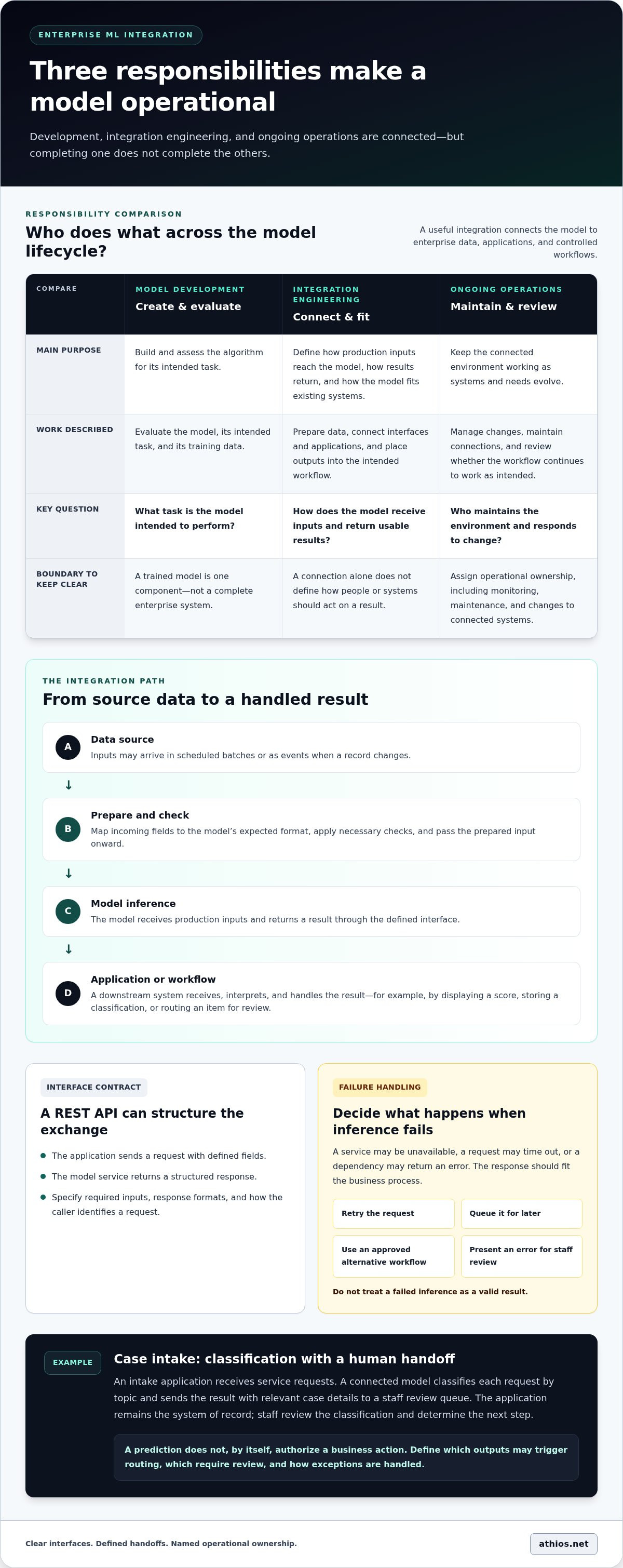
Model development creates and evaluates the algorithm, including its intended task and training data. Integration engineering defines how the model receives production inputs, returns results, and fits into existing systems. Ongoing operations cover responsibilities such as maintaining the connected environment, managing changes, and reviewing whether the workflow continues to work as intended. These activities are related, but completing one does not automatically complete the others.
A prediction or classification has limited practical value if it remains isolated from the systems responsible for action. For example, a model may classify incoming cases by priority. Staff can use that result efficiently only if the application displays it, preserves relevant context, and routes the case to an appropriate workflow. The integration boundary therefore includes both technical connections and the handoffs that determine how people and systems use model outputs.
For background on the underlying discipline, What is Machine Learning? describes machine learning’s relationship to artificial intelligence and its applications. This distinction helps frame integration: machine learning produces model outputs, while surrounding software and operational processes determine how those outputs enter an organization’s work.
What is included in machine learning integration services?
The scope can include interfaces for sending inputs and receiving outputs, data flows that prepare information for inference, and connections to business applications. It also covers the deployment environment where the model runs and operational handoffs that assign responsibility for its use. Machine learning integration services connect these components around a specific workflow, rather than treating the model as a complete system on its own.
The appropriate scope depends on existing systems, workflow requirements, and the intended output. A classification may need to appear in an application, while a numerical estimate may feed a separate analysis process. Integration engineering is different from buying a standalone software license or model: the work is to connect and configure capabilities within the enterprise environment.
Where machine learning fits within an enterprise workflow
Consider an intake application that receives service requests. A connected model could classify each request by topic and send the result, along with relevant case details, to a staff review queue. The application remains the system of record, while staff review the classification and determine the next step. This makes the model’s role clear without removing people from the workflow.
A prediction does not, by itself, authorize a business action. The organization defines which outputs may trigger routing, which require review, and how exceptions are handled. Establishing these boundaries before deployment helps align application behavior with operational authority and keeps responsibility for decisions with the designated people and processes.
How machine learning integration connects data, models, and applications
A production integration creates a controlled path from a data source to a model, then to the application or workflow that uses the result. Inputs may arrive in scheduled batches, such as a daily set of transactions, or as events generated when a record changes. A transformation step maps incoming fields to the format the model expects, applies necessary checks, and passes the prepared input to the inference service. The application then receives the result in a format it can interpret.
A model output has operational value only when downstream systems have a defined way to receive, interpret, and handle it. That may mean displaying a score, storing a classification with a record, or routing an item for review. The integration should also specify what happens when a result is missing, delayed, or outside expected bounds.
Data flow and application interfaces
A REST API can provide a structured interface between an application and a model service. The application sends a request with defined fields, and the service returns a model result in a structured response. The interface should specify required inputs, response formats, and how the caller identifies a request. A clear contract reduces ambiguity as systems evolve and supports consistent exchanges between application components.
Integration design must account for failure. A service may be unavailable, a request may time out, or a dependency may return an error. Teams should decide whether the application retries, queues the request for later, uses an approved alternative workflow, or presents an error for staff review. The right choice depends on the business process. Treating a failed inference as a valid result can lead to misleading downstream behavior.
Identity and access controls define which services and users can submit data, retrieve outputs, or administer model components. Data handling decisions cover what information crosses system boundaries, where it is processed, and what is retained. Logging can support troubleshooting and oversight, but should account for sensitive information by limiting captured data to what the operational purpose requires. These are architectural decisions, not automatic features of an API or model.
Deployment environments and operational boundaries
Cloud deployment can place inference near cloud-based applications and data services. On-premises deployment can keep processing within an organization’s own infrastructure. A hybrid design distributes components across both environments. It can accommodate existing system constraints, but requires deliberate management of data movement, network paths, and access boundaries. The right design depends on the organization’s infrastructure and workflow.
Containers can package a model service and its dependencies for consistent deployment. Kubernetes may suit an architecture that requires orchestration across containerized workloads, but it also introduces platform operations the team must own. Neither technology is necessary for every integration.
Map system boundaries explicitly: identify which component handles protected data, which service performs inference, and which enterprise application receives the output. Define permitted paths between them and assign responsibility for changes, access, and incident handling. MLOps practices provide useful context for connecting deployment with ongoing management. Teams defining these boundaries can also explore Athios’s enterprise engineering capabilities as part of their integration planning.
Machine learning integration patterns: APIs, embedded models, or batch pipelines
Choosing an integration pattern means balancing response time, system boundaries, and operating capacity. An API keeps the model service separate from the application, an embedded model runs closer to the application or device, and a batch pipeline processes accumulated data on a schedule. Each pattern has trade-offs. The right fit depends on required response time, where data resides, how the application is designed, and which teams will maintain the connection.
| Pattern | Latency | Coupling | Deployment constraints | Operational complexity |
|---|---|---|---|---|
| API-based inference | Can support interactive requests when network and service response times meet workflow needs. | Model and application are separate, connected through a defined interface. | Requires a reachable service, network access, and compatible request and response formats. | Teams manage the model service, interface changes, connectivity, and dependency failures. |
| Embedded deployment | Inference occurs within or close to the application, with timing shaped by local resources and implementation. | Model and application are more closely coupled. | Must fit the application’s runtime, device capabilities, and deployment process. | Model updates may need to follow application release or device management procedures. |
| Scheduled batch processing | Results are available after a processing run, rather than in response to each live request. | Data exchange is periodic, with less direct interaction between model and application. | Requires a suitable schedule, accessible input data, and a destination for completed results. | Teams coordinate runs, failed-job recovery, and delivery or reconciliation of outputs. |
This comparison describes trade-offs, not a guaranteed performance level. For an API, network conditions, request size, service availability, and workload affect response time. Embedded inference avoids a separate request to a model service, but the host environment can constrain model size or update practices. Batch processing can suit large or recurring workloads when results are not needed immediately, but requires clear procedures for delayed or incomplete runs.
Pattern selection should follow the workflow and architecture, not a preference for one technology. Map where source data is held, which application consumes the result, how quickly staff need it, and what deployment constraints apply. Also account for how the model will be updated without disrupting dependent systems.
When API-based machine learning integration fits
An API pattern suits an application that needs to request a result from a separately deployed model through a defined interface. Separation can allow the model service and application to be deployed independently, provided teams manage interface compatibility and service dependencies. This pattern may suit real-time or near-real-time workflows, but actual responsiveness depends on the full system, including network paths, service load, and failure handling.
When embedded or batch integration may be appropriate
Embedding may suit an application or device with a supported runtime and a need to keep inference close to its operation. Batch processing may suit periodic scoring, reporting, or prioritization where immediate output is unnecessary. Embedded designs can tie model updates to application releases, while batch designs need scheduled execution and dependable result handoffs. Each pattern shifts operational responsibilities rather than removing them.
A readiness framework for secure, maintainable machine learning integration
Readiness is a sequence of decisions, not a final security review. Before deployment, teams should establish why the model is needed, what information it can access, how its outputs will be assessed, and who will operate the connected system. Use this framework to move from use-case definition to accountable ownership.
- Define the use case. Specify the operational decision the model supports, its intended users, and the conditions under which its output will be used.
- Document data provenance. Identify approved sources, data owners, collection context, and known limitations that may affect interpretation.
- Classify information. Record the sensitivity of inputs and outputs, applicable handling constraints, and retention requirements at each system boundary.
- Set access permissions. Define which users and services can submit data, access results, administer the model, or change the integration.
- Assess data quality. Establish checks for completeness, format, and relevance. Determine how the workflow responds to missing or unexpected values.
- Evaluate the model. Test performance against representative data and use-case acceptance criteria, including situations where staff review should take precedence.
- Test the integration. Verify interfaces, permissions, output handling, and failure paths, including unavailable dependencies and incomplete responses.
- Define safeguards. Specify fallback behavior when inference cannot be completed, and preserve human review where the decision process requires it.
- Assign operational ownership. Name the teams responsible for monitoring, model updates, integration changes, incident response, and retention decisions.
Assess data, security, and governance prerequisites
Before connecting systems, map how inputs and outputs move across applications, model services, and protected data stores. At each boundary, identify the data owner, authorized users, access controls, and handling limits. Confirm which sources are approved for the use case and how long related records or logs should be retained. Governance should align with the organization’s policies and applicable obligations, rather than assume one framework covers every environment.
The NIST AI Risk Management Framework can help teams organize risk identification and management across an AI system’s lifecycle. It is guidance for structuring oversight, not a universal legal requirement. Use it alongside established organizational governance processes and the specific requirements that apply to the deployment.
Plan testing, monitoring, and operational ownership
Define acceptance criteria before testing so results can be assessed against the intended workflow. Test normal requests, invalid inputs, access denials, timeouts, and unavailable dependencies. Verify that outputs reach the right destination and that fallback or human-review paths work as designed. After deployment, monitor relevant data and model behavior for changes that may affect output quality, and establish who investigates alerts and approves corrective changes.
Operational ownership should also cover model updates and changes to connected applications, since either can affect the integration. Athios supports secure machine-learning integration planning through custom AI development, enterprise data automation, architecture, and cybersecurity sustainment.
How Athios supports machine learning integration from design through deployment
Once an organization has defined its use case, data boundaries, integration pattern, and operating responsibilities, the next step is to turn those requirements into an engineered solution. Athios provides custom AI development and enterprise data automation, connecting algorithm design and data transformation with deployment into client enterprise environments. This work treats the model, surrounding systems, and operational context as parts of one project rather than isolated technical tasks.
In secure IT environments, a model must fit the organization’s applications, infrastructure, data practices, and workflow. Deployment must also account for the environment in which the system will operate. Project scope is shaped by requirements and the systems involved.
From integration requirements to an engineered solution
Project scoping aligns the intended use case with the systems that provide inputs, consume outputs, and support day-to-day operation. It clarifies workflow objectives, data sources, application connections, deployment context, and operational boundaries before design decisions are finalized. This gives teams a shared basis for shaping algorithm design and data transformation around the enterprise environment.
As the work advances, the integration approach connects these components through a deployment plan suited to the client environment. Athios’s project work includes scoping, algorithm design, data transformation, and deployment, with architecture and infrastructure planning informing how the solution fits existing systems.
Preparing for a defined next step
Make planning more concrete by documenting the current application landscape, the workflow the model will support, the location and sensitivity of data, and the services that need to exchange information. Identify data and system owners, access boundaries, how outputs will be reviewed or used, and who will maintain the model and its connections.
These details give architecture and deployment planning practical constraints to work from. Systems administration and cybersecurity sustainment support the wider integration context, because operational environments require ongoing oversight as systems and dependencies change. Defining responsibilities early connects implementation decisions with maintainable operation.
For organizations assessing machine learning integration services, a written scope is a useful starting point for project discussions. It gives technical teams a clearer basis for aligning custom AI work, enterprise data automation, and engineering requirements without presuming a single architecture or deployment pattern.
Learn more about Athios’s enterprise AI and automation capabilities, including custom development and engineering work that supports integration from design through deployment.
Move from integration planning to a defined first step
Select one workflow where a model output could support an existing operational decision. Define the business objective, the decision owner, and what a useful result would enable. This creates a focused basis for deciding whether the work should proceed and keeps the scope connected to an enterprise need rather than model novelty.
For teams evaluating machine learning integration services, the project brief can also state key constraints: systems involved, data boundaries, deployment environment, and the organizational roles responsible for ongoing operation. Recording these priorities helps align technical design with how the organization works and gives teams a reference point for future changes.
With a defined starting point, organizations can assess how custom AI development and enterprise engineering fit their objectives. Explore Athios’s enterprise AI and automation capabilities to consider a project-based path from requirements to implementation.
Clear priorities make complex integration work more manageable and give teams a sound foundation for deliberate progress.
Frequently Asked Questions
What is the difference between machine learning integration and machine learning development?
Machine learning development produces or adapts a model, while integration connects that model to an organization’s systems and processes. A development team might deliver a model that classifies service requests; integration work ensures the receiving application can provide the expected inputs and use the returned classification. This distinction helps teams set separate acceptance criteria: assess model quality against its intended task, and assess integration against system behavior and workflow needs.
Can machine learning models be integrated with legacy enterprise systems?
Yes. Legacy systems can often use model outputs through an interface or intermediary component that fits their existing capabilities. For example, a system that cannot call a modern service directly might exchange structured files with an integration layer that submits requests and returns results. The design should preserve established controls and account for supported data formats, change constraints, and the effort needed to maintain the connection.
Does machine learning integration require cloud infrastructure?
No. A model can be integrated in cloud, on-premises, or hybrid environments, depending on the organization’s infrastructure and operational requirements. For example, an organization may keep a protected data source and inference service on premises while connecting results to an application hosted elsewhere. The architecture should account for network access, data movement, available computing resources, and who can administer each environment.
What data quality issues can delay a machine learning integration project?
Inconsistent identifiers, changing field names, missing values, duplicate records, and timestamps recorded in different formats can disrupt the connection between source systems and model inputs. Label quality can also affect evaluation when examples are categorized inconsistently. Before integration, inspect representative records, document expected schemas, and decide how to handle invalid or incomplete inputs. This helps teams distinguish data issues from model or interface defects.
How can an organization determine whether a model is ready for integration?
A model is ready for integration when it has a defined purpose, documented input and output formats, and evaluation results that meet acceptance criteria for its intended use. Test it with representative data that was not used to develop it, then confirm that the receiving workflow can interpret its outputs. Document known limitations and specify when uncertain or out-of-scope results require human assessment.
Who is responsible for maintaining a machine learning integration after deployment?
Responsibility should be assigned across the teams that operate the model, source data, and connected applications. A named operational owner can coordinate model updates, interface changes, monitoring, and incident response, while system and data owners manage their respective environments. Machine learning integration services should include agreed handoff procedures so staff know who investigates an issue, who approves a change, and how changes are tested before release.
Planning a machine learning integration project? Contact Athios to discuss custom AI development and enterprise data automation.

Article by
Kevin Torres


