

Effective PED is not a standalone data-processing task. It is an operational workflow that carries sensor data through to usable intelligence. When formats and volumes vary, analysis can lose value if preparation, exploitation, or delivery falls behind mission needs. Processing exploitation and dissemination services should connect every stage, from organizing incoming data to extracting relevant information and delivering outputs decision-makers can use.
That end-to-end view helps teams assess service scope, integration responsibilities, and timelines against operational needs. This guide explains how processing, exploitation, and dissemination work together, what a complete PED approach can deliver, and which criteria help evaluate support. It also covers how to align scope with mission objectives and the existing client environment. Athios provides PED as part of its broader government and commercial IT professional services, connecting the workflow to wider engineering and IT delivery.
Key Takeaways
- Assess PED as connected functions with clear handoffs, rather than treating processing, exploitation, and dissemination as separate tasks.
- Map how data preparation, analysis, validation, and delivery connect, including where stages may need to repeat or run in parallel.
- Compare processing exploitation and dissemination services against mission needs, including integration, data handling, validation, and support boundaries.
- Prepare for an engagement by documenting mission outcomes, representative data flows, user needs, operating constraints, and existing dependencies.
- Understand how Athios’s PED services fit within broader IT engineering work, including architecture, administration, cybersecurity sustainment, and custom automation.
What Processing, Exploitation, and Dissemination Services Deliver
Processing, exploitation, and dissemination services coordinate the work of turning collected data into intelligence products for intended users. Each function has a distinct role, but the value comes from effective handoffs: data must be prepared for analysis, findings must retain relevant context, and outputs must reach users in a form they can apply. PED services connect data preparation, interpretation, and delivery to support mission-informed intelligence needs.
Data volume alone does not show whether a workflow is effective. Mission context determines which information matters, timing affects whether it remains useful, and recipient needs shape how findings should be presented. Even a large data set can have limited operational value if relevant details are difficult to interpret or arrive after the decision they were meant to inform.
What do processing, exploitation, and dissemination mean?
Processing organizes, prepares, or transforms incoming data so it can be examined. Depending on the source and system design, this may involve arranging files, preserving associated information, or converting data into a format that supports analysis. The goal is to create a usable input, not to draw conclusions from it.
Exploitation examines and interprets that input to develop mission-relevant information. Analysts or supporting tools may identify patterns, features, or changes, then assess their meaning in context. Findings may be validated or refined before they are presented as an intelligence product.
Dissemination delivers appropriate outputs to intended users through applicable channels. The format depends on the audience and use. It might be a concise report, an annotated image, or another structured product. The handoff should explain what the output conveys and preserve the context users need to interpret it.
These functions do not always follow one fixed sequence. A user’s information need may lead to further examination, while a processing issue may require data preparation to be revisited. The Intelligence Cycle and PED provides foundational context for understanding how PED fits within broader intelligence work.
How PED relates to intelligence, surveillance, and reconnaissance
Intelligence, surveillance, and reconnaissance (ISR) describes the broader activity of collecting and using information to support intelligence needs. Sensors provide inputs, such as imagery or other observations. PED covers work that may organize and analyze those inputs, then deliver resulting products. ISR and PED are connected but not interchangeable: collection produces data, while PED helps develop and communicate its meaning.
A raw sensor record is not automatically an intelligence finding. Prepared data and intermediate analytical products may support an assessment, but they remain distinct from an interpreted output intended to inform a user. Clear handling of each stage helps recipients understand what was observed, what was assessed, and how the information relates to their needs.
How the PED Workflow Moves Data Toward Usable Intelligence
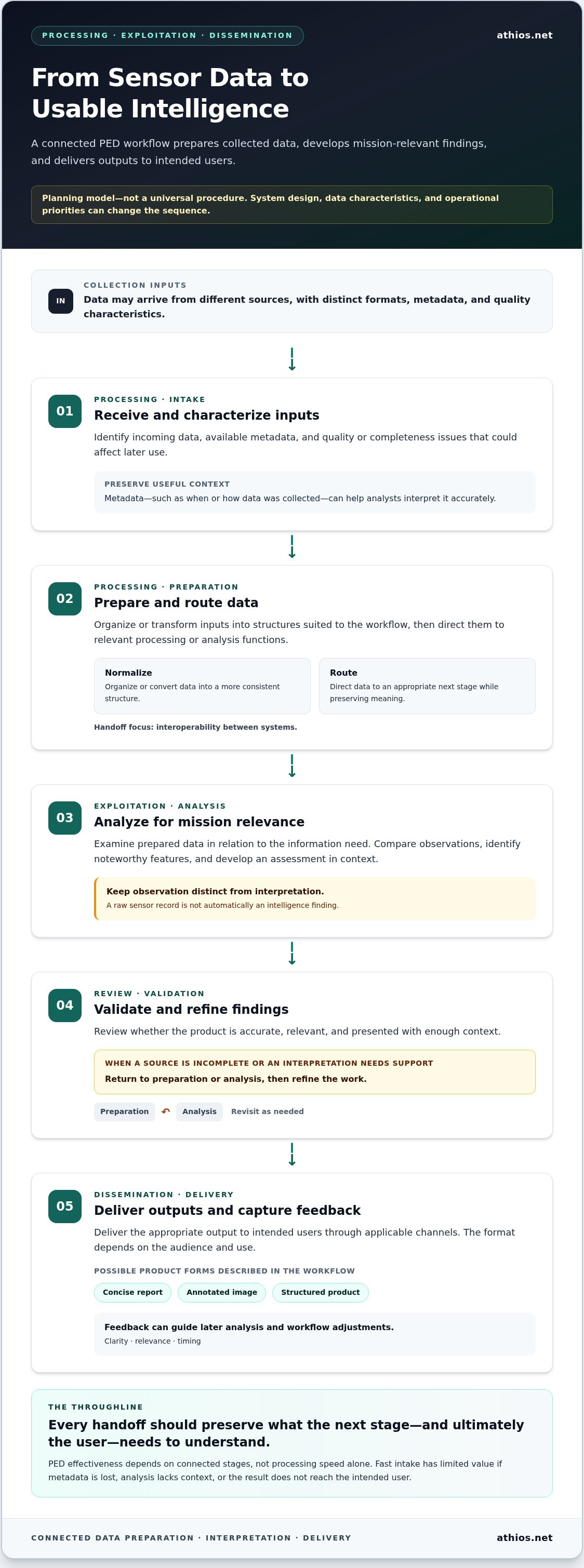
A PED workflow defines how information moves from collection inputs to products that support a mission need. The sequence below is a planning model, not a universal procedure. System design, data characteristics, and operational priorities can change how stages are arranged. PED effectiveness depends on connected stages, not processing speed alone. Fast intake has limited value if metadata is lost, analysis lacks context, or the result does not reach the intended user.
Data intake, preparation, and integration
In ISR workflows, collected data may arrive from different sources with distinct formats, metadata, and quality characteristics. These differences affect the preparation required and how information moves between systems. Normalization organizes or converts data into a more consistent structure; routing directs it to an appropriate next stage. Both steps must preserve useful context and account for data quality.
- Receive and characterize inputs. Identify the incoming data, available metadata, and any quality or completeness issues that could affect later use. Metadata, such as information about when or how data was collected, can help analysts interpret it accurately.
- Prepare and route data. Organize or transform inputs into structures suited to the workflow, then direct them to relevant processing or analysis functions. Interoperability matters: systems need an effective way to exchange information without obscuring its meaning.
- Analyze for mission relevance. Examine prepared data in relation to the information need. Analysts may compare observations, identify noteworthy features, or develop an assessment while distinguishing observed data from interpretation.
- Validate and refine findings. Review whether the product is accurate, relevant, and presented with enough context. If a source is incomplete or an interpretation needs support, return to analysis or preparation and refine the work.
- Disseminate and capture feedback. Deliver the appropriate output to intended users through applicable channels. Feedback about clarity, relevance, or timing can guide later analysis and workflow adjustments.
Analysis, validation, and dissemination handoffs
Each handoff should preserve the information the next stage needs. For example, an analyst who receives an image without useful associated context may struggle to interpret it or relate it to a mission question. Similarly, a recipient needs more than a file: the output should communicate the finding and provide enough context for appropriate interpretation.
Validation creates a deliberate opportunity to assess accuracy, relevance, and context before dissemination. Review methods vary with the mission and system design. Feedback after delivery can reveal unclear products, recurring preparation issues, or changing user needs. Teams can use that feedback to refine tools, handoffs, and subsequent analysis.
Organizations assessing processing exploitation and dissemination services can use this workflow to clarify where data enters, who or what handles each transition, and how outputs reach users. Athios provides PED as part of its broader IT engineering and consulting work. Learn how Athios PED services fit within a wider delivery context.
How to Compare PED Services for Mission and Technical Fit
Start a comparison with the mission outcome, then assess whether the proposed scope and technical approach support it across the full workflow. Processing speed matters, but it does not show whether data can be integrated, findings validated, or intelligence delivered in a usable form. Compare responsibilities, dependencies, and evaluation measures together rather than relying on one performance score.
Compare workflow coverage and integration responsibilities
Break the work into stages so included tasks, interfaces, and ownership are clear. Use the categories below to document what the approach covers and where boundaries or dependencies could affect continuity.
Workflow scope: Identify whether data preparation, analysis support, dissemination, and sustainment are included. Define the handoffs between each activity.
Integration: Map connections to existing systems, tools, data structures, and operational workflows. Record interface or infrastructure dependencies that could interrupt data movement.
Data handling: Describe how information is accessed, organized, transformed, and maintained throughout the workflow, including how metadata and data quality issues are handled.
Validation: Specify how accuracy, relevance, and context are assessed, who owns review activities, and which criteria determine whether an output is accepted.
Dissemination: Identify intended recipients, output formats, delivery channels, and responsibilities at release.
Support boundaries: Distinguish service responsibilities from client-owned systems, operational decisions, and external dependencies. Document how changes and issues are managed.
This structure makes gaps easier to spot. Analysis support, for instance, may be clearly defined while responsibility for data preparation or delivery remains ambiguous. Mapping those boundaries establishes who maintains each handoff and what must be in place for the workflow to continue.
Assess timeliness, quality, and governance together
Throughput describes how much data a process handles over a defined period. Latency describes the time between an input or event and a relevant output. Neither measure is useful in isolation. A high-throughput process may miss a mission’s decision window, while a low-latency result may have limited value if data quality, interpretation, or validation is insufficient.
Set measures against mission requirements and approved evaluation criteria. Where defined, compare processing latency, data quality, rework, and delivery timeliness using representative tasks and conditions. Decide what counts as a useful output, which delays matter operationally, and how incomplete or inconsistent inputs affect evaluation. Avoid comparing figures based on different workloads or assumptions.
Governance is part of technical fit, not an administrative afterthought. Access, handling, auditability, validation, authorities, and security controls vary by program and should guide evaluation. Document applicable requirements and responsible roles before comparing approaches. This helps assess processing exploitation and dissemination services against both technical performance and the controls that govern the mission.
How to Prepare for a PED Services Engagement
A productive engagement starts with the mission outcome, not a tool or processing target. Define what users need to understand or decide, then translate that need into an agreed scope, data flows, interfaces, responsibilities, and evaluation criteria. This sequence keeps processing exploitation and dissemination services aligned with operational priorities and makes dependencies visible before implementation.
Define mission outcomes and operational requirements
Describe the decisions or user needs the intelligence outputs should support. Specify what a useful output must communicate, who will use it, and when it is needed. Then document the operating context, including expected data sources, formats, volumes, timing, and constraints that could affect access, processing, analysis, or delivery.
- Describe the inputs: Record representative data flows, available metadata, expected variations, and known quality concerns.
- Identify the users: Capture recipient roles, information needs, preferred output forms, and relevant decision timelines.
- Map ownership: Identify stakeholders responsible for mission requirements, analysis, technical integration, governance, and acceptance.
- Define evaluation: Establish review points and acceptance measures with the appropriate stakeholders. Tie them to usable outputs and mission needs, not abstract system scores.
Program-specific requirements, authorities, and security controls should shape the preparation. Document the requirements that apply to the environment rather than relying on a universal compliance checklist. This gives technical and operational teams a shared basis for defining scope and evaluating results.
Plan integration, testing, and transition
Before implementation, map how data moves across existing systems and where people or technical components take responsibility for a handoff. Record interfaces, dependencies, data flows, and constraints that could affect continuity. This map distinguishes what the engagement covers from client-owned systems or decisions, reducing ambiguity as work progresses.
- Trace representative workflows. Follow an input from its source through preparation, analysis, review, and delivery. Note where information changes or ownership transfers.
- Test mission-relevant scenarios. Use representative inputs and user needs to assess workflow behavior, output clarity, validation, and delivery against agreed acceptance measures.
- Set review and decision points. Agree who evaluates results, how findings are recorded, and how changes to scope or requirements are handled.
- Plan transition responsibilities. Define the documentation, knowledge transfer, and sustainment activities needed to support ongoing operations and future adjustments.
Testing should establish more than whether data passes between systems. A workflow can complete technically and still produce an output that users cannot readily interpret or apply. Include intended recipients in reviews so usability and mission relevance inform acceptance alongside integration behavior.
A tailored engagement aligns scope with mission objectives and the client environment. Discuss a tailored PED engagement with Athios to set a practical starting point for planning.
How Athios Approaches Processing, Exploitation, and Dissemination Services
Athios provides processing, exploitation, and dissemination services within a broader government and commercial IT engineering context. This connects PED scope with the systems and operating environment that support the work, rather than treating data analysis as an isolated task. Athios’s wider capabilities include enterprise architecture, systems and network administration, cybersecurity sustainment, and custom AI-driven automation. Which capabilities are relevant depends on the mission, defined responsibilities, and client environment.
Align PED scope with the operating environment
Effective scoping starts with mission objectives and the data workflows intended to support them. Athios aligns engagement scope with the operating environment by accounting for existing systems, integration needs, delivery responsibilities, and desired outputs. This creates a basis for connecting PED work to architecture, administration, and sustainment considerations.
Architecture and integration planning clarify how information moves across systems and teams. Custom automation can support defined workflow tasks, with its role shaped by requirements and system design rather than assumed performance gains.
- Mission objectives: Define intended outcomes and the intelligence outputs users need.
- Data workflows: Document sources, formats, handoffs, and relevant operating constraints.
- Existing environment: Identify systems, interfaces, dependencies, and technical responsibilities.
- Delivery boundaries: Clarify which PED activities and supporting engineering tasks belong in scope.
This information helps establish a practical scope while aligning mission needs, technical dependencies, and delivery ownership. It also gives teams a common reference for deciding how related capabilities fit without assuming every engagement requires the same combination of services.
Establish a practical path to engagement
Athios structures IT engineering and consulting through project, retainer, and statement-of-work engagements. A project can organize specified deliverables, a retainer can structure ongoing support, and a statement of work can document agreed activities and responsibilities. The right structure depends on the work being planned.
Planning is more productive when mission and technical stakeholders share a clear account of requirements. Useful inputs include:
- Mission objectives, intended users, and desired outcomes.
- Representative data flows, system interfaces, and existing dependencies.
- Operational constraints, applicable program requirements, and decision authorities.
- Review points, acceptance measures, delivery responsibilities, and sustainment expectations.
With these elements defined, Athios can align processing exploitation and dissemination services with the agreed scope and client environment. Discuss PED support with Athios to begin planning around mission objectives and PED requirements.
Set a Clear Direction for Your PED Mission
Turn mission priorities into a shared basis for action. Identify the decisions your intelligence should support, the users who need it, and the constraints that shape how data can be handled and delivered. These fundamentals help define a practical scope for processing exploitation and dissemination services and create a clear starting point for aligning technical work with operational requirements.
Athios provides PED within government and commercial IT engineering and consulting engagements, structured around defined project, retainer, or statement-of-work needs. A focused discussion connects mission objectives with an appropriate scope and delivery context, without assuming every environment requires the same approach.
Discuss your PED requirements with Athios to take the next step toward a well-aligned engagement. Clear objectives provide a solid foundation for moving forward.
Frequently Asked Questions
What is the difference between PED and ISR?
ISR describes the broader activity of collecting and using information through intelligence, surveillance, and reconnaissance. PED focuses on processing, exploiting, and disseminating collected data. For example, a sensor observation is an ISR input, while organizing it, interpreting its significance, and delivering a relevant product are PED functions. This distinction helps teams identify whether a requirement concerns collection, data-to-intelligence work, or coordination between the two.
How do organizations measure the effectiveness of PED services?
Measure effectiveness against mission-defined criteria, not a single universal score. Useful measures may include the time from receipt to delivery, the proportion of outputs accepted without rework, data quality, and whether recipients find products relevant to their decisions. For example, a team could assess whether a product arrives before a specified planning event and contains the context users need. Evaluate processing exploitation and dissemination services with consistent scenarios and agreed measurement methods.
Can PED workflows integrate data from different sensor sources?
Yes. PED workflows can be designed to handle inputs from different sources when the systems and data can be connected and handled appropriately. Integration planning considers formats, metadata, quality, interfaces, and applicable controls. For example, two files may describe similar observations but use different structures or time references, requiring alignment before analysts can compare them. Scope depends on the sources, environment, and mission requirements.
What causes delays in processing, exploitation, and dissemination?
Delays can arise at several points, including incomplete metadata, inconsistent formats, limited system capacity, interface failures, analysis backlogs, validation needs, or unclear release responsibilities. A delay at one handoff can affect later stages even when the processing component is fast. Teams can locate bottlenecks by recording timestamps at intake, preparation, analysis, review, and delivery, then comparing them with mission-relevant timelines.
How does artificial intelligence support PED workflows?
Artificial intelligence can assist with defined tasks such as sorting data, identifying patterns, or prioritizing items for human review, depending on the application and available data. It does not remove the need to assess whether results are accurate, relevant, and appropriate for their intended use. A practical evaluation examines how a tool fits existing workflows, which inputs it relies on, and how users review its outputs before relying on them.
What information should an organization prepare before engaging PED support?
Prepare a concise mission brief identifying intended users, decisions to support, desired outputs, and relevant timing. Include representative sample data or data-flow descriptions, system interfaces, operating constraints, stakeholder roles, and known dependencies. Also document who will review deliverables and what acceptance means. For example, define whether a product is complete when it meets a format requirement, answers a stated information need, or satisfies both.
How do PED services handle data quality and validation?
Address data quality by identifying issues that could affect interpretation, such as missing context, inconsistent metadata, or incomplete inputs. Validation then applies review criteria suited to the mission and product. These may include checking source information, comparing observations, or confirming that conclusions are supported by available evidence. Document limitations and distinguish observed data from interpretation so recipients can assess outputs appropriately.

Article by
Kevin Torres


