

Reliable IT operations depend on more than isolated fixes. System and network administration services help maintain infrastructure, support access to business systems, and keep operational responsibilities visible across an environment. But the scope can blur with engineering, help desk, and cybersecurity work. That ambiguity can leave teams unsure who owns routine maintenance, how work is tracked, and where one team’s responsibility ends. Defining ownership helps connect day-to-day operations with broader technical priorities.
Organizations need a defined operating model, not just a list of technical tasks. This guide explains the core responsibilities of system and network administration, how work moves from monitoring and maintenance through change and improvement, and how to set service scope and performance measures. It also distinguishes administration from adjacent IT functions and outlines what to prepare for a service discussion. Athios provides system and network administration alongside architecture, infrastructure planning, IT engineering, and cybersecurity sustainment, connecting ongoing operations with broader technical requirements.
Key Takeaways
- Understand how ongoing system, infrastructure, and network oversight supports continuity and dependable access to enterprise services.
- See how a consistent cycle of monitoring, maintenance, change control, and documentation improves visibility across platforms.
- Distinguish reactive break-fix work from recurring administration and engineering initiatives, then choose measures that fit each responsibility.
- Prepare for service delivery by documenting platforms, dependencies, critical services, ownership, existing providers, and operational concerns.
- Learn how system and network administration services can align with architecture, infrastructure planning, and cybersecurity sustainment.
What System and Network Administration Services Cover in an Enterprise
System and network administration is the ongoing oversight and maintenance of an organization’s operating systems, infrastructure, and network environment to support reliable access to business systems.
In an enterprise, administration is a continuing operational function, not a one-time installation or repair. Administrators maintain visibility into system condition and configuration, carry out approved routine changes, and help preserve continuity across connected services. A System administrator may oversee operating environments and supporting services, while network administration focuses on the components and connections that let systems and users communicate.
Which systems and network components may be administered?
Scope can include server operating systems, user accounts and access permissions, core network devices, and supporting services. Windows Server and Linux are examples of operating systems an organization may use. Directory services and network protocols may also require routine administration. These are examples, not a standard configuration for every enterprise.
The actual scope depends on the organization’s environment, operational priorities, and agreed statement of work. A useful scope names the covered systems, describes recurring oversight, and assigns related responsibilities. This makes administration visible across platforms instead of leaving teams to assume someone else maintains a component.
How administration differs from adjacent IT services
Administration focuses on operating and maintaining existing systems and networks. A one-time installation delivers a defined setup, while an architecture project designs or plans infrastructure. Help desk support primarily addresses user requests and access issues. Cybersecurity sustainment focuses on maintaining security capabilities and controls. These functions can overlap, so clear ownership matters.
For example, account administration may involve creating, changing, or disabling access, while help desk staff may receive the request that starts the process. A routine network configuration adjustment may fall under administration, while a broader redesign may require architecture or engineering work. Security requirements can shape how either task is carried out.
Clear boundaries do not mean teams must work in isolation. They establish who performs, approves, documents, and reviews work when responsibilities overlap. Without that clarity, routine maintenance can be mistaken for project work, or an operational task can fall between teams. Athios provides system and network administration alongside architecture, infrastructure planning, IT engineering, and cybersecurity sustainment, aligning operational work with broader technical requirements.
How System and Network Administration Supports Multi-Platform Operations
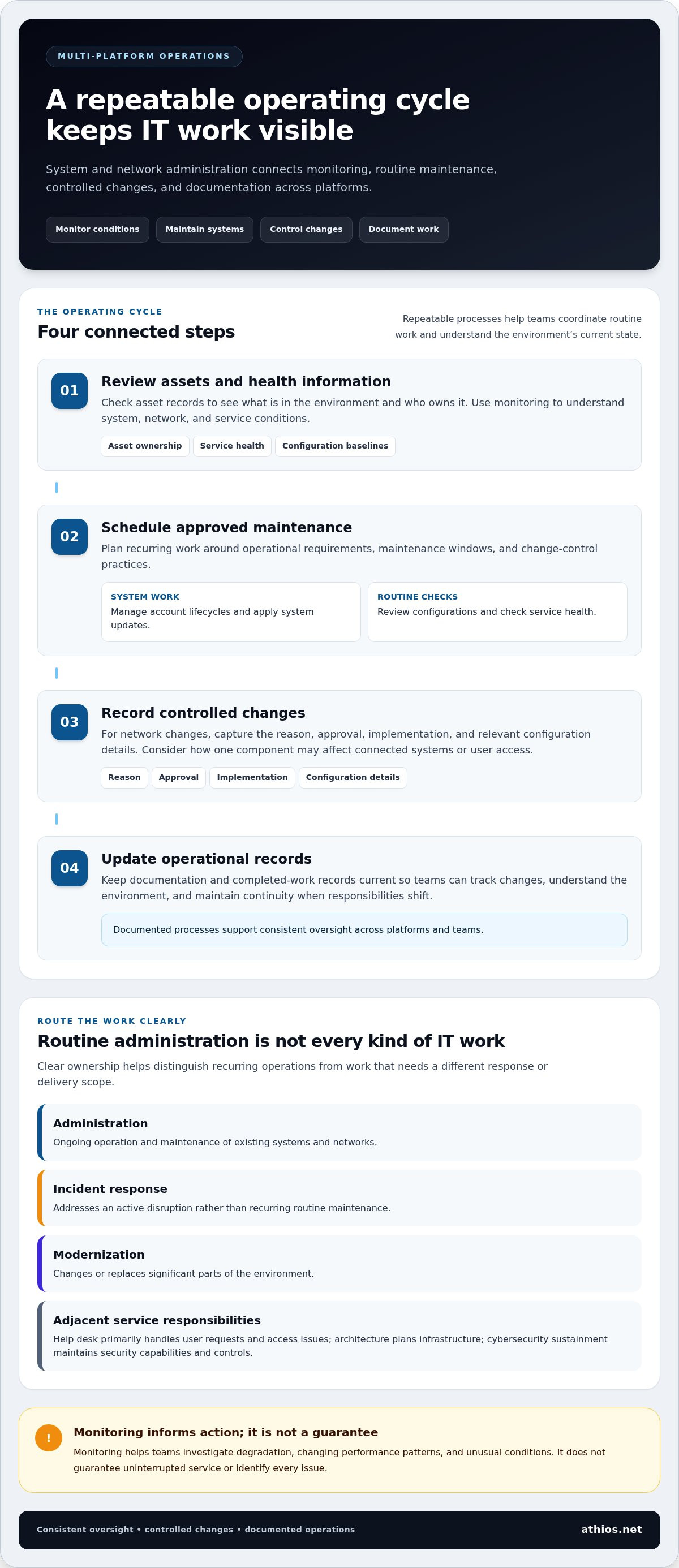
Multi-platform environments require more than expertise in individual platforms. They need a repeatable operating process that makes routine work visible and coordinates changes across systems, services, and network components. System and network administration services support that coordination through monitoring, maintenance, controlled change, and documentation.
Documented operational processes make system oversight more consistent across platforms and teams. Asset records show what is in the environment and who owns it. Configuration baselines provide a reference for expected settings, while defined access procedures help administrators apply account changes consistently. Together, these practices help teams understand dependencies and assess a change’s operational impact before implementation.
What routine system administration work can include
Recurring system work can include managing account lifecycles, applying system updates, reviewing configurations, and checking service health. These activities should follow schedules and approval processes that reflect operational requirements, maintenance windows, and change-control practices. Records of completed work help teams track changes and maintain continuity when responsibilities shift.
Routine maintenance differs from incident response, which addresses an active disruption, and large-scale modernization, which changes or replaces significant parts of the environment. Distinguishing the work helps organizations route requests appropriately and maintain a record of recurring administrative responsibilities.
How network administration maintains connectivity and visibility
Network administration includes oversight of device configurations, connectivity services, and documented network changes. In a mixed environment, an adjustment to one component may affect connected systems or user access elsewhere. Recording the reason for a change, its approval, implementation, and relevant configuration details helps teams understand the current state and review later changes.
Monitoring provides information about network and service conditions. Teams can use it to investigate degradation, changing performance patterns, or other unusual conditions, then determine whether action is needed. Monitoring supports awareness, but it does not guarantee uninterrupted service or identify every issue.
A practical operating cycle connects these activities: review asset and health information, schedule approved maintenance, record changes, and update operational documentation. Shared records are especially useful when teams support different platforms, since they clarify dependencies and help reduce gaps in oversight.
Organizations assessing their operating model can compare these practices with Athios system and network administration, alongside related architecture, infrastructure planning, and cybersecurity sustainment capabilities.
Administration Is More Than Break-Fix Support: Responsibilities and Measures
Administration is not limited to restoring service after a visible failure. It also includes planned work to maintain systems, document changes, and identify operational concerns before they become disruptions. Distinguishing this work from incident response and engineering initiatives clarifies task ownership and how completion should be assessed.
Reactive support, recurring administration, and engineering compared
These categories can intersect, but they differ in what triggers the work and what outcome it is meant to produce.
| Work category | Typical trigger | Work pattern and intended output |
|---|---|---|
| Reactive support | An outage, degraded service, or reported issue | Investigates and resolves a specific incident, with relevant findings recorded. |
| Recurring administration | An established schedule or operational process | Performs planned maintenance, reviews system condition, and records completed work or identified concerns. |
| Engineering initiatives | A defined need for modernization, redesign, or significant change | Plans and implements broader platform improvements, producing an updated capability or technical design. |
An incident ticket does not replace recurring maintenance, and a scheduled update is not the same as platform modernization. An engagement can include more than one category, but responsibilities, approval paths, and deliverables should be agreed explicitly. Clear boundaries help prevent planned work from being displaced by reactive demand or larger changes from being treated as routine operations.
Which operational measures help assess service health?
Choose measures that reflect the work in scope, rather than rewarding activity with little connection to operational priorities. Useful indicators can include incident trends, completed change records, patch status, and whether scheduled maintenance was completed or deferred. Together, they show both unplanned demand and planned operational work.
Service measures are meaningful only when scope is defined and baseline data is reliable. For example, an incident trend needs context about covered systems, incident categories, and any changes to reporting practices. Patch status should be interpreted against the systems in scope and the applicable maintenance process, not treated as a standalone score.
Reporting cadence and ownership matter too. Establish who records each measure, how exceptions are documented, and who reviews the results. Any numerical target or response commitment should be set for the specific engagement, based on agreed responsibilities and requirements. This gives system and network administration services a transparent basis for review without suggesting that one metric represents the health of an entire environment.
How to Define Administration Scope and Prepare for Service Delivery
A clear service scope starts with a practical picture of the environment and the responsibilities already assigned to internal teams or existing providers. This preparation helps identify which systems need ongoing administration, where dependencies exist, and how work will be approved, recorded, and reported. Incomplete records are useful discovery items, not a reason to assume the environment is fully documented.
What information should an organization gather first?
Gather the records available, such as asset inventories, network diagrams, platform versions, service ownership details, maintenance windows, and known operational concerns. Include stakeholders who understand business-critical services and their dependencies, since one infrastructure component may support several functions. Mark gaps and uncertainties so they can be addressed during scope development rather than treated as established facts.
How to establish responsibilities and operating procedures
Define who approves changes, manages access, receives escalations, and maintains operational documentation. Align reporting expectations and service measures with organizational priorities and the agreed contractual scope. If the environment also needs broader design or security work, connect administration planning with enterprise infrastructure planning and cybersecurity sustainment.
Use this readiness sequence to move from environment review to a workable scope:
- Inventory the environment. Record known platforms, network components, versions, and relevant supporting services.
- Map dependencies and critical services. Identify systems that support essential business functions and note applicable maintenance windows.
- Review ownership. Document internal responsibilities, existing provider roles, and areas where accountability is unclear.
- Record operating concerns. Capture recurring issues, incomplete documentation, planned changes, and access or configuration dependencies.
- Define procedures. Establish change approval, access management, escalation paths, documentation ownership, and reporting expectations.
- Confirm the scope. Specify covered systems, recurring work, exclusions, responsibilities, and how measures will be interpreted.
Pre-discussion checklist: Gather available asset inventories, network diagrams, platform versions, service and provider ownership, dependency notes, critical services, maintenance windows, known concerns, and current change or escalation procedures. Mark missing information as discovery work. This gives everyone a shared starting point without requiring every record to be complete before scope development begins.
For organizations defining system and network administration services, Athios can align the operating scope with related architecture, infrastructure planning, and cybersecurity sustainment requirements. Discuss your administration scope with Athios using the readiness information to establish priorities and responsibilities.
How Athios Approaches System and Network Administration Services
Athios provides system and network administration for federal and commercial clients, connecting ongoing operational needs with related IT engineering capabilities. Effective service delivery starts with understanding the environment, the systems that support business priorities, and the responsibilities assigned across teams. That foundation helps define a practical scope for recurring administration while keeping adjacent technical work distinct.
Where administration fits within broader IT engineering
Administration focuses on maintaining and overseeing systems and networks in operation. Architecture and infrastructure planning address how environments are structured and how they may need to evolve. These functions inform one another: operational findings can reveal a planning need, while infrastructure decisions establish requirements for day-to-day administration. Coordinating the work does not make the scopes interchangeable.
Cybersecurity sustainment is related but distinct. Security priorities can shape operational procedures, access controls, and configuration decisions, while sustainment addresses ongoing security needs within its defined scope. Athios provides administration alongside architecture, infrastructure planning, cybersecurity sustainment, and IT engineering, helping organizations consider connected requirements without assuming one service automatically includes all the others.
What to clarify before discussing an engagement
Before a scope discussion, summarize the environment, business priorities, current responsibilities, known constraints, and areas where documentation or ownership is incomplete. Then identify the outcomes and operating boundaries that matter most. This context supports a focused conversation about deliverables, governance, change procedures, and reporting expectations, including how recurring work will be distinguished from project-based improvements.
Engagements may be organized through a long-term statement of work, a retainer, or fixed-scope project milestones. The structure depends on the work and the responsibilities defined for the engagement. Clear documentation of scope and governance provides a shared reference as operational needs develop.
Use your inventory, dependency notes, and priority list as a starting point, then refine the scope with Athios. Discuss IT services with Athios to explore how system and network administration can align with your operational and infrastructure requirements.
Establish a Clear Operating Model for Your IT Environment
Reliable administration depends on more than responding to visible failures. It requires defined ownership, consistent maintenance and change practices, and documentation that supports oversight across platforms. Clear scope and meaningful measures help organizations understand what work is being performed and how it aligns with operational priorities.
Preparing an inventory of systems, dependencies, critical services, existing responsibilities, and known concerns gives a scope discussion a practical foundation. It also helps distinguish ongoing administration from engineering initiatives and related cybersecurity work. Athios provides system and network administration alongside architecture, infrastructure planning, and cybersecurity sustainment, connecting operational support with broader IT requirements.
Use your priorities and available environment records to identify where clearer accountability or sustained oversight would help. Discuss system and network administration services with Athios to define an approach aligned with your organization’s needs.
Frequently Asked Questions
What do system and network administration services include?
System and network administration services cover ongoing oversight and maintenance of operating systems, infrastructure, and network environments. Depending on the agreed scope, work can include account and access administration, system updates, configuration reviews, network device oversight, service health checks, change records, and operational documentation. Responsibilities vary by environment. A clear scope identifies covered platforms, recurring tasks, approval processes, and ownership so teams know what is maintained and how work is tracked.
What is the difference between system administration and network administration?
System administration primarily focuses on operating systems, servers, user accounts, access, and supporting services. Network administration focuses on connectivity, network devices, configurations, and the services that let systems communicate. The responsibilities can overlap: a system change may affect network access, and a network configuration may influence system availability. Defining ownership and coordination procedures helps ensure related tasks are assigned, approved, and documented.
Do system and network administrators provide proactive maintenance or only break-fix support?
Administration can include planned work as well as incident response. Recurring tasks may include reviewing configurations, applying updates, checking service health, managing account changes, and documenting completed maintenance. Break-fix work addresses a reported issue or disruption, while scheduled administration maintains oversight between incidents. The schedule and approval process should reflect organizational requirements, and the scope should distinguish routine maintenance from incident response and larger modernization projects.
How do administration services support a multi-platform IT environment?
Administration supports multi-platform environments by applying consistent processes across different operating systems, network components, and supporting services. Shared asset records, configuration baselines, access procedures, and change documentation help teams understand what is in the environment and how components relate. For example, documenting a network configuration change alongside affected systems can support later review. Processes should account for platform differences while maintaining consistent ownership, approval, and reporting practices.
How should an organization evaluate system and network administration services?
Evaluate the proposed scope against operational priorities and the actual environment. Identify covered systems, recurring tasks, exclusions, change responsibilities, escalation procedures, and documentation ownership. Consider measures such as incident trends, change records, patch status, and completion of scheduled maintenance. Interpret those measures in context, using clear definitions, reliable baseline information, and an agreed reporting cadence. Avoid relying on a single metric to represent the health of every system or service.
What information should we prepare before engaging an administration provider?
Prepare available asset inventories, network diagrams, platform versions, service ownership records, and notes on critical services and dependencies. Include existing provider responsibilities, maintenance windows, known operational concerns, and incomplete documentation. Also identify who approves changes, manages access, receives escalations, and reviews reports. Record gaps as discovery items rather than assuming the environment is fully documented. This information gives scope discussions a practical starting point.
Can system and network administration be provided under a statement of work or retainer?
Yes. Athios engagements can be structured through a long-term statement of work, a retainer, or fixed-scope project milestones. The structure should align with the work and clearly state deliverables, covered systems, responsibilities, governance, change procedures, and reporting expectations. A statement of work can establish recurring responsibilities, while project milestones can define bounded efforts. The appropriate arrangement depends on the agreed scope and organizational needs.

Article by
Kevin Torres


