

A network change can improve a metric without improving the experience that prompted it. When an application is slow or inconsistent, network performance tuning services should start with evidence, not assumptions: a clear baseline, tests along the affected path, and a defined understanding of what users need the network to support.
Diagnosis can be difficult because traffic patterns, infrastructure limits, and configuration issues may produce similar symptoms. An untested change can disrupt service without addressing the cause. The priority is to identify the actual bottleneck before adjusting the environment.
This guide explains how to baseline throughput, latency, and jitter; isolate performance constraints; and prioritize controlled changes by expected impact, risk, and operational requirements. It also covers how to compare results with the baseline and use ongoing monitoring to verify improvements. Athios connects network tuning work with network and infrastructure planning, system and network administration, and cybersecurity sustainment, supporting measurable outcomes while keeping operational continuity in view.
Key Takeaways
- Define the performance issue and establish a baseline before changing network configurations.
- Compare time-aligned evidence across devices, endpoints, applications, and infrastructure to narrow down the bottleneck.
- Prioritize potential changes by user impact, supporting evidence, implementation risk, and reversibility.
- Apply changes through a controlled process with stakeholder communication, verification criteria, and an appropriate rollback path.
- Use recurring monitoring to detect performance drift and keep improvements aligned with network planning, administration, and security needs.
What Network Performance Tuning Services Address in Enterprise Environments
Network performance tuning services assess, adjust, and verify how a network behaves under real operating conditions. The objective is to resolve a defined performance constraint while preserving reliability and security, not to make changes for their own sake. That means connecting technical evidence to operational priorities such as application responsiveness, user access, and the network’s ability to support essential workloads.
Tuning differs from initial network design, which establishes architecture and capacity for expected needs, and routine administration, which maintains configurations and services over time. It also differs from application code optimization, which addresses software behavior. These areas can overlap during an investigation: an application may reveal a network issue, but evidence should establish where the constraint lies before teams assign corrective work. This systematic performance tuning approach links assessment and measurement to targeted changes and post-change verification.
Which network performance symptoms warrant investigation?
Intermittent latency, packet loss, jitter, congestion, and unstable throughput can all contribute to inconsistent application response. A brief variation may be expected during a workload change. Recurring degradation, or a pattern tied to particular periods, locations, or applications, warrants closer review. Monitoring history helps distinguish a repeated issue from an isolated event.
Technical symptoms need operational context. A delay affecting one application, site, or user group has different implications from a problem across multiple workloads. Record who is affected, when the issue occurs, which services are involved, and which business processes depend on them. This helps teams set investigation priorities without assuming that a single device is responsible.
What does a tuning engagement include?
A structured engagement moves from assessment to baseline definition, diagnosis, controlled changes, and outcome verification. The baseline records relevant network behavior under representative conditions. Diagnosis then tests whether the suspected constraint aligns with the symptoms. Teams apply changes against agreed objectives and compare the results with the baseline, documenting what changed and whether the intended outcome was achieved.
Set the scope and measures according to the client environment, workload patterns, operational priorities, and acceptable change risk. Professional services provide the engineering assessment and execution process; they are distinct from purchasing software licenses or network hardware. Athios connects network performance work with network and infrastructure planning, system and network administration, and cybersecurity sustainment, aligning technical actions with operational continuity. Tuning is a measured engineering activity, not a default instruction to replace equipment or alter configurations before the cause is understood.
How Engineers Diagnose Network Bottlenecks Before Changing Configurations
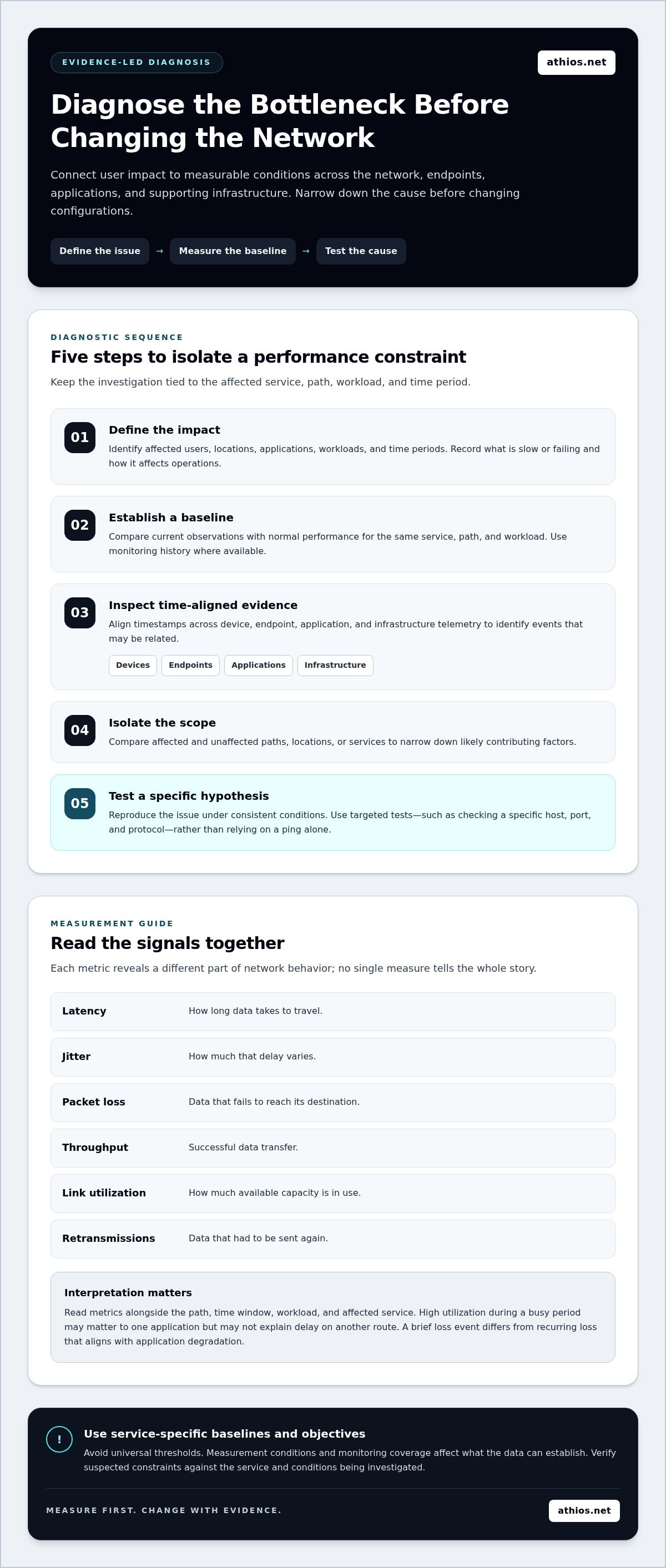
Reliable diagnosis narrows the problem before any configuration is changed. Network performance tuning services use an evidence-led process to connect user impact with measurable conditions across the network, endpoints, applications, and supporting infrastructure.
- Define impact. Identify affected users, locations, applications, workloads, and time periods. Record what is slow or failing and how it affects operations.
- Establish a baseline. Compare current observations with normal performance for the same service, path, and workload, using monitoring history where available.
- Inspect evidence. Align timestamps across device, endpoint, application, and infrastructure telemetry to identify related events.
- Isolate the scope. Compare affected and unaffected paths, locations, or services to narrow down likely contributing factors.
- Test a hypothesis. Reproduce the issue under consistent conditions and use targeted tests, such as checking a specific host, port, and protocol, rather than relying on a ping alone.
Each metric provides only part of the picture. Latency measures how long data takes to travel; jitter shows how much that delay varies. Packet loss indicates data that fails to reach its destination, while throughput measures successful data transfer. Link utilization shows how much available capacity is in use, and retransmissions can indicate that data had to be sent again. The IBM network performance tuning documentation also identifies factors such as MTU, link speed, and latency that can shape performance.
Which metrics reveal a constraint?
Interpret metrics alongside the path, time window, workload, and affected service. High utilization during a busy period may matter to one application but fail to explain delay on another route. A brief loss event may have different operational significance from recurring loss that aligns with application degradation. Set service-specific baselines and objectives instead of applying universal thresholds. Measurement conditions and monitoring coverage also affect what the data can establish.
How can teams separate network issues from application or host issues?
Compare observations at multiple points, including user locations, endpoints, network segments, and application tiers. If one location experiences delay while another reaches the same service normally, the contrast helps narrow the investigation, but it does not prove the cause. Correlate records using consistent timestamps and repeatable test conditions. Document competing hypotheses and the evidence for or against each before assigning responsibility to the network.
For organizations that need structured support connecting network observations to infrastructure and operational objectives, Athios network and infrastructure planning provides a foundation for evidence-led investigation.
How to Prioritize Tuning Changes by Impact, Risk, and Evidence
A performance symptom identifies a problem to investigate, not a configuration to change. Slow response alone does not prove that a link needs more capacity or that a device setting is responsible. Prioritize candidate actions by the user impact they could address, the strength of supporting evidence, the implementation risk, and how easily the change can be reversed. This keeps network performance tuning focused on verified constraints rather than familiar fixes.
The right response depends on the observed pattern. Evidence of congestion may justify reviewing traffic policy or capacity. Instability along a particular path may make routing, link health, or configuration useful hypotheses to test. If network measures do not explain the user experience, investigate application and endpoint dependencies before changing the network.
| Candidate action | Evidence that may support review | Key prioritization considerations |
|---|---|---|
| Configuration adjustment | A specific setting or path behavior aligns with the affected service and repeatable performance symptoms. | Assess scope, dependencies, security implications, and whether the prior configuration can be restored cleanly. |
| Traffic management | Congestion or competing workload demand corresponds with degradation for a defined service or user group. | Consider which traffic may be affected by a policy change and whether prioritization reflects operational objectives. |
| Capacity remediation | Utilization or throughput evidence indicates a persistent capacity constraint under representative demand. | Evaluate the affected infrastructure, operational dependencies, and implementation constraints before committing to a capacity change. |
| Application-side investigation | Network observations do not account for the reported delay, or the issue appears limited to an application or endpoint. | Coordinate investigation across relevant teams so network changes do not mask a host, application, or service dependency. |
More bandwidth or new hardware is not automatically the answer. Either can add cost and operational complexity without resolving issues caused by traffic patterns, a route, configuration behavior, or an application dependency. A small configuration adjustment can also have broad effects if it changes behavior for shared services. Use evidence to determine where to investigate, then weigh the expected user benefit to decide whether an action merits priority.
Balance expected gains with operational risk
Before implementation, assess the change scope, affected services, maintenance constraints, security considerations, and rollback feasibility. Prefer a small, controlled change when it can test a clear hypothesis and distinguish cause from coincidence. Record the expected result and the conditions that would signal failure, including service impacts that should trigger rollback. Compare candidate changes using consistent criteria so teams can prioritize measurable benefit without overlooking operational continuity.
How to Implement and Validate Network Tuning Changes Safely
A tuning change is complete only after its effects have been measured and documented. Use a controlled sequence that connects approval, implementation, and verification, while keeping stakeholders informed and maintaining a rollback path suited to the environment.
- Approve the scope. Define the systems and services affected, the change rationale, supporting evidence, owner, dependencies, and required approval path.
- Capture the baseline. Record relevant network measures and user-facing service outcomes before implementation.
- Schedule the change. Coordinate with service owners around operational constraints and communicate the planned scope, timing, and potential impact.
- Implement the approved change. Follow the documented procedure and avoid bundling unrelated adjustments, which can make results difficult to interpret.
- Verify the outcome. Compare post-change observations with the baseline under equivalent conditions, then determine whether the intended result was achieved.
- Document the result. Record the actual change, observed effects, deviations, and any follow-up or rollback decision.
What should a tuning change plan document?
A useful plan identifies affected systems, the technical rationale, evidence supporting the change, the accountable owner, dependencies, and approval path. It also states the expected improvement, monitoring signals, validation period, and rollback triggers. Coordinate timing with service owners so the change and observation period account for relevant workloads, maintenance constraints, and operational priorities.
Define success and failure conditions before implementation. Specify which service outcome should improve and which adverse signal would require the team to stop or revert. The rollback path should suit the change and environment, including who can authorize and execute it. This preparation supports controlled action without assuming that every change carries the same level of risk.
How can teams confirm that a tuning change worked?
Compare pre-change and post-change measurements using the same metrics, locations, workloads, and time windows wherever practical. Review network telemetry alongside service response and relevant error indicators; a better network metric alone does not establish that users received the intended benefit. Document unexpected effects, and refine or revert the change when the evidence does not support success.
For teams applying network performance tuning across complex environments, disciplined change control makes results more reliable and operational effects easier to assess. Review Athios network and infrastructure capabilities to see how structured infrastructure support can align with operational objectives.
How Network Performance Tuning Services Sustain Measurable Improvements
A successful tuning change is one point in an ongoing operational cycle, not a permanent end state. Workloads shift, dependencies change, and configurations evolve, so recurring monitoring is needed to identify performance drift and renewed constraints. Reviewing trends against service objectives helps teams determine whether an earlier improvement remains effective or new evidence calls for investigation.
What belongs in an ongoing network performance review?
A useful review brings together baseline trends, incident patterns, capacity signals, configuration changes, and service objectives. Teams can assess whether a prior adjustment continues to support the affected service, whether new workloads have changed demand, and whether reported user impact aligns with network observations. No single measure establishes success on its own; consider service outcomes and technical indicators together.
Prioritize follow-up work by operational impact, evidence strength, and risk. A recurring incident affecting a critical workload may warrant attention before a minor metric fluctuation with no demonstrated user effect. Reviews also create a record of what changed and what the resulting observations show, helping teams distinguish persistent gains from temporary variation.
How can Athios support a structured tuning lifecycle?
Network performance work is most effective when connected to the wider operating environment without confusing distinct responsibilities. Network and infrastructure planning provides context for architecture, dependencies, and performance objectives. System and network administration supports controlled, documented operations, while cybersecurity sustainment keeps security requirements in operational decision-making. These functions inform one another, but each retains its own scope.
Athios provides network and infrastructure planning, system and network administration, and cybersecurity sustainment for enterprise and government clients. This work can align with the client environment and operational priorities, supporting a disciplined cycle of review, targeted action, and continued oversight. The objective is not change for its own sake; it is to maintain measurable performance while supporting secure operational continuity.
For structured support across this lifecycle, discuss a network performance engagement with Athios.
Make Network Improvements Measurable and Sustainable
Effective network performance tuning follows a repeatable operational cycle: define the impact, establish a baseline, investigate the evidence, and select changes according to expected benefit and risk. Controlled implementation and comparison with the original conditions help teams confirm whether a change improved service rather than simply shifting a metric.
That discipline continues after implementation. Recurring reviews can reveal performance drift, changing workloads, and renewed constraints, allowing organizations to prioritize follow-up work with operational needs in view. Connecting tuning to network planning, system administration, and cybersecurity sustainment supports coordinated technical decisions without treating these functions as interchangeable.
Athios provides network and infrastructure planning for enterprise and federal clients, along with system and network administration aligned to operational requirements. This structured support helps organizations pursue measurable performance improvements while maintaining operational continuity. Discuss a network performance engagement with Athios to take the next step toward evidence-led network improvement.
Frequently Asked Questions
What are network performance tuning services?
Network performance tuning services are structured technical work to assess network behavior, identify constraints, apply appropriate changes, and verify results against agreed objectives. The scope may include reviewing network paths, configuration, traffic patterns, and infrastructure dependencies. Tuning differs from initial network design, routine administration, and application code optimization, though these functions may inform the investigation. The goal is to improve relevant service outcomes based on evidence, not to make changes simply because a metric appears unusual.
How do you tune network performance step by step?
Start by defining the affected users, applications, locations, and operational impact. Establish a baseline, then review time-aligned evidence from network devices, endpoints, applications, and relevant infrastructure. Compare affected and unaffected paths to narrow likely causes, and test a specific hypothesis under consistent conditions. Prioritize a controlled change by expected impact and risk, obtain approval, define rollback conditions, and verify results against the original baseline before documenting the outcome.
Which metrics are used to assess network performance?
Common measures include latency, or data travel time; jitter, or variation in latency; packet loss; throughput, or successfully transferred data; link utilization; and retransmissions. Interpret each in context, including the route, time period, workload, and affected service. For example, high utilization during a workload peak may matter if it coincides with slow application response. Establish service-specific baselines and objectives rather than treating one threshold as appropriate for every network.
Can network tuning improve application response times?
Network tuning can improve application response times when evidence shows that a network condition contributes to delay, loss, or inconsistent delivery. For example, a verified path constraint or congestion pattern may warrant a targeted network change. However, application response also depends on hosts, application tiers, and other infrastructure. Compare network telemetry with the user-facing service outcome before assigning cause. If network measures do not explain the delay, investigate application and endpoint dependencies as well.
How do teams tune a network without causing an outage?
No change process can eliminate all operational risk, but teams can reduce it through disciplined controls. Define and approve the scope, communicate with affected stakeholders, record a baseline, and schedule implementation around service constraints. Make a focused change, monitor agreed signals, and maintain a rollback path appropriate to the environment. Validate against the same conditions used for the baseline, and revert or refine the change if results indicate unacceptable impact or fail to support the intended outcome.
When should an organization use network performance tuning services?
Consider network performance tuning services when application response is persistently slow or inconsistent, monitoring shows recurring performance issues, or the cause spans network, infrastructure, and application dependencies. They are also useful when proposed changes carry operational risk and teams need a documented basis for prioritizing and validating them. Athios connects network and infrastructure planning with system and network administration, aligning technical support to enterprise and government operational requirements.

Article by
Kevin Torres


