

Enterprise system administration consulting works best as a defined operating model, not simply extra hands. When internal teams and outside specialists share responsibility without clear boundaries, routine administration can become inconsistent across platforms and environments, increasing operational risk.
Defined ownership, reliable escalation paths, and measurable work help prevent that. A well-scoped engagement aligns administration with the organization’s infrastructure and security requirements instead of treating each task in isolation.
This article explains what enterprise system administration consulting can cover, how engagements can be structured, and how to assess which model fits your environment. We’ll look at scope, governance, accountability, and practical ways to turn business requirements into a statement of work. Athios connects system administration with architecture, infrastructure planning, cybersecurity sustainment, and automation for commercial and federal clients.
Key Takeaways
- Define administration scope around the platforms, controls, documentation, and coordination your operations require.
- Separate recurring administration from time-bounded engineering, modernization, and remediation work to clarify ownership and deliverables.
- Compare advisory, project-based, retainer, and time-and-materials models by flexibility, governance, continuity, and organizational fit.
- Use enterprise system administration consulting to establish clear accountability, escalation paths, and measurable outcomes in a statement of work.
- Plan the engagement from environment discovery through review and transition, aligning administration with infrastructure, cybersecurity, and operational priorities.
What Enterprise System Administration Consulting Covers
Enterprise system administration consulting is planned administration and technical oversight aligned with an organization’s operational requirements, risk profile, and internal capacity. The goal is not just to complete a list of technical tasks. It is to establish how systems are maintained, how operational issues are addressed, and how responsibilities support dependable business operations.
The work can include assessing an environment, administering systems, improving configurations, and documenting operating procedures. It is distinct from purchasing software licenses, reselling hardware, or repairing residential computers. The System Administrator role provides useful context for the operational responsibilities involved. Enterprise engagements define how those responsibilities apply across a particular organization.
Which systems and responsibilities can fall within scope?
Depending on the environment, scope can include operating systems, identity services, network dependencies, and other enterprise infrastructure. Responsibilities may cover routine administration, configuration oversight, issue resolution, and operational documentation. For example, a team might coordinate system configuration with identity access requirements or document a recurring process so internal staff can follow it consistently.
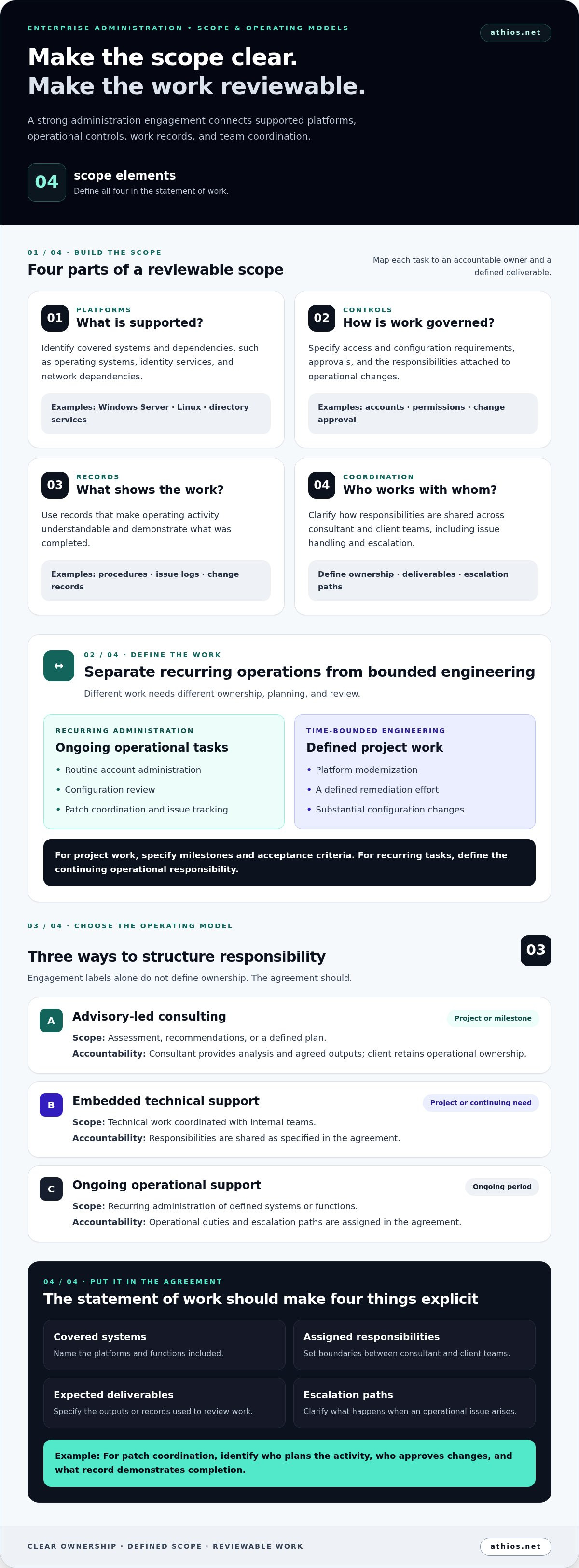
There is no universal task list. The platforms, operating requirements, risk considerations, and capacity of internal teams shape the work. The statement of work should identify covered systems, assigned responsibilities, expected deliverables, and the boundaries between consultant and client teams.
How consulting differs from staff augmentation and managed services
Engagement labels alone do not establish who owns a task or what happens when an issue arises. Advisory-led consulting typically assesses needs and recommends an approach. Embedded technical support works alongside internal personnel. Ongoing operational support assigns defined administration responsibilities for an agreed period. The statement of work should specify accountability and deliverables for each approach.
| Model | Scope | Accountability | Engagement duration |
|---|---|---|---|
| Advisory-led consulting | Assessment, recommendations, or a defined plan | Consultant provides analysis and agreed outputs; client retains operational ownership | Often bounded by a project or milestone |
| Embedded technical support | Technical work coordinated with internal teams | Responsibilities are shared as specified in the agreement | May follow a project timeline or continuing need |
| Ongoing operational support | Recurring administration of defined systems or functions | Operational duties and escalation paths are assigned in the agreement | Structured for an ongoing period |
Enterprise system administration consulting can combine these approaches. Choose a structure based on whether the priority is guidance, additional engineering capacity, or sustained administration. A clear scope aligns the engagement with operational needs and prevents assumptions about ownership, response expectations, or deliverables.
Enterprise Administration Scope: Platforms, Controls, and Deliverables
A useful administration scope connects four elements: the platforms being supported, the controls governing access and configuration, the records needed to understand operational activity, and the coordination required across teams. This structure makes work reviewable without assuming every organization uses the same technologies or procedures.
Map each task to an accountable owner and a defined deliverable. For example, patch coordination can specify who plans the activity, who approves changes, and what record demonstrates completion. Access administration can define who authorizes changes and how they are documented. Security sustainment intersects with these operations through controlled access, configuration oversight, and coordinated remediation, while remaining tied to the agreed administration scope.
Core administration work across enterprise environments
Depending on the environment, platforms may include Windows Server, Linux, directory services, and network dependencies. Administration activities can cover accounts and permissions, configuration changes, patch coordination, backup oversight, issue tracking, and change records. The systems in scope and the organization’s operating requirements determine which tasks apply.
Separate recurring operations from bounded engineering work. Routine account administration or configuration review may recur throughout an engagement. Platform modernization, a defined remediation effort, or a substantial configuration change may be managed as a project with specific milestones and acceptance criteria. This distinction helps internal teams plan capacity and review progress without treating every operational request as the same kind of work.
Deliverables that make consulting work reviewable
Deliverables should provide evidence of work and clarify what happens next. Depending on the requirement, they may include:
- Baseline findings: a record of relevant systems, dependencies, and observed operating conditions, tied to the agreed assessment scope.
- Administration procedures: documented steps for recurring activities, with the responsible role identified.
- Issue and change logs: records of reported issues, decisions, changes, and status, reviewed at an agreed cadence.
- Transition documentation: current operational information and open items that support continuity when responsibilities change.
Each output should correspond to a stated requirement, name the role accountable for producing or reviewing it, and specify when the review occurs. Where client requirements make it applicable, work products can also be organized to support relevant NIST guidance. Select specific control references after establishing the governing requirements.
For organizations aligning administration with infrastructure planning and cybersecurity sustainment, system and network administration can be structured around defined responsibilities, reviewable outputs, and operational priorities.
How to Compare Enterprise System Administration Consulting Models
The engagement model should reflect how clearly the work can be defined, how often priorities change, and which responsibilities the organization intends to retain. A fixed-scope project, retainer, or time-and-materials arrangement can each support effective administration when scope, governance, and decision rights are explicit.
External support does not require giving up client control. The organization can retain authority over priorities, approvals, access, and operational decisions while consultants provide assessment, engineering, or agreed administration. The agreement should explain how that division works in practice.
When a project, retainer, or time-and-materials engagement fits
A project or fixed-scope milestone suits bounded work, such as an assessment, implementation, or defined remediation effort. A retainer can support recurring needs when priorities may evolve, provided governance clarifies how work is selected and reviewed. Time-and-materials arrangements can accommodate tasks whose details develop as technical findings emerge. Each model should state how changes to priorities or scope are handled.
| Engagement model | Scope flexibility | Governance and continuity | Suitable conditions |
|---|---|---|---|
| Advisory or fixed-scope project | Defined outputs, with changes managed through agreed change control | Milestones and reviews support progress oversight; continuity is tied to project needs | A bounded assessment, implementation, or defined engineering outcome |
| Retainer | Work priorities can be adjusted within agreed boundaries | Recurring planning and review provide continuity across ongoing needs | Regular administration or engineering support with changing priorities |
| Time-and-materials | Task definition can adapt as work develops | Progress and work performed require agreed tracking and review | Work whose full scope is difficult to establish at the outset |
How to define ownership and operational boundaries
To keep enterprise system administration consulting governed, document who can access systems, authorize changes, approve priorities, and receive escalations. Distinguish consultation, execution, and final authorization rather than assuming one party owns every decision.
- Consult: the technical advisor assesses options and recommends an approach.
- Execute: the assigned consultant or internal team performs approved work and records its status.
- Authorize: the designated client decision-maker approves changes and retains the operational decisions assigned to the organization.
The engagement agreement should also record assumptions, exclusions, and change-control procedures. This gives both teams a reference for resolving scope questions and managing work outside the original plan. Athios structures administration engagements around defined scope and client requirements, coordinating system administration support as operational needs evolve.
How to Plan and Govern an Administration Consulting Engagement
A governed engagement turns operational needs into an agreed sequence of work, decisions, and reviews. Baseline information helps teams set priorities, but discovery should focus on the systems, constraints, and procedures relevant to the specific environment rather than follow a universal checklist.
From discovery to an actionable statement of work
Use this five-step sequence to move from understanding the environment to transferring knowledge. At each stage, identify the accountable role and the decision or output required to proceed.
- Discover: Review relevant systems, dependencies, existing procedures, operational constraints, and internal team capacity.
- Define scope: Translate findings into priorities, deliverables, acceptance criteria, assumptions, and exclusions.
- Approve: Confirm decision-makers, access boundaries, change approval, escalation paths, and the contract structure.
- Deliver and review: Track work against agreed outputs, report progress, document changes, and raise issues through the defined governance process.
- Transition: Provide current procedures, open-item status, and knowledge transfer appropriate to the ongoing operating model.
Use discovery findings to set priorities rather than create an indiscriminate task list. Identified system dependencies, for example, can shape the order of work, while operational constraints can determine the review and approval process. Fixed-scope milestones may suit well-defined outcomes. Retainers or time-and-materials arrangements can accommodate changing priorities or task details. The statement of work should connect the selected structure to scope certainty, variability, and client governance requirements.
Managing change, reporting, and knowledge transfer
Governance depends on clear roles and a practical reporting cadence. Name the client decision-maker, technical lead, delivery owner, and escalation contact as applicable. Specify who approves changes, how routine status is reported, where issue and change records are maintained, and how risks are escalated. A concise status report can identify completed work, decisions needed, emerging issues, and next priorities.
Clear ownership and documented changes make operational accountability visible, reviewable, and actionable. Make knowledge transfer part of delivery, not an end-of-engagement afterthought. Maintain procedures and transition records as work progresses so internal teams can understand current configurations, decisions, and unresolved items.
This sequence gives both parties a shared basis for adjusting priorities while preserving agreed decision rights. Enterprise administration support can be aligned with operational requirements and governance needs.
How Athios Aligns System Administration with Enterprise Needs
Enterprise system administration consulting delivers more value when it connects day-to-day operations with the architecture and infrastructure those operations depend on. Athios provides system administration alongside architecture and infrastructure planning, cybersecurity sustainment, and custom automation, aligning the work with operational objectives for commercial and federal clients.
This connection supports a deliberate path from project delivery into ongoing operations. Administration requirements can inform infrastructure planning, while architecture decisions shape how systems are configured and supported. For example, a defined modernization effort can include operating procedures and ownership for the resulting environment, helping internal teams understand how project outputs move into sustainment. Translate availability objectives into scoped requirements and reviewable responsibilities rather than treating them as an unsupported uptime guarantee.
Connecting administration to architecture and sustainment
Administration findings can identify dependencies or operational constraints to consider in technical architecture and infrastructure planning. Coordinating system administration with cybersecurity sustainment can also align configuration oversight and remediation responsibilities with the organization’s broader operating approach, while keeping security activities within the agreed scope.
Custom automation may be appropriate when a specific recurring workflow has been identified and the intended operational outcome is clear. Define its purpose in relation to that workflow, and document ownership and support responsibilities alongside the technical work. This keeps automation connected to operations rather than treating it as a separate objective.
Establishing the next steps with Athios
A useful starting point is a concise account of the environment, current operational constraints, and desired outcomes. Include relevant platforms and dependencies, existing procedures, internal team responsibilities, and known priorities. This information helps shape a practical scope without assuming that every enterprise requires the same assessment or service structure.
Athios structures engagements around project scope, deliverables, and client requirements. Depending on the work, the arrangement may use a statement of work, retainer, fixed-scope milestones, or time-and-materials contract. Connect the defined work to its governance, decision rights, review process, and transition into operations. This helps commercial and federal clients align administration support with their requirements while maintaining clear accountability.
Discuss your enterprise system administration requirements and the operational objectives that should guide the engagement.
Set a Clear Course for Enterprise Operations
Effective enterprise system administration consulting starts with a defined operating need, then connects scope, ownership, and deliverables to that requirement. A clear statement of work and governance model help internal teams and consultants coordinate administration, review changes, and maintain accountability. The engagement structure, whether a statement of work, retainer, or project milestone, should fit the work and the organization’s priorities.
Athios provides system and network administration alongside architecture and infrastructure planning, helping align operational support with the systems it sustains. Athios serves federal government and commercial clients, structuring engagements around client requirements and defined scope. This creates a practical foundation for coordinated work, clear responsibilities, and continuity across project and operational needs.
Bring your environment, constraints, and desired outcomes into the planning process. Discuss your enterprise system administration requirements with Athios to identify an engagement approach that supports your operational objectives.
Frequently Asked Questions
What does enterprise system administration consulting include?
Enterprise system administration consulting can include administration of operating systems, identity services, network dependencies, configuration records, and operating procedures. The precise scope depends on the organization’s environment and agreed requirements. An engagement may also cover discovery, documentation, issue coordination, and transition planning. Define which responsibilities are included, who owns each task, and what deliverables demonstrate completion.
How is system administration consulting different from managed services?
System administration consulting typically provides defined expertise, engineering support, or operational assistance under an agreed scope. Managed services generally assign a broader set of ongoing responsibilities to a service provider. The contract, rather than the label, establishes the practical difference. Compare who approves changes, owns operational outcomes, handles escalations, and maintains documentation. Clear boundaries show which responsibilities remain with internal teams and which are assigned externally.
Can enterprise system administration consulting work alongside an internal IT team?
Yes. An engagement can complement an internal IT team by addressing defined technical work, adding engineering capacity, or supporting a specific project. The operating model should set out decision rights, system access, approvals, escalation paths, and knowledge-transfer expectations. For example, a consultant may carry out approved technical work while a designated internal lead retains change authorization. Explicit boundaries support oversight and coordinated delivery.
How should an organization define the scope of an administration consulting engagement?
Start by documenting relevant systems, dependencies, operational constraints, and desired outcomes. Translate that baseline into defined tasks, deliverables, assumptions, acceptance criteria, and accountable roles. Identify which responsibilities stay with internal teams and how new requirements or scope changes will be handled. A clear statement of work gives both parties a reviewable basis for execution, governance, and progress assessment, reducing uncertainty about ownership and expected outputs.
What contract models are used for enterprise system administration consulting?
Common structures include fixed-scope projects, time-and-materials engagements, retainers, and longer-term statements of work. A bounded project can fit a defined assessment or implementation, while recurring support may suit a retainer or continuing statement of work. Time-and-materials can accommodate work whose tasks need adjustment as delivery progresses. Align the agreement with scope certainty and governance needs, and document deliverables, responsibilities, assumptions, and change control.
How can an organization measure the effectiveness of system administration consulting?
Measure effectiveness against the engagement’s agreed objectives rather than generic targets. Relevant measures may include completion of defined deliverables, documentation quality, traceability of changes, issue-resolution progress, or readiness for transition. Select measures during scope definition and review them on an agreed reporting cadence. Distinguish work directly controlled by the consultant from outcomes that also depend on client decisions, system dependencies, or wider enterprise conditions.
Does enterprise system administration consulting include cybersecurity work?
Administration can intersect with security through access management, configuration practices, patch coordination, and change documentation. Broader cybersecurity engineering or sustainment may be defined as a separate or coordinated workstream, depending on the engagement. Make the boundary clear so responsibilities and applicable control requirements remain understandable. If a specific framework applies to the environment, identify relevant requirements and establish their applicability before including them in scope or deliverables.

Article by
Kevin Torres


