

What if an IT project’s biggest risk is not the technology, but an unclear agreement about what the work must deliver? An IT consulting statement of work turns technical goals into defined outputs, responsibilities, and decision points. When deliverables are vague or client dependencies go unrecorded, teams can face scope disputes, stalled work, and difficult acceptance decisions.
A sound SOW does more than describe the project. It explains how each deliverable will be assessed, who supplies the required inputs and approvals, which assumptions shape the work, and how proposed changes will be reviewed. Before drafting, identify the business outcome, the people who will review the work, and the systems or information delivery depends on. These details give both parties a practical basis for decisions as technical needs evolve.
This guide provides a practical SOW structure you can adapt to an IT engagement, with guidance on defining scope, milestones, acceptance criteria, roles, dependencies, and change control. It also explains how scope certainty and continuity can inform a choice between fixed-price, time-and-materials, and retainer terms. The result is a shared framework for managing delivery from planning through acceptance.
Key Takeaways
- Use an IT consulting statement of work to establish the work, outputs, responsibilities, and delivery conditions before execution begins.
- Translate business objectives into bounded work packages, with clear deliverable formats and review ownership.
- Set acceptance criteria that explain how each deliverable will be evaluated and what evidence supports approval.
- Match fixed-price, time-and-materials, or retainer terms to the work’s scope certainty and continuity, then align them with oversight processes.
- Review the SOW as a connected baseline, checking that scope, dependencies, timeline, pricing, and incorporated documents remain consistent.
What an IT Consulting Statement of Work Defines Before Delivery Begins
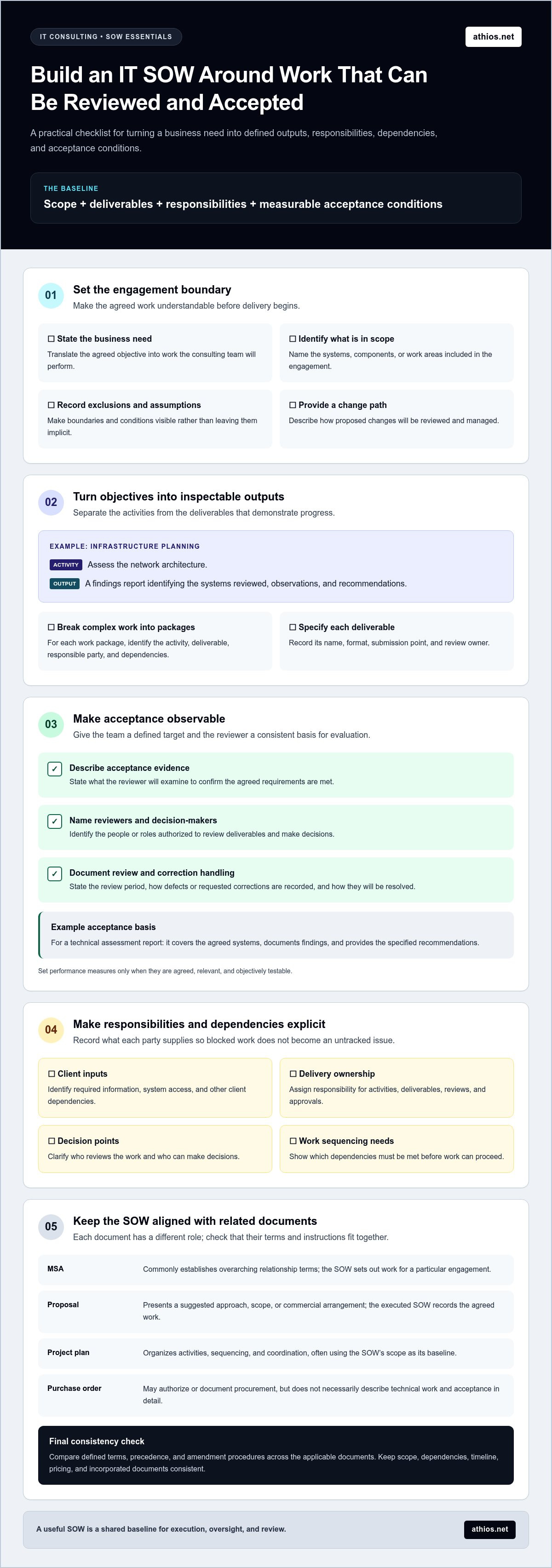
An IT consulting statement of work (SOW) records the work a consulting team will perform, the outputs it will produce, each party’s responsibilities, and the conditions for delivery and acceptance. It translates an agreed business need into a shared basis for execution, oversight, and review. A useful Statement of Work (SOW) also makes clear what falls outside the agreed scope. That boundary reduces ambiguity while leaving room for the parties to manage changes through an agreed process.
Quotable definition: An IT consulting SOW connects defined scope and deliverables to assigned responsibilities and measurable acceptance conditions.
For example, an infrastructure planning engagement could specify which systems are in scope, what assessment activities will be performed, what architecture recommendations will be delivered, which client inputs are needed, and who reviews the recommendations. The SOW can also identify the format of the findings, such as a written report or architecture documentation. This gives both parties a reference point for coordinating work and assessing progress.
An SOW serves a different purpose from related procurement and delivery documents:
- Master services agreement (MSA): Commonly establishes overarching terms for the relationship, while an SOW sets out the work for a particular engagement.
- Proposal: Presents a suggested approach, scope, or commercial arrangement; the executed SOW records the agreed work.
- Project plan: Organizes activities, sequencing, and coordination for delivery, often using the SOW’s scope as its baseline.
- Purchase order: May authorize or document a procurement transaction, but does not necessarily describe technical work and acceptance in detail.
How an SOW relates to the master services agreement
The MSA and SOW should work together rather than leave gaps or create conflicting instructions. Document hierarchy, defined terms, and amendment procedures depend on the executed agreement, so review the applicable language instead of assuming one document always controls. Compare how each document uses key terms, identifies precedence, and handles changes. Align those provisions across the MSA and SOW so the engagement’s scope and governing terms remain coherent.
When an IT consulting engagement needs an SOW
A written SOW can support a scoped engineering project, ongoing IT operations, or a defined consulting assignment. It gives procurement a record of what is being authorized, helps delivery teams coordinate responsibilities and dependencies, and gives stakeholders a basis for reviewing progress. Match the document’s detail to the engagement: a bounded deliverable needs specific outputs and acceptance evidence, while ongoing work benefits from clearly stated service boundaries, reporting, and priority reviews. Precision supports informed change decisions; it does not eliminate the need to manage them.
Build the IT Consulting SOW Around Scope, Deliverables, and Acceptance
Once the engagement’s purpose is established, translate it into work that can be assigned, tracked, and reviewed. An IT consulting statement of work should distinguish the activities a team performs from the deliverables that demonstrate progress. “Assess the network architecture,” for example, describes an activity. A findings report that identifies the systems reviewed, observations, and recommendations is an output that can be inspected and accepted.
For complex work, use a Work Breakdown Structure to divide broad objectives into manageable work packages. Each package can identify the activity, its deliverable, the responsible party, and any dependency that must be met before work proceeds. This approach can support architecture planning, system administration, cybersecurity sustainment, or software development without implying that every engagement follows the same model. The GSA IT Services SOW Template offers a practical reference for organizing IT service requirements.
Turn technical objectives into measurable deliverables
For each deliverable, specify its name, format, submission point, review owner, and acceptance evidence. For a technical assessment, state which systems or components it covers, whether the output is a report or another agreed format, and who will review it. Acceptance criteria could require that the report address the agreed systems, document its findings, and provide the specified recommendations. Set performance measures only when they are agreed, relevant, and objectively testable; avoid implying unsupported guarantees.
Acceptance criteria make completion observable rather than subjective. They give the delivery team a defined target and the reviewer a consistent basis for recording approval or identifying gaps.
Write acceptance criteria and client responsibilities
State how the client will review each output, the applicable review period, what evidence supports acceptance, and how defects or requested corrections will be documented and resolved. Name the people or roles authorized to review deliverables and make decisions. Record assumptions, exclusions, access requirements, and client dependencies alongside the acceptance process, so a missed input does not become an untracked schedule or scope issue.
- Access: Identify required environments, accounts, systems, and permissions, including who is responsible for arranging them.
- Inputs: Specify client-provided data, documentation, and subject-matter expertise needed for the work.
- Approvals: Assign decision owners and describe how decisions and approvals will be recorded.
- Boundaries: State exclusions and assumptions so related work is not mistaken for an included deliverable.
Unresolved access, missing inputs, or delayed approvals can affect sequencing and planned delivery dates. Document how the parties will assess those impacts and update the schedule or delivery plan, rather than leaving the response implicit. Athios structures enterprise and federal IT engagements around defined deliverables and milestones. Athios IT consulting includes services such as architecture and infrastructure planning, system administration, cybersecurity sustainment, and custom software and AI development.
Choose IT Consulting SOW Pricing and Governance That Fit the Work
The commercial structure should reflect how clearly the work can be defined and whether support is continuous or bounded. An IT consulting statement of work should connect that structure to the agreed scope, assumptions, deliverables, and governing contract language. When comparing options, look at how much of the work can be specified in advance, how priorities may shift, and what oversight is needed to track effort or outcomes. The Stanford University's SOW Guide provides a useful reference for aligning an SOW with the work and expected outcomes it describes.
Fixed-price, time-and-materials, and retainer SOWs
Fixed-price terms generally fit work with sufficiently defined scope, deliverables, and acceptance conditions. Time-and-materials terms can suit work where tasks or sequencing may evolve, provided the SOW establishes how effort is authorized, tracked, and reported. A retainer can support ongoing capacity or services, with defined priorities and review practices guiding how that capacity is directed.
These structures are not interchangeable. Choose by considering scope maturity, how predictable the work is, and how the parties will manage adjustments. If the SOW cannot explain what is included, what can change, and how progress will be reviewed, clarify those points before relying on the pricing structure to control delivery.
| Structure | Suitable conditions | Budgeting considerations | Change implications |
|---|---|---|---|
| Fixed-price | Defined scope and agreed deliverables | Costs align to the agreed work and milestones | Changes should be assessed and authorized against the baseline |
| Time-and-materials | Tasks or sequence may evolve | Reporting should make effort and progress visible | Reprioritization and added work require clear approval controls |
| Retainer | Ongoing services or capacity are required | Terms should define covered capacity or service boundaries | Priorities should be reviewed and recorded as needs shift |
Governance, reporting, and change control
Each structure needs an oversight rhythm suited to the work. Set the reporting cadence, the status information to be shared, the escalation path, and the people authorized to approve deliverables or changes. Milestones can anchor reviews for fixed-price work. Effort and progress reporting can inform time-and-materials oversight. Recurring priority reviews can keep retainer work aligned with operational needs.
A change request should describe the proposed adjustment and its effects on scope, schedule, dependencies, deliverables, and commercial terms. Identify who evaluates the request, who can authorize it, and how approval is documented before revised work proceeds. A simple change log can record the request, decision, date, and resulting updates to the delivery baseline.
Commercial terms should remain consistent with the executed agreement and the SOW’s assumptions and scope. Clear governance gives both parties a practical basis for monitoring work, making decisions, and adapting delivery through an agreed process.
Use This IT Consulting SOW Review Checklist Before Approval
Before approval, review the SOW as one connected delivery and commercial baseline. Use this checklist to evaluate an IT consulting statement of work, whether the engagement covers a defined engineering project or ongoing operations. Record the reviewer, decision, and any unresolved item at each step. That way, approval does not conceal open questions about scope, inputs, or dependencies.
A practical sequence for reviewing an SOW
Work through the checklist in order, resolving inconsistencies before the authorized parties sign:
- Confirm the business outcome. Verify that the intended result is stated clearly and corresponds to the work being authorized.
- Check scope boundaries. Review included work, exclusions, assumptions, and any limits on the engagement.
- Trace each deliverable. Confirm its format, owner, submission point, review method, dependencies, and acceptance evidence.
- Validate client inputs. Identify required access, systems, data, subject-matter input, and approvals, including the party responsible for each.
- Compare schedule and sequencing. Ensure milestones and planned dates account for dependencies, review periods, and decision points.
- Align governance and commercial terms. Check that reporting, decision authority, change procedures, and the pricing model fit the described scope.
- Reconcile documents and approvals. Confirm that referenced exhibits and incorporated documents are current and consistent, then verify signature blocks identify authorized representatives.
If an item cannot be answered from the SOW or its incorporated documents, record it for resolution before approval. Use that list to close gaps, rather than treating the signature process as a substitute for clarifying open issues.
Security and operational details to document
Where relevant, specify the systems and environments involved, required access, and the data flows the work will use or affect. Record applicable client policies and the parties’ agreed security responsibilities in terms suited to the engagement. General references to security are not a substitute for describing the operational details that shape the work.
- Identify who provisions, approves, and removes access, along with the systems or environments covered.
- Describe relevant data inputs, transfers, handling expectations, and any agreed limitations.
- Document transition, handoff, maintenance, or support expectations when they are part of the scope.
These checks help align procurement, technical delivery, and operational stakeholders before work starts. For an engagement involving architecture, system administration, or cybersecurity sustainment, Athios IT consulting capabilities include services relevant to defining that technical scope.
Move from the IT Consulting SOW to a Governed Engagement
An approved IT consulting statement of work becomes the working baseline for kickoff and delivery oversight. Use its work packages, deliverables, owners, dependencies, schedule, and acceptance criteria to agree what begins first and how progress will be assessed. This turns the signed document into an operating reference, not simply a record of authorization.
Translate the signed SOW into delivery controls
At kickoff, review the approved scope with the people responsible for delivery, client inputs, technical decisions, and acceptance. Confirm dependencies and decision paths, then use the SOW’s milestones and reporting cadence to track work against the agreed plan. Maintain a record of decisions, risks, approvals, and requested changes so stakeholders can see how delivery is progressing and what requires action.
When requirements shift, assess the proposed adjustment through the change process established in the SOW. Document its effect on scope, deliverables, dependencies, schedule, and commercial terms, then follow the agreement’s approval process before proceeding. At agreed intervals, review performance against the baseline and record authorized adjustments so the working plan remains aligned with the approved engagement.
Align technical scope with Athios delivery capabilities
Work packages should map to the client’s actual technical requirement, rather than listing capabilities without a delivery purpose. If the engagement centers on technical foundations, scope may address architecture, networks, and infrastructure planning. Where ongoing operations are the focus, defined work may involve system and network administration or cybersecurity sustainment.
Other requirements may call for custom software development, AI-driven automation, or Processing, Exploitation, and Dissemination (PED) support. Include a capability only when it serves the stated objective, then specify its activities, outputs, dependencies, and acceptance conditions in the SOW. Athios structures enterprise and federal IT consulting engagements around scoped work, deliverables, and milestones, tailoring the technical scope to the engagement rather than assuming every project follows the same pattern.
A disciplined transition from agreement to governance gives both parties a clear basis for coordination and change decisions. Discuss an IT consulting engagement with Athios to define the technical scope, deliverables, and governance for your project.
Put a Clear SOW to Work
A well-structured IT consulting statement of work connects business objectives to defined deliverables, responsibilities, and acceptance criteria. It also establishes how the parties will manage dependencies, review progress, and authorize changes, giving the engagement a shared foundation before delivery begins.
Choose commercial terms that match the work: fixed-price structures for sufficiently defined scope, time-and-materials for evolving tasks, or retainers for ongoing services. Then align milestones, reporting, and decision authority with those terms so delivery remains visible and governed.
Athios provides enterprise and federal IT consulting, with engagements structured through fixed-price, time-and-materials, retainer, and milestone approaches. A disciplined SOW helps connect the technical requirement to the right delivery structure and measurable outcomes. To plan a structured engagement, discuss your IT consulting needs with Athios.
Frequently Asked Questions
What should an IT consulting statement of work include?
An IT consulting statement of work should define objectives, scope, exclusions, deliverables, milestones, responsibilities, assumptions, dependencies, acceptance criteria, governance, and commercial terms. It should also explain how proposed changes are requested, assessed, approved, and recorded. Match the detail to the engagement’s technical and operational complexity. For example, work involving multiple systems may need explicit access dependencies and coordination points. Ensure the SOW aligns with the master agreement and any incorporated documents.
What is the difference between an SOW and a consulting contract?
A consulting contract or master services agreement commonly sets overarching legal and commercial terms, while a statement of work describes a specific engagement under those terms. The SOW may identify the work, deliverables, schedule, responsibilities, and payment structure. The relationship depends on the executed documents, so review their precedence and amendment provisions. Align defined terms across them, and resolve conflicts before approval rather than relying on assumptions about which document controls.
How do you write acceptance criteria for IT consulting deliverables?
Define how each deliverable will be reviewed, what evidence demonstrates completion, who is authorized to accept it, and how comments or defects will be handled. Criteria should be objective and proportionate to the output. For example, a configuration deliverable might be reviewed against documented requirements, while a report can be checked for agreed sections and findings. Avoid relying only on subjective terms such as “satisfactory,” and align review steps with the contract and delivery schedule.
Should an IT consulting SOW use fixed-price or time-and-materials terms?
Fixed-price terms generally suit work with sufficiently defined scope, assumptions, and acceptance conditions. Time-and-materials terms can accommodate tasks or sequencing that may evolve, provided the SOW establishes authorization and oversight controls. A retainer may fit ongoing capacity or recurring services, with defined priorities and review practices. Compare these structures against scope certainty, flexibility, budget controls, and actual delivery needs. The commercial terms should be consistent with the agreed work and governing contract.
Can an IT consulting SOW be changed after work begins?
Yes. An SOW can establish a formal process for evaluating changes after delivery begins. Identify who may request and approve an adjustment, how its technical, schedule, dependency, and commercial impacts will be assessed, and when written approval is required. Record authorized changes in the manner set out in the agreement. This keeps the working scope aligned with approved decisions and helps prevent informal requests from becoming untracked obligations or creating conflicting expectations.
How detailed should an IT consulting statement of work be?
An IT consulting statement of work should be detailed enough for both parties to understand the work, outputs, responsibilities, dependencies, acceptance process, and governance, without prescribing irrelevant implementation detail. A bounded project may need fewer work packages than a multi-system initiative or ongoing operations engagement. Include technical constraints that affect delivery, and state assumptions and exclusions explicitly. The aim is to make scope reviewable and actionable while keeping the document proportionate to the engagement.
Does an IT consulting SOW need to include security requirements?
Yes, when security requirements affect the systems, data, access, or environments included in the engagement. Document relevant client policies, access constraints, approval points, data flows, and the parties’ agreed security responsibilities. Referenced materials can provide detail when they are clearly incorporated into the SOW. Avoid generic compliance language that does not match the work. Recording relevant requirements early helps teams account for them in delivery planning, assigned responsibilities, and acceptance reviews.

Article by
Kevin Torres


