

A security control can be correctly implemented and still lose effectiveness as infrastructure, software, and mission requirements change. Cybersecurity sustainment services cover the work that follows implementation: adapting configurations, resolving findings, maintaining operational practices, and validating that controls continue to support system security. Protection is not a one-time milestone. It depends on consistent engineering and operational follow-through.
Organizations may recognize that systems change but still struggle to turn assessment findings and policy requirements into sustained work. Ownership can be divided across teams, and evidence of ongoing performance may be unclear. Without defined responsibilities and regular review, security measures can drift from the conditions they were designed to address.
This article explains what cybersecurity sustainment includes, where its scope begins and ends, and how ongoing engineering connects system changes to operational risk. It also covers practical ways to assign ownership, track work, and demonstrate progress. Athios provides cybersecurity sustainment and engineering support alongside architecture, infrastructure planning, and systems administration, helping organizations maintain security as their environments evolve.
Key Takeaways
- Distinguish ongoing security sustainment from a one-time assessment or the launch of a new security program.
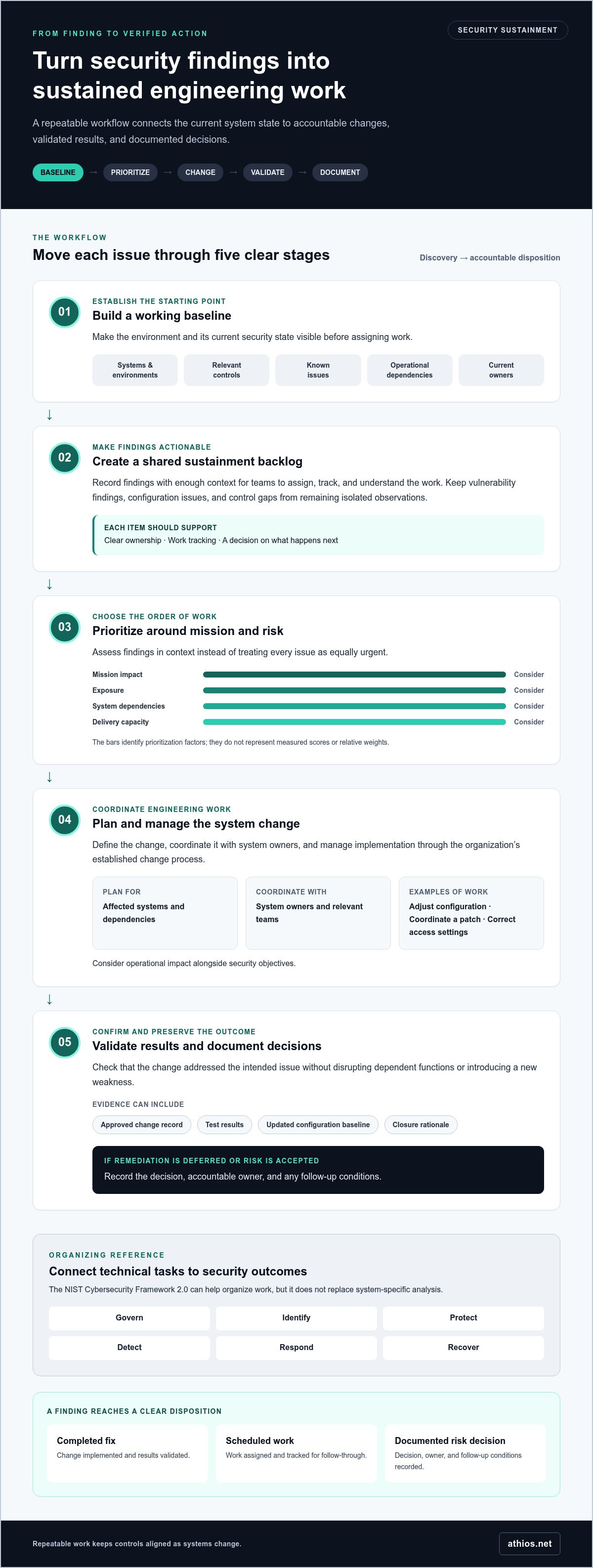
- Turn findings into a repeatable workflow: establish a baseline, prioritize work, implement changes, validate results, and document decisions.
- Use measures such as remediation age, recurring issues, control validation, and change-related incidents to assess progress beyond activity counts.
- Define the systems, workflows, dependencies, and owners in scope so sustainment reflects mission priorities and operational responsibilities.
- Cybersecurity sustainment services can coordinate engineering with infrastructure planning and systems administration as IT environments change.
What Cybersecurity Sustainment Services Maintain After Initial Implementation
Cybersecurity sustainment is the recurring engineering and operational work that preserves and improves an organization’s security capability as systems and requirements change. It can include maintaining configurations, testing controls, remediating weaknesses, coordinating operational changes, and documenting the resulting state. Cybersecurity sustainment services keep implemented protections aligned with the environment they are meant to protect, rather than treating security as a one-time deployment.
Initial implementation establishes or changes a control. A one-time assessment identifies conditions at a particular point in time. Sustainment covers the work that continues afterward: applying findings, maintaining controls, and reassessing them as the system evolves. An assessment can inform sustainment, but it does not perform the ongoing engineering and operational work itself.
Cybersecurity Sustainment Versus Implementation and Managed Security
Implementation may introduce access controls, logging, or secure configurations. Sustainment keeps those measures functional through testing, maintenance, and improvement. Monitoring-focused services can detect and report events, while engineering sustainment addresses changes to the underlying systems and controls. These activities can complement one another, but they are not interchangeable. The defined scope should clarify which responsibilities belong to internal teams and which are assigned to external support.
Why Security Controls Require Ongoing Attention
Software releases, infrastructure changes, new integrations, and identity updates can alter how a control works or what it needs to protect. A revised application may require updated access permissions; a network change may affect security boundaries or logging. Mission needs can also shift, changing which systems and workflows need priority attention.
Configuration drift occurs when a system’s actual settings gradually depart from its approved or intended configuration. For example, a temporary access exception may remain after the work is complete, or a software update may change a security setting. If those differences go unnoticed, controls may provide less protection than teams expect, increasing operational risk and complicating incident response.
These activities are part of a broader approach to Information Security Management, which connects information protection with organizational processes and risk management. In practice, sustainment can combine engineering changes, system and network administration, remediation, control testing, and coordination among security, IT, and mission teams. The right mix depends on the systems in scope, their dependencies, and established ownership. Athios aligns cybersecurity sustainment and engineering support with infrastructure planning and systems administration, connecting security tasks to the technical environments they affect.
How Cybersecurity Sustainment Services Turn Findings Into Engineering Work
Security findings create value when they lead to accountable decisions and verifiable action. A practical sustainment workflow moves each issue from discovery to disposition, whether the outcome is a completed fix, scheduled work, or a documented risk decision. This keeps vulnerability findings, configuration issues, and control gaps from remaining isolated observations.
From Security Baseline to Prioritized Sustainment Backlog
Start by establishing a working baseline. Identify the systems and environments in scope, relevant controls, known issues, operational dependencies, and current owners. Then record findings in a shared backlog with enough context to assign and track the work. Prioritize according to mission impact, exposure, system dependencies, and available delivery capacity, rather than treating every finding as equally urgent.
The NIST Cybersecurity Framework 2.0 can provide an organizing reference through its functions, including Govern, Identify, Protect, Detect, Respond, and Recover. These categories help teams connect technical tasks to risk oversight and operational outcomes, but they do not replace system-specific analysis. For acquisition and program contexts, AcqNotes describes a Cybersecurity Strategy as a living document that supports risk management as a system matures, reinforcing the need to revisit priorities throughout the lifecycle.
Engineering, Validation, and Evidence of Completion
Once work is prioritized, define the change, coordinate it with system owners, and manage implementation through the organization’s established change process. Work might involve adjusting a configuration, coordinating a patch, or correcting access settings. Identify affected systems and dependencies in the change plan so teams can consider operational impact alongside security objectives.
After implementation, validate that the change addressed the intended issue without disrupting dependent functions or introducing a new weakness. Evidence might include an approved change record, test results, an updated configuration baseline, and a closure rationale. If remediation is deferred or a risk is accepted, document the decision, accountable owner, and any follow-up conditions. The backlog should show completed work and unresolved items, rather than imply that every finding can be eliminated immediately.
In this way, cybersecurity sustainment services connect findings to engineering execution while preserving a traceable record of decisions and results. Athios aligns cybersecurity engineering with infrastructure planning and systems administration, structuring support around defined systems and priorities. Organizations can review Athios’s cybersecurity engineering support as part of an ongoing sustainment approach.
What to Measure in Cybersecurity Sustainment Without Chasing Vanity Metrics
Useful sustainment measures show whether work is progressing, controls perform as intended, and changes affect mission operations. Activity counts alone cannot establish that risk has declined. A high number of closed findings, for example, says little without context about severity, recurrence, or validation.
Set a baseline for each measure, identify an accountable owner, define the reporting period, and connect results to the systems and mission priorities in scope. Cybersecurity sustainment services should use metrics to guide decisions and improvement, not imply that risk can be eliminated.
Operational Indicators That Show Whether Work Is Progressing
Track findings by severity, age, owner, status, and documented disposition. Reviewing remediation age by risk category can show whether high-priority work is delayed. Monitoring repeat findings can expose a persistent configuration weakness or process gap. Interpret trends alongside system context, since changes in workload or scope can affect comparisons between reporting periods.
- Work completed: Track items assigned, remediated, deferred, or accepted. These are activity measures. They show throughput and disposition, not whether a control is effective.
- Control performance: Record validation results and recurring issue rates. These indicators show whether controls continue to work as intended within the systems and conditions tested.
- Operational impact: Review change-related incidents or disruptions alongside sustainment activity. This helps teams assess whether security changes affect critical workflows, but an investigation is needed to establish cause.
Use consistent definitions. For example, establish when an item’s age begins, what qualifies as a recurrence, and which validation evidence supports closure. Without shared rules, reports can appear to show progress while obscuring unresolved or repeatedly reopened issues.
Governance, Control Evidence, and Reporting
Change records, test results, updated configurations, and closure rationale create traceability between a finding, the work performed, and its observed result. NIST SP 800-53 may serve as a control catalog when it fits an organization’s security requirements and system context. It should not be treated as a universal checklist. Applicable controls, evidence expectations, and reporting cadence depend on organizational needs and engagement scope.
Clear ownership also depends on sustained expertise and coordination. CISA’s discussion of cybersecurity workforce sustainment provides broader context for maintaining the people and capabilities that support cyber work. For operational reporting, assign responsibility for each measure and specify how exceptions, deferred work, and risk decisions will be reviewed. This keeps metrics connected to action rather than presentation alone.
How to Scope Cybersecurity Sustainment Around Systems, Risk, and Ownership
A clear scope connects security work to the systems and mission activities it supports. Without defined boundaries, teams can overlook dependencies, duplicate effort, or leave important responsibilities unresolved. Scope should identify what is covered, who makes decisions, how work is coordinated, and what evidence demonstrates completion.
Define the System Boundary and Operational Priorities
Document the applications, networks, infrastructure, identities, environments, and integrations included in the work. Map the workflows they support and the technical dependencies that could affect a change or validation. For example, an identity update may touch several applications, while a network configuration change may affect access to a critical workflow. Recording these relationships helps teams plan sustainment around actual operating conditions.
Then rank work according to mission importance, exposure, and dependencies. A risk-informed backlog helps teams sequence activities and set a practical cadence, taking account of operational windows and team capacity. This makes priorities explicit and gives security, engineering, and mission owners a shared basis for planning.
Set Roles, Deliverables, and Decision Paths
Separate execution from authority. Engineering and system administration teams may implement and test changes, while designated organizational decision-makers approve changes, accept risk, or resolve conflicts with mission priorities. Security teams can define control expectations and review evidence. Naming an accountable owner for each decision prevents technical findings from becoming unassigned organizational questions.
Document the agreement in operational terms: systems in scope, deliverables, coordination points, reporting expectations, evidence requirements, and boundaries for system changes. Deliverables may include engineering changes, status reports, validation evidence, and issue dispositions. The agreement should also explain how work affecting connected systems or responsibilities outside the defined boundary will be handled.
For cybersecurity sustainment services, this scoping discipline aligns engineering activity with the operational environment instead of treating security as separate from IT delivery. Athios coordinates cybersecurity engineering with architecture, infrastructure planning, and systems administration, with work structured around client systems and priorities.
Before work begins, define the systems, owners, decision paths, and deliverables. Scope cybersecurity sustainment with Athios around your environment and operational requirements.
How Athios Supports Cybersecurity Sustainment Across Changing IT Environments
Security changes affect the systems around them. A revised network configuration can alter connectivity between applications, while an identity update may affect access across several services. Effective sustainment therefore connects cybersecurity engineering with architecture, infrastructure planning, and systems administration. This helps teams consider dependencies and operating requirements as they plan and deliver changes.
Coordinate Cybersecurity Work With Enterprise IT Operations
Athios provides cybersecurity sustainment and engineering support alongside technical architecture, infrastructure planning, and system and network administration. Coordinating these disciplines connects security requirements to the systems being changed, rather than treating a control adjustment as an isolated task. For example, teams can consider a planned configuration update alongside network dependencies, system administration procedures, and the workflow the system supports.
This coordination supports controlled delivery. Teams can identify affected components, align implementation with established change processes, and plan validation around operational needs. The goal is to integrate security work with IT operations while managing potential disruption, not to imply that changes carry no operational risk or guarantee a particular compliance outcome. Athios supports federal government and commercial clients through consulting and engineering services, with work aligned to the systems and priorities in scope.
Prepare for a Sustainment Engagement
Preparation gives technical work a defined starting point. Before an engagement, assemble a concise view of the environment and the outcomes the organization needs. Useful inputs include:
- System boundaries: Applications, networks, infrastructure, identities, integrations, and critical workflows in scope.
- Current priorities: Known findings, recent or planned system changes, and mission needs that affect sequencing.
- Existing responsibilities: Security, engineering, administration, approval, and risk decision roles.
- Delivery expectations: Desired deliverables, decision points, reporting needs, validation evidence, and change processes.
These inputs help define cybersecurity sustainment services as scoped technical work, whether the organization needs ongoing support or defined project deliverables. They also clarify how engineering activities coordinate with internal teams and which decisions remain with organizational leadership.
Athios works with federal and commercial organizations to align cybersecurity engineering with their operating requirements and IT environments. Bring the system scope, known concerns, desired outcomes, and coordination needs to an initial discussion about sustainment.
Keep Security Aligned as Your Systems Evolve
Security controls need continued attention as infrastructure, software, integrations, and mission requirements change. Effective sustainment turns findings into prioritized engineering work, validates changes, and records decisions so teams can see what has been addressed and what still requires attention.
Strong cybersecurity sustainment services also depend on meaningful measures and clear ownership. Tracking remediation, recurring issues, control validation, and operational effects helps organizations assess progress, while a defined scope clarifies the systems, responsibilities, and decisions involved. These practices support informed risk management without suggesting that every risk can be eliminated.
Athios provides cybersecurity sustainment and engineering support, coordinating that work with related capabilities such as technical architecture, infrastructure planning, and systems administration. This connects security needs to the IT environments and operating requirements they affect.
Frequently Asked Questions
What are cybersecurity sustainment services?
Cybersecurity sustainment services are recurring engineering and operational activities that preserve and improve security controls after initial implementation. They adapt protections as applications, infrastructure, identities, and mission needs change. Work can include configuration maintenance, patch coordination, remediation, testing, documentation, and coordination among security, IT, and system owners. Unlike a one-time assessment, sustainment carries findings into ongoing work and tracks whether changes remain appropriate.
How are cybersecurity sustainment services different from managed security services?
Cybersecurity sustainment focuses on engineering and operational work that maintains controls as systems change. Managed security services often emphasize ongoing monitoring, alerting, or other defined security operations. The models can complement each other, but monitoring findings does not itself implement system changes or validate updated configurations. The scope and agreements should clarify responsibilities, approval paths, and how findings move into corrective work.
Why do cybersecurity controls need ongoing sustainment?
Controls need ongoing sustainment because the conditions they protect are not static. Software releases, infrastructure modifications, new integrations, and identity changes can alter configurations, access paths, or system dependencies. A control that worked as intended before a change may need adjustment or retesting afterward. Regular review helps organizations detect configuration drift, address emerging weaknesses, and keep security practices aligned with current operational needs.
What activities are included in cybersecurity sustainment?
Cybersecurity sustainment can include reviewing system baselines, prioritizing findings, coordinating patches, maintaining secure configurations, remediating control gaps, and validating changes. Teams also document approvals, test results, updated settings, and decisions to defer or accept risk. The precise activities depend on the systems and responsibilities in scope. Engineering work may be coordinated with system administration, infrastructure planning, security staff, and operational owners.
How do organizations measure cybersecurity sustainment?
Organizations can measure sustainment by tracking remediation age, findings by status and owner, repeat issues, control validation results, and incidents associated with changes. Establish a baseline, reporting period, and consistent definitions so trends can be interpreted. Activity counts show work completed, while validation and operational indicators provide different evidence about control performance and system effects. Metrics support decisions and improvement, but they cannot demonstrate that all risk has been eliminated.
Can cybersecurity sustainment services support federal and commercial systems?
Yes. Athios provides cybersecurity sustainment and engineering support for federal government and commercial clients. Work can be scoped to the organization’s systems, priorities, and operating requirements, alongside related capabilities in technical architecture, infrastructure planning, and systems administration. Defining system boundaries, current concerns, responsibilities, and desired deliverables helps align sustainment activities with the environment and the teams responsible for operating it.
Discuss your cybersecurity sustainment requirements with Athios and define a practical path for maintaining security as your systems evolve.

Article by
Kevin Torres


