

What if the most urgent security alert isn’t the threat that poses the greatest risk to your organization? Alerts and vulnerability findings can quickly outpace available staff. Unclear ownership can delay action and increase the chance that remediation disrupts essential systems.
Effective cybersecurity threat mitigation services turn identified exposure into prioritized, implemented, and verified risk reduction. That takes more than detecting threats: teams need shared workflows, clear accountability, and remediation plans that reflect both security requirements and operational needs.
This guide explains how to identify, prioritize, contain, and reduce cyber threats through a repeatable process. You’ll learn how to assess threats in context, coordinate response and remediation, and verify that changes have reduced risk without compromising system reliability. The result is a practical framework for turning security findings into sustained technical improvements.
Key Takeaways
- Understand how cybersecurity threat mitigation services reduce the likelihood or impact of identified risks, while complementing prevention, detection, response, and recovery.
- Use a repeatable sequence to move from defining scope and assessing exposure to treatment, verification, and review.
- Prioritize findings by considering exploit evidence, exposure, asset importance, operational impact, and existing controls, not severity scores alone.
- Integrate mitigation into change management and system administration, with clear ownership across security, engineering, operations, system owners, and leadership.
- Reassess completed fixes as systems, dependencies, and threat information change, so risk decisions and safeguards remain relevant.
What cybersecurity threat mitigation services do and when organizations need them
Cybersecurity threat mitigation reduces the likelihood that an identified cyber risk will be exploited, or limits the damage if it is. It turns findings such as an exposed service, an unpatched system, or excessive account privileges into defined actions that lower risk. Cybersecurity threat mitigation services support this work through coordinated assessment, decision-making, implementation, and verification, rather than treating alerts as an end in themselves.
Mitigation works alongside other security functions, but does not replace them. Prevention establishes safeguards to stop threats; detection identifies suspicious activity; incident response coordinates action during an active event; and recovery restores systems and operations afterward. Mitigation supports these functions by addressing known weaknesses and reducing potential impact. It draws on information security management principles, applying risk-based controls in ways that fit organizational responsibilities and operational needs.
What is included in a threat mitigation service?
A structured engagement may assess systems and exposures, prioritize risks, recommend or implement controls, coordinate response activities, and verify that completed changes work as intended. Advisory work can define the problem, compare options, and develop a remediation plan. Hands-on engineering carries approved changes into system configurations or infrastructure, while cybersecurity sustainment maintains and reassesses security over time.
The scope depends on the organization’s systems, mission, and risk priorities. A mitigation action must account for the people who operate and use the system, the processes governing changes, technical dependencies, and constraints such as service availability. For example, restricting access may reduce exposure, but the change should preserve authorized workflows and be documented for operational teams.
Which organizations benefit from a structured mitigation process?
Enterprises with distributed systems, third-party dependencies, or sensitive information benefit from a consistent way to turn findings into owned technical work. A shared process helps security, engineering, and operations coordinate decisions across environments, rather than applying isolated fixes without considering system relationships.
Public-sector teams also need to balance security requirements with mission continuity. Some systems cannot be changed without planning, testing, and coordination with their owners. Defined mitigation steps help teams evaluate risk, sequence work, and record decisions while protecting essential operations.
Engineering support can complement internal security staff when assessment findings exceed available technical capacity, remediation spans multiple systems, or teams need help coordinating changes. Athios supports federal and commercial clients through cybersecurity sustainment, IT engineering, system administration, and architecture planning, aligning security changes with the systems and operations they are intended to protect.
How cybersecurity threat mitigation moves from exposure to risk reduction
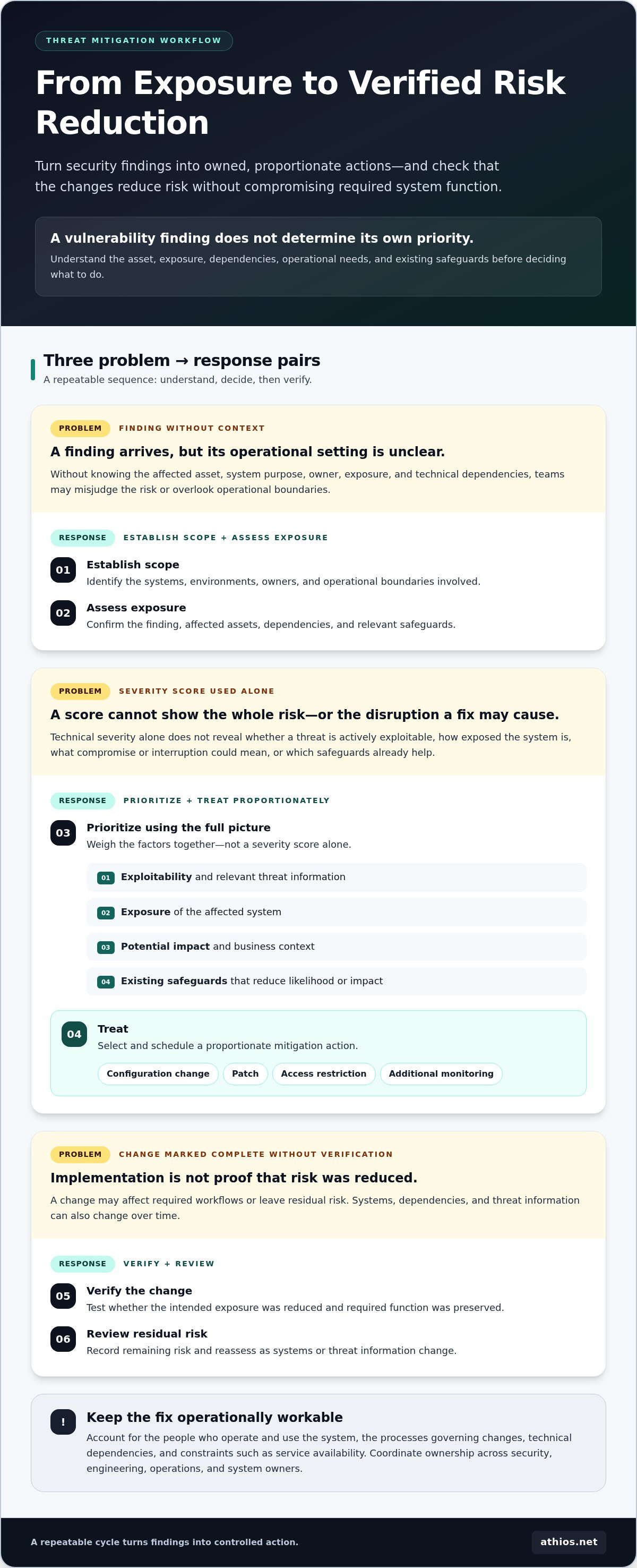
A vulnerability finding does not determine its own priority. Teams need to understand which asset is affected, what the system supports, how it is exposed, and which other services depend on it. A weakness on an isolated test system may call for a different response from the same weakness on a mission-critical service connected to sensitive information.
Use a repeatable cycle to turn findings into controlled action:
- Establish scope: Identify the systems, environments, owners, and operational boundaries involved.
- Assess exposure: Confirm the finding, affected assets, dependencies, and relevant safeguards.
- Prioritize: Weigh exploitability, threat information, exposure, potential impact, and business context.
- Treat: Select and schedule a proportionate mitigation action.
- Verify: Test whether the change reduced the intended exposure and preserved required function.
- Review: Record residual risk and reassess as systems or threat information change.
Threat intelligence and vulnerability information help teams understand what may be exploited and how, but they are inputs to a risk decision, not a substitute for one. Current CISA and NIST guidance can inform an assessment when it applies to the system and mission. Confirm that referenced guidance is current and relevant to the environment. For a focused example of structured threat management, CISA's Insider Threat Mitigation Guide provides a resource to consider when addressing insider risk.
How should teams identify and prioritize threats?
Start with an accurate picture of asset ownership, system purpose, exposure, and technical dependencies. Then assess whether a threat is actively exploitable, what credible threat information indicates, the consequences of compromise or interruption, and which safeguards already reduce likelihood or impact. A severity score can describe a technical condition, but it cannot show on its own whether a system can be changed immediately or how disruptive a fix might be.
How do teams select and verify mitigation actions?
Match the action to the underlying weakness. Options may include a configuration change, patch, access restriction, or additional monitoring. Before implementation, define approvals, testing, rollback considerations, and communications for affected operators. Afterward, verify the control’s effect, document remaining exposure, assign an owner, and set follow-up requirements. This makes the outcome traceable as well as technically meaningful.
Mitigation is an iterative cycle, not a one-time remediation event. Cybersecurity threat mitigation services can connect assessment to engineering and verification, supporting changes that reduce exposure while accounting for operational constraints. Organizations seeking to align security work with system reliability can explore Athios cybersecurity sustainment and IT engineering support.
How to prioritize mitigation when threats, resources, and mission needs compete
A severity score is a useful signal, not a complete remediation order. It describes aspects of a technical weakness, but may not show whether an attacker can reach the affected asset, whether exploitation is occurring, what the system supports, or how existing safeguards change exposure. Prioritization connects technical evidence to mission and business consequences.
How do teams rank vulnerabilities and active threats?
Start by confirming which assets are affected, who owns them, how they are exposed, and which services depend on them. Use the relevant CVE record and current CISA resources, including the Known Exploited Vulnerabilities Catalog, as inputs to the assessment. Verify current information, then evaluate exploit evidence alongside asset criticality, potential service or data impact, and compensating controls. MITRE ATT&CK can help teams describe adversary tactics and techniques when that context informs detection or response planning.
For example, a technically severe issue on an isolated system with effective controls may need a different remediation sequence from a less severe weakness on a reachable system that supports an essential service. The objective is not to dismiss the score, but to put it in context and explain the resulting decision.
How can security work proceed without avoidable operational disruption?
Group remediation work by urgency, implementation risk, dependencies, and maintenance requirements. A change to a critical service may need testing in a representative environment, approval from system owners, and a staged rollout with operational communications. These steps do not eliminate risk, but they make the change more controlled and help teams spot unintended effects before broader deployment.
If immediate remediation is not feasible, apply a suitable compensating control where possible and document any exception. Define conditions that would accelerate action, such as new evidence of exploitation or a change in exposure. Set a review date so a deferral does not become indefinite.
Maintain a concise decision record for each significant action or deferral. It should capture:
- Rationale: Evidence, asset context, and factors that shaped priority.
- Accountability: The decision owner and the person or team responsible for implementation.
- Timing: A target deadline and review date.
- Exception and residual risk: Any approved deviation, remaining exposure, and compensating controls.
- Escalation conditions: Events that require the decision to be reconsidered.
This record gives security, engineering, operations, and leadership a shared basis for action. Cybersecurity threat mitigation services can support this discipline by turning threat evidence into prioritized engineering work while keeping operational trade-offs visible.
How to embed threat mitigation into engineering and daily operations
Mitigation is more sustainable when a security finding enters the same controlled workflow used to plan, approve, implement, and maintain system changes. Security identifies the risk and defines the intended control; engineering translates it into a technical change; operations plans implementation and monitoring; system owners confirm mission requirements and accept residual risk; and leadership resolves decisions beyond delegated authority. Clear handoffs prevent findings from becoming detached from the teams responsible for changing systems.
How should security controls fit into engineering workflows?
Translate each finding into a specific requirement, implementation task, and acceptance criterion. For example, a recommendation to restrict access should identify the relevant system or configuration, the access needed for authorized operations, and how the team will verify the restriction. Before implementation, account for architecture, dependencies, maintenance schedules, approvals, and rollback needs.
Record the approved change, its rationale, implementation details, and verification evidence within the organization’s established change and configuration controls. This gives system administrators and future engineering teams a reliable account of what changed and why. It also supports review when a later system modification could weaken or supersede the control.
Keep ownership explicit throughout the work. Security personnel provide risk context, engineers implement the control, operations teams monitor system behavior, system owners validate mission impact, and leadership oversees exceptions or unresolved risk. After deployment, monitoring can reveal whether the control remains effective and whether the change introduced operational issues. Feed incidents and near misses into revised requirements, procedures, or monitoring instead of treating them as isolated events.
How can organizations measure mitigation progress?
Use measures that show both execution and outcome, rather than relying on a single count of closed findings. A focused review can track:
- Exposure: Aging high-priority findings and actions past their agreed deadlines.
- Implementation: Changes completed and fixes verified against their acceptance criteria.
- Governance: Approved exceptions, assigned owners, review dates, and remaining risk.
- Operations: Service effects associated with security changes and recurring implementation issues.
Interpret these measures in context. A rising closure count does not demonstrate reduced risk if fixes have not been verified. A deferred action may remain controlled when an approved exception includes safeguards and active review. Examine recurring causes, such as configuration drift or unclear ownership, then adjust controls, procedures, or monitoring to address them.
Documented ownership and verified changes turn individual fixes into sustained risk reduction. Athios aligns cybersecurity sustainment with engineering and system operations. Explore Athios cybersecurity sustainment and IT engineering support.
How to sustain cybersecurity threat mitigation as threats and systems change
A completed fix reflects the system’s state at the time it was implemented. New software, changed configurations, additional connections, or shifts in threat information can alter exposure and make an earlier risk decision incomplete. Treat each verified control as an ongoing responsibility, with monitoring and reassessment tied to system ownership and operational change.
What should a repeatable mitigation review include?
A review should examine whether priority findings remain addressed, controls continue to perform as intended, and approved exceptions still reflect current conditions. Revisit affected systems after material changes to assets, software, dependencies, access, or external exposure. Incident lessons and relevant new threat information can also change the likelihood or potential impact of a risk, prompting teams to reassess safeguards and remediation decisions.
Keep the review record actionable. Document the evidence considered, the decision made, the accountable owner, unresolved exposure, and the next review date. If a control no longer meets its objective, assign follow-up work through the organization’s engineering and change processes. This creates a traceable link between changing conditions and the technical action taken in response.
How can engineering support strengthen mitigation execution?
Engineering helps translate risk priorities into system changes that account for architecture, operational dependencies, and established administration practices. Architecture and infrastructure planning can inform where controls belong; system administration can carry approved configuration changes into daily operations; and cybersecurity sustainment can support continued review as systems evolve. These activities connect security objectives to the environments they are meant to protect.
Effective cybersecurity threat mitigation services fit an organization’s systems and operational requirements, maintaining clear ownership from assessment through sustainment. For federal and commercial clients, Athios brings cybersecurity sustainment together with IT engineering, system administration, and architecture planning. This integrated perspective supports security work as continuous technical activity, with changes aligned to system reliability and documented outcomes.
Organizations seeking to strengthen the connection between mitigation priorities and ongoing engineering can explore Athios cybersecurity and IT engineering capabilities.
Make Threat Mitigation Part of Ongoing Engineering
Effective mitigation takes more than identifying vulnerabilities. Teams need a repeatable way to assess exposure, prioritize risks in light of mission and business needs, implement controlled changes, and verify that those changes remain effective. Clear ownership and periodic review help keep safeguards aligned as systems, dependencies, and threats evolve.
Cybersecurity threat mitigation services are most effective when connected to engineering and daily operations, rather than treated as a separate alert-handling task. This approach helps organizations reduce risk while accounting for system reliability, operational constraints, and documented outcomes.
Athios provides cybersecurity sustainment for federal and commercial clients, supported by architecture planning and system administration capabilities. These engineering functions help align security work with the systems it is intended to protect. Explore Athios cybersecurity sustainment and IT engineering support to strengthen your organization’s ongoing mitigation practices.
With clear priorities, accountable owners, and verified changes, your team can make threat mitigation a sustained part of secure and reliable operations.
Frequently Asked Questions
What are cybersecurity threat mitigation services?
Cybersecurity threat mitigation services help organizations reduce the likelihood or impact of identified cyber risks. They can include assessing exposures, prioritizing findings, planning or implementing controls, coordinating response activities, and verifying that changes work as intended. The scope depends on the systems, mission, and risk priorities involved. Effective mitigation connects security decisions to engineering and operations, so controls address actual exposure while accounting for system dependencies and business requirements.
How do organizations prioritize cybersecurity threats?
Organizations prioritize threats by weighing technical severity alongside exploit evidence, system exposure, asset importance, potential business impact, and existing safeguards. A vulnerability on an internet-facing system supporting essential operations may require faster action than a similar finding on an isolated asset. Use current vulnerability and threat information to inform the assessment, then document why an action is prioritized, deferred, or accepted. Scores support decisions, but organizational context determines the order of work.
What is the difference between threat mitigation and incident response?
Threat mitigation reduces the likelihood or potential impact of a cyber risk, while incident response coordinates action when a security event is underway or suspected. Mitigation can include fixing a vulnerability, restricting access, or applying a compensating control. Incident response focuses on assessing and managing the event, containing activity, and coordinating next steps. The functions complement each other: response findings may reveal weaknesses that require mitigation, while mitigation can reduce exposure to future incidents.
Can threat mitigation reduce risk without disrupting critical systems?
Teams can reduce risk while managing operational impact by planning changes with system owners and operators. Before implementation, assess dependencies, define approvals, test the change where feasible, plan a rollback, and communicate with affected teams. A staged rollout can help reveal unexpected effects before wider deployment. If immediate remediation presents unacceptable operational risk, teams can apply compensating controls and document the remaining exposure, owner, and review date.
How often should an organization review its threat mitigation plan?
Review the plan on a defined schedule and whenever a material change could affect risk. Triggers may include new assets, software updates, altered system connections, significant incidents, or relevant changes in threat information. During each review, reassess priority findings, control performance, and approved exceptions. Set review intervals according to the organization’s systems and risk needs, and record accountable owners and follow-up dates so actions remain active between formal reviews.
What happens if a vulnerability cannot be fixed immediately?
If a vulnerability cannot be fixed immediately, assess the reason and implement appropriate compensating controls to limit exposure where possible. Document the affected asset, business context, residual risk, accountable decision-maker, and planned remediation or review date. Define escalation conditions, such as evidence of exploitation or increased exposure, that would prompt an earlier decision. A deferral should remain visible and actively reviewed rather than being treated as a completed mitigation.
How do cybersecurity teams measure threat mitigation effectiveness?
Teams measure effectiveness by tracking whether high-priority findings are addressed, actions meet deadlines, and completed changes pass verification. They can also monitor approved exceptions, residual risk, and operational effects associated with security changes. Review incident lessons and recurring weaknesses to determine whether controls or procedures need adjustment. Closure counts alone are insufficient: evidence should show that the intended exposure was reduced and that the change continues to support required system functions.

Article by
Kevin Torres


