

An assessment can expose infrastructure weaknesses and still leave teams without a clear path to address them. The value of IT infrastructure security consulting depends on what happens next: findings need to lead to owned, sequenced engineering work that fits operational and mission priorities.
Security priorities compete with modernization schedules, daily service demands, and responsibilities spread across infrastructure, operations, and security teams. A useful engagement does more than document risk. It defines a defensible scope, makes assumptions and ownership visible, and gives leaders actionable decisions rather than another isolated report.
This 2026 evaluation checklist explains what an engagement should cover, how to assess whether its methods and deliverables fit your environment, and how to turn findings into planned improvement work. It covers scope, stakeholder responsibilities, evidence, risk prioritization, delivery structure, and measures of progress. Use it to weigh immediate exposure against dependencies, engineering capacity, and longer-term resilience, while aligning infrastructure architecture, cybersecurity sustainment, and ongoing operations around a structured improvement effort.
Key Takeaways
- Use IT infrastructure security consulting to connect assessment evidence with prioritized engineering work and clear ownership.
- Set scope around systems, networks, cloud dependencies, users, data flows, and business services, while documenting assumptions and boundaries.
- Compare assessment, implementation, and sustainment engagements by their deliverables, required client participation, and operational handoff.
- Assign executive sponsors, technical owners, security stakeholders, and approval authorities before kickoff to support timely decisions.
- Align security improvements with infrastructure planning and ongoing operations, using defined deliverables and an engagement structure suited to the work.
When IT infrastructure security consulting is useful: identify the operational need
Infrastructure security consulting provides structured assessment and engineering guidance for the systems, networks, and dependencies that support an organization’s operations. It helps leaders understand how the environment is configured, where security concerns affect business services, and which actions deserve priority. Information security management describes how organizations establish controls to protect the confidentiality, availability, and integrity of assets.
IT infrastructure security consulting connects assessment evidence to prioritized recommendations and practical implementation planning. It is different from product procurement, which supplies tools; a one-time scan, which identifies a limited set of technical conditions; and routine system administration, which maintains daily operations. Consulting can inform each of these areas, but its purpose is to clarify risk, decisions, ownership, and the engineering work needed to address findings.
Which conditions justify an infrastructure security review?
A review is useful when changes to the environment or its operational context make previous assumptions unreliable. Acquisitions can introduce unfamiliar systems and ownership boundaries. Migrations, new services, and architecture changes can alter access paths, dependencies, and data flows. Reviewing these changes helps teams determine whether controls still fit the updated design.
- Recurring incidents or unresolved findings: Repeated disruptions or recommendations that remain open may point to an underlying configuration, process, or ownership issue that merits structured investigation.
- Unclear asset ownership: If teams cannot readily identify who approves changes or maintains a system, remediation and incident decisions may be delayed.
- Aging infrastructure: Older platforms can constrain maintenance and modernization planning. Understand operational dependencies before scheduling changes.
- Mission or service changes: New delivery requirements can change which systems and connections are essential, helping teams focus review and engineering effort.
What should leaders expect from consulting?
A well-scoped engagement clarifies current-state architecture, documents relevant security gaps, and identifies accountable owners. It distinguishes observed conditions from assumptions and explains why findings matter to business services, operational continuity, or mission delivery. Recommendations are most useful when they account for maintenance windows, technical dependencies, available engineering capacity, and planned modernization.
Advisory findings do not automatically become implementation work. An assessment can identify and sequence changes, while internal teams or a separately scoped engineering effort carry them out. Sustainment covers the operational practices needed to maintain and review improvements over time. Define these boundaries early so leaders can assign decisions, establish handoffs, and avoid treating a report as completed remediation.
IT infrastructure security consulting checklist: define scope and evidence
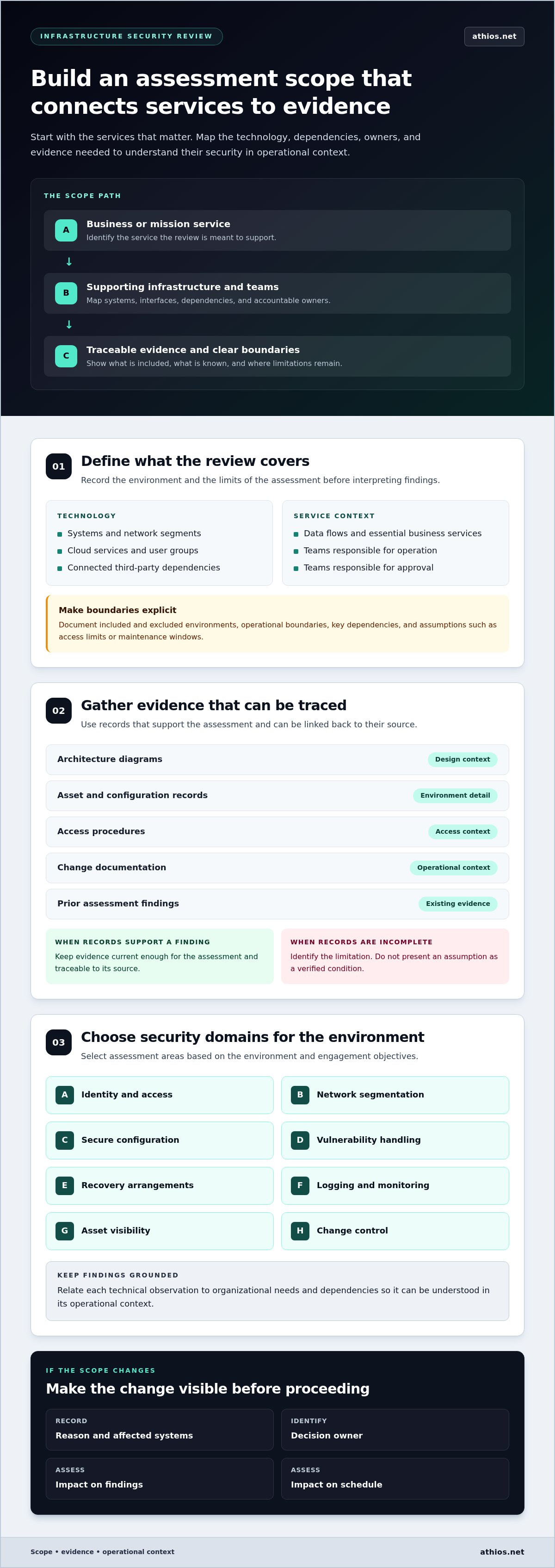
A useful scope connects business services to the technology that supports them, then sets clear boundaries for what the assessment will examine. For IT infrastructure security consulting, document not only systems and networks, but also dependencies, accountable owners, evidence sources, and constraints that could affect findings.
How should the environment and assessment boundaries be documented?
Start with critical business or mission services and map the infrastructure, interfaces, and teams that support each one. Record included and excluded environments, operational boundaries, key dependencies, and assumptions such as access limits or maintenance windows. If scope changes during delivery, document the reason, affected systems, decision owner, and impact on findings or schedule before proceeding.
- Technology: Systems, network segments, cloud services, user groups, and connected third-party dependencies.
- Service context: Data flows, essential business services, and the teams responsible for operation and approval.
- Evidence: Architecture diagrams, asset and configuration records, access procedures, change documentation, and prior assessment findings.
Evidence should be current enough to support the assessment and traceable to its source. If records are incomplete, identify the limitation rather than presenting an assumption as a verified condition.
Which security domains belong on the assessment checklist?
Select domains based on the environment and engagement objectives. A practical review may examine identity and access, network segmentation, secure configuration, vulnerability handling, recovery arrangements, logging and monitoring, asset visibility, and change control. Relate each area to organizational needs and dependencies so technical observations can be assessed in their operational context.
- Confirm how access is approved, reviewed, and removed across relevant systems.
- Review whether network boundaries and configurations reflect documented service dependencies.
- Determine how vulnerabilities, system changes, logs, and recovery procedures are managed and evidenced.
NIST Cybersecurity Framework and NIST SP 800-53 can provide reference structures for organizing security outcomes and controls. Their suitability depends on the organization’s purpose, obligations, and assessment scope. Naming a framework does not establish compliance. Map references only where applicable, and document the basis for the mapping.
Before kickoff, consolidate the scope, owner list, evidence inventory, assumptions, and change-review process into an agreed working record. This gives technical teams and decision-makers a shared basis for interpreting findings. Athios connects infrastructure planning, networks, and cybersecurity sustainment through infrastructure security consulting support tailored to client objectives.
Compare consulting approaches by deliverables, engineering depth, and sustainment
Engagement models differ in what they leave an organization ready to do. When evaluating IT infrastructure security consulting, compare more than the final report. Consider the depth of engineering support, the client effort required, and how work transitions into ongoing operations.
How do assessment and engineering-led engagements differ?
An assessment documents current conditions, evidence-based gaps, and prioritized recommendations. Engineering support takes approved priorities further by translating them into architecture changes or implementation tasks. Continuous sustainment extends the work into operational practice, supporting the review and maintenance of improvements over time. The right model depends on the defined scope, available internal capacity, and responsibilities the client will retain.
| Engagement model | Expected outputs | Client participation | Operational handoff |
|---|---|---|---|
| Assessment-only | Current-state findings, supporting evidence, risk context, and prioritized recommendations | Provide access, records, subject-matter input, and review of findings | Internal owners accept recommendations and plan follow-on work |
| Implementation-focused | Approved design or configuration changes, implementation records, and updated documentation | Set priorities, approve changes, coordinate access, and manage operational constraints | Changes and supporting records transfer to designated operations teams |
| Continuous sustainment | Agreed recurring engineering support, issue tracking, and review of security improvements | Maintain decision access, provide operational context, and participate in regular reviews | Responsibilities and review cadence are defined for ongoing operations |
What makes security recommendations usable after delivery?
A report describes observations. An operationally actionable security plan assigns each priority an owner, sequence, dependencies, and decision point. It distinguishes immediate risk reduction from changes that require design work, approvals, or coordination with service owners. This helps leaders align remediation with engineering capacity instead of treating every finding as an independent task.
Assess findings for traceable evidence, relevant risk context, and a clear rationale for priority. Recommendations should identify the accountable team, prerequisite work, approval authority, and expected handoff, along with documentation for the people maintaining the environment. If implementation falls outside the engagement, the plan should still name the next decision and responsible owner.
Zero Trust Architecture can inform discussions about identity, access, and resource protection, but it is a contextual reference, not a universal design prescription. Apply its principles in light of the environment, service dependencies, and operating constraints. Compare each engagement against its intended outcome: documented understanding, completed engineering changes, or sustained operational improvement.
Prepare an infrastructure security consulting engagement with an actionable checklist
Preparation establishes who can make decisions, what evidence is available, and how findings will move into action. A clear kickoff process also keeps IT infrastructure security consulting aligned with operational constraints, rather than treating the assessment as a standalone technical exercise.
What should the client prepare before kickoff?
Use this sequence to align stakeholders and organize the engagement before assessment work begins:
- Define the desired outcomes. Record the decisions the engagement should support, relevant mission or business priorities, operational constraints, and important deadlines.
- Assign decision-makers and owners. Name an executive sponsor, technical owners for the systems in scope, security stakeholders, and approval authorities for access, changes, and risk decisions.
- Assemble relevant evidence. Gather current architecture diagrams, asset inventories, policies and procedures, incident records, previous assessment findings, and remediation records for the agreed environment.
- Establish access and data-handling processes. Identify access request steps, points of contact, evidence transfer methods, and expectations for handling sensitive operational information.
- Set the review cadence. Agree on working sessions, finding validation, decision reviews, and escalation routes so issues can be addressed while the engagement is underway.
CISA resources may help inform planning and the questions teams consider. Check guidance against current publications and the organization’s environment, mission, and applicable requirements before using it to shape assessment criteria.
How should findings move into remediation governance?
Agree in advance how the team will validate observations and convert accepted findings into tracked work. Each action should have an accountable owner, an agreed priority, dependencies, a target milestone, and a decision path for risks that cannot be addressed immediately. Record accepted risks with the responsible authority and review conditions, rather than leaving them implicit.
Set governance checkpoints to review progress, resolve blockers, approve exceptions, and assess proposed scope changes. At each checkpoint, distinguish completed work from actions delayed, dependent on other changes, or awaiting a decision. This gives leadership a practical view of delivery without confusing assessment findings with completed remediation.
Closeout should preserve the information needed for continuity: validated findings, assigned actions, decisions, and relevant handoff documentation. If improvement work continues after the assessment, define how owners will report progress and how unresolved items will return for review. This supports accountable follow-through while allowing teams to work within established operational processes.
Athios aligns consulting engagements with infrastructure planning, engineering, and cybersecurity sustainment. Explore infrastructure security engagement planning with Athios.
How Athios connects security consulting with infrastructure engineering and sustainment
Security recommendations are most useful when they reflect how infrastructure is designed, operated, and maintained. Athios connects cybersecurity sustainment with infrastructure planning, network architecture, systems administration, and engineering support. This aligns security work with the environment it is intended to improve and helps organizations move from identified concerns to engineering priorities that account for dependencies, operating requirements, and decision paths.
How does an integrated engineering perspective support security work?
Architecture and network planning provide context for evaluating how systems connect and which services depend on them. Systems administration adds an operational view of infrastructure maintenance, while cybersecurity sustainment supports continued attention to security needs as environments evolve. For example, addressing a finding involving an older network component may depend on service relationships, change approval, and the timing of related infrastructure work. Considering these factors together helps teams plan changes in a deliberate sequence.
IT infrastructure security consulting should distinguish recommendations from execution. Assessment findings can inform design decisions, implementation tasks, or follow-on sustainment, while the engagement scope defines which activities and responsibilities are included. Athios tailors its work to client objectives, supporting commercial enterprises and federal agencies without treating every environment or requirement as the same.
What happens when an organization is ready to scope an engagement?
Scoping begins with a shared understanding of the desired outcome, the systems and teams involved, and the operational constraints that shape the work. The engagement can then define deliverables and responsibilities around project requirements. Depending on the work, it may be structured through project deliverables, a statement of work, or a retainer engagement.
That structure gives stakeholders a basis for deciding how findings will inform engineering priorities and how continuing operational support will be organized. A focused project may center on defined deliverables, while a broader or continuing need may call for a different arrangement. In either case, clarity about scope, decision points, and handoffs supports coordination among security, infrastructure, and operations teams.
To align security consulting with your infrastructure objectives and operating constraints, discuss an IT infrastructure security engagement.
Turn security findings into an actionable improvement plan
A sound IT infrastructure security consulting engagement begins with a scope tied to business and mission priorities, clear evidence and ownership, and recommendations that account for operational constraints. Its value depends not only on what an assessment identifies, but also on whether teams can sequence the work, make decisions, and carry improvements into ongoing operations.
Athios connects cybersecurity sustainment and engineering support with infrastructure planning, network services, and systems administration. Work can be organized around defined project deliverables, a statement of work, or a retainer, aligning the engagement structure with client objectives and requirements.
Ready to define the next steps? Discuss your IT infrastructure security engagement with Athios to align objectives, constraints, scope, and delivery approach. Clear responsibilities and a workable sequence help your teams move forward with greater alignment.
Frequently Asked Questions
What does IT infrastructure security consulting include?
IT infrastructure security consulting typically includes a scoped review of relevant systems, networks, dependencies, and operational priorities. Consultants examine available evidence, identify material gaps, and organize findings into recommendations with practical next steps. Depending on the agreed engagement, work may also include architecture guidance, engineering support, or sustainment planning. Deliverables and responsibilities should reflect the organization’s objectives, environment, and operating requirements.
When should an organization use IT infrastructure security consulting?
Consider consulting when infrastructure changes, recurring findings, unclear ownership, or operational complexity make security priorities difficult to coordinate. An engagement can clarify the current environment, map technical concerns to affected services, and help sequence improvement work. This is useful when leaders need to weigh security needs against service continuity, mission requirements, modernization plans, or engineering capacity, and establish who will own decisions and follow-up actions.
How do you evaluate an IT infrastructure security consulting engagement?
Evaluate whether the proposed scope identifies relevant systems, stakeholders, evidence, and operational constraints. Expected outputs should include documented findings with evidence, risk context, priorities, owners, dependencies, and a defined operational handoff. Also review how recommendations connect to engineering and sustainment, what decisions the client must make, and how findings will be validated. A well-structured engagement makes responsibilities and next steps clear before work begins.
Can infrastructure security consulting support both assessment and implementation?
Yes. An engagement can combine assessment with engineering support when the work, approvals, and responsibilities are clearly scoped. Assessment establishes current conditions and recommendations; implementation translates approved priorities into architecture or operational changes. Organizations may engage these as separate stages or coordinate them under a broader effort. In either case, define deliverables, decision authority, client participation, and handoff arrangements so recommendations become controlled, accountable work.
How should an organization prepare for a security consulting assessment?
Begin by documenting objectives, scope boundaries, stakeholders, and operational constraints. Assemble relevant architecture diagrams, asset records, policies, incident documentation, prior assessment findings, and remediation records. Identify system owners, access procedures, evidence-handling expectations, and points of contact. Agree on review and decision meetings before kickoff. This preparation helps the assessment focus on the environment and organizational decisions that matter, while making evidence gaps and ownership boundaries visible early.
What is the difference between security consulting and managed security services?
Security consulting generally provides defined assessment, architecture, engineering, or advisory work tied to an agreed scope. Managed security services generally cover ongoing operational functions under a continuing service arrangement, though responsibilities vary. Distinguish the models by defining deliverables, decision rights, operational responsibilities, and sustainment expectations. Athios provides consulting and engineering support aligned with client requirements, including infrastructure planning, systems administration, and cybersecurity sustainment.

Article by
Kevin Torres


