

A system can be fully implemented and still need sustained engineering to remain secure, reliable, and aligned with changing operational demands. IT engineering support services address architecture, integrations, automation, and cybersecurity work that routine administration and user support may not cover. Enterprise teams know that keeping systems available is essential. The challenge is determining who owns the deeper work needed to strengthen and evolve them.
This guide explains what engineering support includes, how it differs from managed IT and help desk services, and when an organization may need specialized capacity beyond its internal team. It also shows how lifecycle engineering connects daily operations with modernization, from infrastructure planning and cybersecurity sustainment to custom applications and workflow automation.
Athios provides IT engineering and consulting for federal government and commercial organizations. Its work connects architecture, administration, security, and development to defined objectives. The sections ahead outline typical engineering activities and how to frame an engagement around system needs, priorities, and outcomes, helping teams sustain complex environments while preparing for what comes next.
Key Takeaways
- IT engineering support services extend beyond help desk response to address the design, integration, sustainment, and improvement of complex systems.
- Map engineering work across the system lifecycle to see how early architecture decisions shape security, interoperability, resilience, and future changes.
- Match enterprise needs to practical engineering capabilities and outputs, including architecture planning, cybersecurity sustainment, and automation.
- Scope an engagement around defined outcomes, constraints, dependencies, and deliverables so internal owners and technical teams can coordinate effectively.
- Athios aligns architecture, administration, cybersecurity, and custom development with federal and commercial organizational needs.
What IT Engineering Support Services Cover Beyond the Help Desk
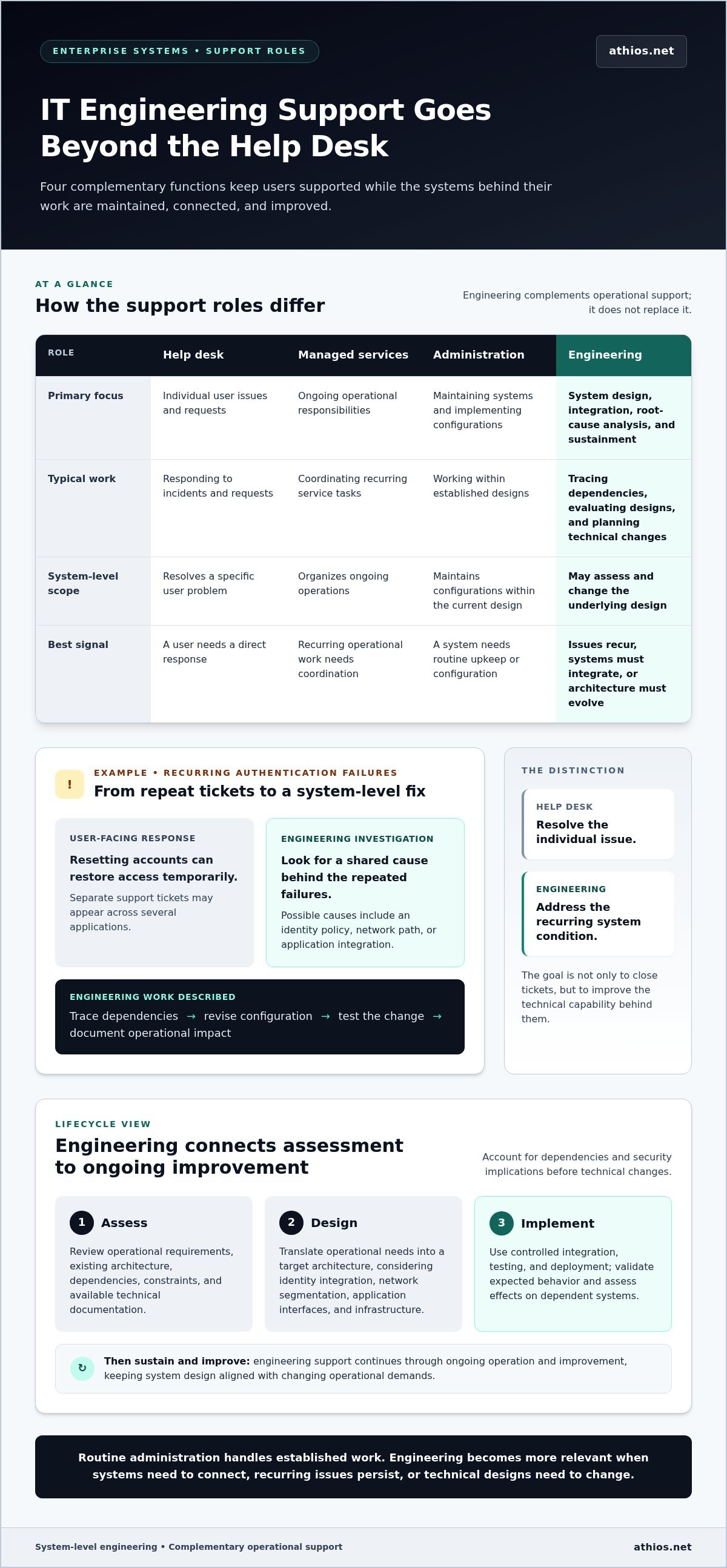
A help desk keeps users productive by responding to incidents and requests. Complex environments also need technical work on the systems behind those requests: how components are designed, connected, secured, maintained, and improved. IT engineering support services provide that system-level focus. They complement operational support rather than replace it.
Organizations need dependable daily operations as well as deliberate technical change. Service management coordinates recurring activities such as access requests, incident handling, and maintenance schedules. Engineering examines whether the underlying architecture and configurations still meet operational needs, then plans and implements changes with connected systems in view. This distinction matters in zero-trust architectures, where identity, network, and application decisions must work together.
In brief: “IT engineering resolves system-level causes and improves technical capability; help desk support resolves individual user issues and requests.” For foundational context on organizational support functions, see What is IT Support?
How engineering support differs from IT support and managed services
User support typically addresses a specific incident, such as restoring an employee’s access. Managed services often organize ongoing operational responsibilities and recurring service tasks. Engineering focuses on design, integration, root-cause analysis, and sustainment. Administration overlaps with engineering when maintaining systems or implementing configurations, but it generally works within established designs. Engineering may assess and change those designs.
For example, repeated authentication failures across several applications may create separate support tickets. Resetting accounts can restore access temporarily, but engineering investigates shared causes, such as an identity policy, network path, or application integration. Corrective work may involve tracing dependencies, revising configuration, testing the change, and documenting its operational impact. The goal is to address the recurring system condition, not just close individual tickets.
Which organizations use IT engineering support
Engineering support is relevant to enterprises managing interconnected infrastructure, applications, and data workflows, where a change in one component can affect several others. Public-sector organizations also rely on technical environments shaped by mission requirements and complex system dependencies. The right level of support depends on system complexity, operational risk, and the internal team’s capacity to sustain architecture, cybersecurity, and technical change.
Not every operational issue needs to become an engineering project. A routine request may be resolved through established administration or service processes. Engineering becomes more relevant when issues recur, systems need to integrate, architecture must evolve, or internal capacity is insufficient for sustained technical work. Clear ownership between operations and engineering helps maintain service continuity while making necessary improvements in a controlled way.
For zero-trust environments, the distinction is practical: user-facing support handles immediate access problems, while engineering examines whether system design and configuration support consistent, secure access across connected resources. The functions are complementary. Coordination lets teams respond to users while addressing the technical conditions that shape system behavior.
How IT Engineering Support Works Across a System Lifecycle
Engineering support follows a system from initial assessment through ongoing operation and improvement. This lifecycle approach helps teams account for dependencies, security implications, and operational effects before making technical changes. It avoids treating design, deployment, and maintenance as disconnected tasks. That coordination matters in zero-trust architectures because identity, network access, applications, and supporting infrastructure must function as a connected environment.
From technical assessment to implementation
The lifecycle begins with assessment. Engineers review operational requirements, existing architecture, system dependencies, constraints, and available technical documentation. They identify how components exchange data, where access decisions are enforced, and which changes could affect users or connected services. A current-state picture gives teams a grounded basis for design instead of relying on assumptions about how systems are configured or used.
Design translates operational needs into a target architecture. Decisions about identity integration, network segmentation, application interfaces, and infrastructure can shape security, interoperability, resilience, and the effort required for future changes. Accounting for dependencies can reduce the risk that a security improvement disrupts a critical workflow or leaves an integration unsupported.
Implementation proceeds through controlled integration, testing, and deployment. Teams can define change steps, validate expected behavior, assess effects on dependent systems, and document the resulting configuration. A federal solicitation describing Government IT Engineering Support Services offers one example of how engineering support is framed in a government context. The scope of an engagement depends on its requirements.
Sustainment, security, and continuous improvement
After deployment, operation includes monitoring system behavior, administering configurations, and responding to changes in the environment. Sustainment covers the continuing technical work needed to maintain systems, networks, and supporting infrastructure as requirements, dependencies, and risks evolve. Sustainment preserves system effectiveness as requirements change.
Cybersecurity sustainment is ongoing engineering work, not a one-time installation. Teams may need to review configuration changes, maintain security controls, assess new integrations, and address weaknesses as systems evolve. The NIST Cybersecurity Framework can serve as a general reference for organizing cybersecurity risk activities. Using a framework as a guide does not, by itself, establish that an organization or provider is certified.
Improvement closes the lifecycle loop. Operational observations, recurring issues, and changing mission or business needs can inform updates to architecture, processes, or technical components. Documentation supports this cycle by recording system dependencies, design decisions, configurations, test results, and change history. Current records help internal owners understand why a system is structured as it is, maintain continuity when responsibilities shift, and make better-informed maintenance decisions.
Organizations planning this work can align architecture, administration, and cybersecurity sustainment with defined operational objectives through IT engineering and cybersecurity sustainment.
Which IT Engineering Support Capabilities Address Common Enterprise Needs
Enterprise requirements often span infrastructure, security, applications, and data operations. Start by identifying the technical problem and the output needed to address it. IT engineering support services bring these disciplines together without treating every need as the same kind of project. The comparison below connects common conditions to relevant engineering work and practical deliverables.
| Common need | Engineering capability | Practical output |
|---|---|---|
| Connected networks or infrastructure are difficult to change safely | Architecture and infrastructure planning | Current-state and dependency maps, design decisions, and a target architecture |
| System configurations require consistent operational oversight | Systems and network administration | Configuration records, maintenance activities, and controlled change documentation |
| Security controls must keep pace with system changes | Cybersecurity sustainment | Configuration reviews, identified technical actions, and sustainment priorities |
| Data moves through repeatable, manually coordinated steps | Custom automation and AI solutions | Defined workflow logic, data handoffs, and review points suited to the process |
| Users need a purpose-built digital workflow | Web or mobile application development | Requirements, interface designs, and an application shaped around user tasks |
| Intelligence data requires an organized operational workflow | Processing, Exploitation, and Dissemination (PED) | Defined processing and analysis steps, with outputs structured for intended use |
Infrastructure, systems administration, and cybersecurity sustainment
Architecture and planning are useful when networks, infrastructure components, or system dependencies make change difficult to coordinate. This work clarifies how components connect and identifies design considerations that affect access, integration, and future modification. It does not always require a full infrastructure redesign. A focused assessment may document a specific dependency or inform a bounded design decision.
Administration supports stable operations by maintaining systems and networks within established designs. When conditions call for changes to those designs, engineering and administration can work together. Administration handles system configuration and routine oversight, while engineering assesses broader impacts and develops technical changes. Cybersecurity sustainment connects these activities by addressing security-related configuration and system integrity as environments evolve.
Applications, automation, and intelligence data workflows
Application engineering begins with defined user requirements. A web or mobile application can be designed around particular tasks, roles, information inputs, and outputs. UI/UX improvements help align the interface with the workflow. Scope should state which functions the application must support and how it will interact with existing systems.
Custom automation is appropriate when a workflow has repeatable steps and defined data requirements. For example, an organization can map how information is received, validated, routed, and reviewed before automating selected handoffs. AI can be incorporated when the requirements call for it, with decision points and human review considered as part of the workflow design. The aim is a specified, supportable process, not an assumed performance gain.
PED is a specialized capability for intelligence data workflows. Its relevance depends on the organization’s mission and how information must be processed, exploited, and disseminated. Defining intended users, inputs, and outputs helps connect this capability to the wider technical environment.
How to Scope IT Engineering Support Around Mission and Business Needs
A useful engineering scope starts with the operational result an organization needs, then defines the technical work required to support it. This keeps IT engineering support services tied to mission or business priorities instead of a broad list of activities. For a zero-trust initiative, for example, the scope might focus on a defined access workflow, the systems it touches, and the changes needed to support that workflow.
Set the scope in a sequence that makes decisions and responsibilities visible:
- Define outcomes: Describe the operational need, affected users, and result the work should enable.
- Document constraints: Record system boundaries, dependencies, security considerations, schedule assumptions, and other conditions that shape the technical approach.
- Map dependencies: Identify connected applications, infrastructure, data flows, internal owners, and external interfaces.
- Set deliverables: Specify work products, implementation activities, acceptance conditions, and handoff expectations.
Translate operational needs into a technical scope
Begin with the mission or business outcome, affected systems and users, and operating constraints. Then separate immediate sustainment needs, such as resolving a configuration issue, from modernization or development objectives, such as redesigning an access workflow. This helps teams prioritize urgent work without letting it obscure longer-term technical objectives.
For each objective, document relevant dependencies, data flows, security considerations, and acceptance conditions. An acceptance condition might require review of an agreed design, completion of specified integration tests, or delivery of updated system documentation. Progress indicators should track agreed outputs, such as a completed dependency map or accepted test results, rather than rely on invented performance benchmarks.
Coordinate engineering work with internal teams
Effective coordination depends on clear decision ownership. Identify who approves architecture changes, who provides operational context, and who accepts deliverables. Agree on a communication cadence, where decisions and risks will be recorded, and what documentation internal staff need for ongoing administration. These arrangements help engineering teams work alongside existing technical teams without obscuring operational responsibilities.
For zero-trust architecture work, include the system owners and stakeholders responsible for identity, networks, applications, and security. Shared dependency records and change documentation help teams understand how a proposed change affects connected workflows. Define handoff expectations early, including which configurations, design decisions, and test outcomes must be documented for continued support.
Athios aligns architecture, administration, cybersecurity sustainment, and development work with defined organizational objectives. Engagements can be structured through a statement of work, retainer, or fixed-scope project milestones, with deliverables shaped around agreed requirements. Organizations defining a zero-trust engineering effort can discuss project objectives with Athios and establish a scope that connects technical work to operational needs.
How Athios Delivers IT Engineering Support for Enterprise and Government Needs
Athios provides IT engineering and consulting to federal government and commercial clients, connecting architecture, infrastructure, administration, cybersecurity sustainment, and development work to organizational objectives. For teams working with zero-trust architectures, these capabilities support related technical needs, such as planning network dependencies, maintaining system configurations, and addressing cybersecurity requirements as environments evolve. The scope is shaped around the organization’s systems, constraints, and defined outcomes.
A connected portfolio for technical delivery
Architecture, network, and infrastructure planning provide a foundation for technical decisions. They help organizations understand how systems connect and how proposed changes relate to operational needs. Systems and network administration support ongoing configuration and operation. Engineering and cybersecurity sustainment address technical needs beyond initial implementation, helping teams maintain and adapt systems as requirements change.
Development and automation work extend that foundation when an organization has a defined workflow or user need. Athios delivers custom AI automation and website and mobile application development, along with UI/UX improvements to support user requirements. For example, a team may need an application workflow that brings together information from existing systems, or automation that follows specified steps to receive and route data. Scoping those requirements first aligns design and implementation with the intended work instead of assuming a generic solution.
For relevant government mission contexts, Athios also supports Processing, Exploitation, and Dissemination (PED). This is a distinct intelligence workflow capability, not a substitute for general infrastructure or application engineering. Its fit depends on the mission context and the information workflows the organization needs to support.
These capabilities can be engaged individually or combined when project needs span multiple areas. For instance, an effort may require architecture planning alongside system administration and cybersecurity sustainment, while a separate scoped effort may focus on application development or automation. Defining boundaries and outputs helps internal stakeholders coordinate the work with existing technical responsibilities.
Define a focused next step
Organizations preparing to discuss an engineering requirement can start by identifying the system or workflow involved, the operational objective, and the technical challenge. Also identify affected users, dependencies, constraints, and the decisions internal stakeholders will own. These details provide a practical basis for defining scope and deliverables.
Athios structures engagements through statements of work, retainers, or fixed-scope project milestones. The engagement model can match the nature of the work, whether it involves a defined architecture effort, ongoing sustainment, or a bounded development objective. Deliverables can then be tied to the agreed scope, giving internal teams a clear basis for coordination and review.
For organizations assessing IT engineering support services for enterprise or government systems, Athios can align technical work with operational priorities. Identify the system, objective, and engineering challenge, then discuss the requirement with Athios to define a focused path forward.
Turn Engineering Priorities Into a Defined Next Step
Complex systems continue to change, so start by identifying which technical decision or constraint deserves attention first. A focused engineering requirement gives teams a practical basis for setting priorities, coordinating owners, and sequencing work without turning every issue into a broad modernization effort. Well-scoped IT engineering support services can turn that priority into technical work aligned with operational needs.
Athios works with federal government and commercial clients across infrastructure, cybersecurity sustainment, administration, custom AI, and application development. Engagements can be structured through statements of work, retainers, or project milestones, with the work aligned to the requirement. Identify the system, objective, and challenge your team needs to address, then discuss your IT engineering requirements with Athios.
Frequently Asked Questions
What is the difference between IT engineering support and IT support?
IT support generally helps users regain access, resolve device or application issues, and complete routine service requests. Engineering support addresses technical requirements that affect how systems are designed or interact. If a user cannot access one application, support may restore access. If the issue stems from a shared identity configuration affecting several applications, engineering may be needed to analyze and change the underlying design. Some situations require both.
When does an organization need IT engineering support services?
An organization may need IT engineering support services when a planned change affects several systems, an integration needs to be designed, or a recurring technical issue requires analysis beyond a routine fix. Engineering support can also help when internal staff are occupied with daily operations and cannot advance a defined modernization or cybersecurity sustainment effort. A practical signal is a technical objective with dependencies, risks, or specialized work that the current team cannot accommodate.
Can IT engineering support work alongside an internal IT team?
Yes. External engineers can contribute specialized project work while internal IT staff retain organizational knowledge and operational ownership. For example, an internal team might continue handling user access requests while engineering support documents dependencies and implements an agreed system change. Coordination improves when teams establish who approves changes, where technical decisions are recorded, and how completed work is handed back for ongoing operation.
What deliverables can IT engineering support services include?
Deliverables depend on the requirement and may include architecture materials, infrastructure plans, system configuration work, cybersecurity sustainment activities, or custom application and automation outputs. For a workflow project, deliverables might document input data, transformation steps, system interfaces, and user-facing functions. Defining acceptance conditions and handoff materials in advance helps stakeholders assess whether the work meets its purpose and gives maintainers useful context after delivery.
How are IT engineering support engagements structured?
Engagements may be organized through a statement of work, a retainer, or fixed-scope project milestones. A statement of work can define a bounded set of activities and outputs, while a retainer can support continuing requirements. Milestones can organize work around agreed project stages. Athios uses these structures for consulting and project work, aligning responsibilities, deliverables, and progress reviews to the scope rather than assuming one format suits every need.
Do IT engineering support services include cybersecurity?
They can include cybersecurity engineering and sustainment when those activities are part of the agreed scope. For example, a project involving changes to identity or network access may require technical review of affected systems and configurations. Define which systems and responsibilities are in scope, how security decisions are governed, and what outputs are expected. The term itself does not mean every security function or compliance obligation is covered.
Can IT engineering support include AI automation and custom application development?
Yes. Athios provides custom AI automation and web and mobile application development for defined organizational workflows. A project could begin by documenting how information enters a process, what transformations are required, which systems exchange data, and what users need from an application. Scoping these elements informs design and development, including algorithm design and data transformation where applicable, while keeping the technical approach tied to an operational requirement.

Article by
Kevin Torres


