

A government software effort can meet its delivery target and still miss the mission if requirements, security, and operational realities are treated as separate concerns. Effective custom software development for government brings them together from the start, translating complex needs into systems that can be integrated, secured, and sustained.
That coordination is challenging when requirements come from multiple stakeholders, accessibility and security must shape delivery, and legacy systems limit what can change. Addressing these conditions takes more than choosing a technology or setting a launch date. Teams need a shared understanding of the mission, the users, and the constraints that will guide design and delivery.
This guide explains how to move from mission needs to secure, maintainable software. It covers the development lifecycle, ways to turn user and operational needs into testable requirements, and practical considerations for architecture, legacy integration, deployment, and sustainment. Use it to connect delivery decisions to the mission the software must support.
Key Takeaways
- Custom software development for government should align mission workflows with security, accessibility, and integration needs from the start.
- Use a structured lifecycle, from discovery and testable requirements through iterative development, deployment, and sustainment.
- Assess interoperability, data handling, access, and maintenance together to make deliberate architecture trade-offs.
- Use prototypes and iterative demonstrations to identify workflow gaps before broad implementation and release.
- Connect application design with architecture, UI/UX, cybersecurity sustainment, and automation to support mission needs over time.
What makes custom software development for government different?
Custom government software is designed around a public-sector mission, its users, and the workflows needed to deliver services or carry out operations. A configurable commercial product adapts established features to an organization’s processes. Bespoke software can instead be shaped around specific operational needs. Neither approach is automatically preferable. Compare how well each meets the mission requirements, integration needs, and long-term support responsibilities.
Government custom software turns mission requirements into capabilities that users can operate, verify, and sustain. A system may serve residents, field staff, program administrators, analysts, and oversight teams, each with different tasks and access needs. Legacy applications, data formats, accessibility requirements, security controls, and review processes also affect what the software must do and how teams can deliver it. Custom software development for government therefore starts with coordinated requirements, not a feature list assembled in isolation.
Custom development can provide a closer fit, but it also brings responsibility for design decisions, integration, maintenance, and ongoing security. A general overview of Custom Software Development describes potential advantages and disadvantages. The practical lesson is to assess fit and delivery risk rather than assume bespoke software is the better option.
How mission requirements shape the software scope
Document the mission outcome, the people who perform each task, the conditions in which they work, and the systems or manual workarounds they rely on. Map each workflow from its starting point to its result. This can reveal failed handoffs, duplicated information, and steps where users lack a clear way to complete essential work. Include constraints such as limited connectivity, existing identity processes, records practices, and accessibility needs where they apply.
Next, separate essential capabilities from preferences. For each priority, define an observable result and acceptance criteria that can be tested. Instead of requesting “faster case handling,” specify which user action should be completed, what information must be available, and what evidence demonstrates success. Defer lower-priority features when they do not support an essential outcome or would complicate initial delivery.
When custom development is a practical fit
Custom development may be appropriate when a mission-critical workflow crosses multiple systems, depends on specialized data handling, or cannot be supported adequately through existing configuration. A tailored application can reflect a distinct sequence of approvals or user roles. A configurable commercial product may be more suitable when its established functions already meet operational needs.
Compare both approaches against the same requirements: workflow fit, integration effort, accessibility, security responsibilities, and maintainability. Identify which capabilities are essential, which can be handled through existing tools, and what each option requires over its lifecycle. This comparison keeps custom software focused on genuine gaps instead of rebuilding functions an existing system already supports.
How to plan a secure government software development lifecycle
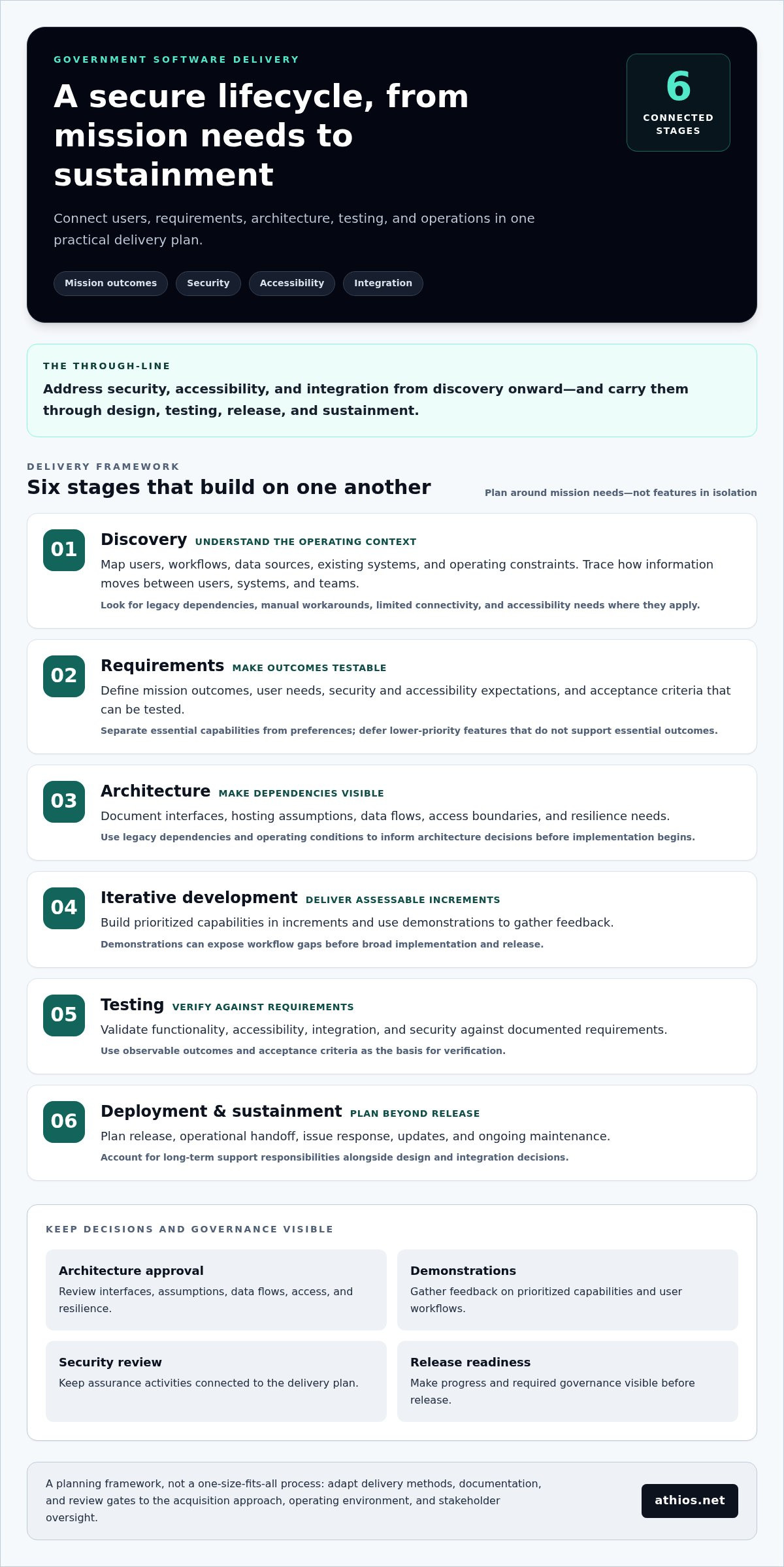
A secure lifecycle connects mission needs, technical decisions, and assurance activities in one delivery plan. In custom software development for government, teams should address security, accessibility, and integration during discovery and requirements work, then carry those considerations through design, testing, release, and sustainment. Doing so helps surface issues early, such as an application’s inability to connect to an essential system or support a user’s needs.
A practical lifecycle moves through connected stages:
- Discovery: Map users, workflows, data sources, existing systems, and operating constraints.
- Requirements: Define mission outcomes, user needs, security and accessibility expectations, and testable acceptance criteria.
- Architecture: Document interfaces, hosting assumptions, data flows, access boundaries, and resilience needs.
- Iterative development: Deliver prioritized capabilities in increments and use demonstrations to gather feedback.
- Testing: Validate functionality, accessibility, integration, and security against documented requirements.
- Deployment and sustainment: Plan release, operational handoff, issue response, updates, and ongoing maintenance.
This sequence is a planning framework, not a requirement to use the same process on every program. Delivery methods, documentation, and review gates should reflect the acquisition approach, operating environment, and stakeholder oversight. Set decision points for architecture approval, demonstrations, security review, and release readiness so progress is visible and required governance remains in place.
Turn discovery into architecture and delivery decisions
During discovery, trace how information moves from the user who creates it to the systems and teams that depend on it. Record external interfaces, legacy dependencies, hosting assumptions, and relevant conditions such as intermittent connectivity or constrained devices. These details inform architecture reviews and can reveal risks before implementation begins.
Break the work into increments that deliver assessable capabilities, not just technical components. For each increment, decide what stakeholders will review, what evidence they need, and which unresolved issues could affect the next stage. Testable requirements turn stakeholder expectations into measurable acceptance decisions.
Build security and accessibility into requirements
Define the data the application handles, which roles can view or change it, and where sensitive actions require additional controls. Capture threat considerations and security review needs alongside functional requirements, then carry them into architecture decisions and test plans. NIST’s Secure Software Development Framework, described in NIST SP 800-218, provides practices organizations can integrate into their development lifecycle. Teams should determine its applicability to their program.
Accessibility belongs in design and validation planning too. Specify how users will complete key tasks, and include accessibility checks and user testing at relevant review points. This can uncover barriers in navigation, forms, and feedback before release, rather than leaving accessibility as a final-stage correction.
For programs coordinating application work with technical architecture and cybersecurity sustainment, Athios’ government software capabilities connect these considerations across delivery and operations.
How to balance interoperability, security, and maintainability
Government applications rarely operate alone. They may exchange information with systems of record, identity services, reporting tools, or applications maintained by separate teams. Each connection can support a more continuous workflow, but it also adds dependencies that affect security, reliability, and future changes. In custom software development for government, make these trade-offs explicit during architecture planning instead of treating integration as a final technical task.
The right balance depends on the system’s mission, data, users, and operating environment. Use the comparison below as a starting point for architecture discussions, not as a universal design prescription.
| Area | Design consideration | Trade-off to manage |
|---|---|---|
| Integration | Documented APIs or other defined interfaces | More consistent exchange can introduce dependencies on external system availability and change schedules. |
| Data handling | Clear ownership, validation, and exchange rules | Reducing duplicated data can simplify records, while relying on a source system can affect access and availability. |
| Access | Roles and permissions aligned to user responsibilities | Restricting access protects sensitive functions, but overly broad or complex controls can impede legitimate work. |
| Maintenance | Modular components and documented decisions | Separating functions can isolate changes, while additional boundaries require clear interface ownership. |
Plan integrations around existing systems and data
Start with an inventory of systems of record, data owners, available interfaces, and operational dependencies. For each exchange, define what information moves, which system is authoritative, how errors are identified, and what happens if a connection is unavailable. APIs and other documented interfaces can make responsibilities and change impacts easier to trace. Data standards can support consistent interpretation when they fit the program’s information needs.
Plan data migration as its own workstream. Define how records will be mapped, validated, and reconciled, then specify rollback or recovery steps before a transition. These decisions help teams identify discrepancies and protect operational continuity before release.
Design for security reviews and long-term operation
Security and maintainability depend on operational detail as much as architecture. Define how identities are established, permissions are assigned, and significant actions are recorded. Establish how vulnerabilities will be identified and addressed, and what monitoring will help operations teams detect failures or unusual activity. Modular design can isolate changes, but only when interfaces, dependencies, and ownership are documented well enough for teams to maintain them.
Do not assume one architecture, security framework, or authorization path applies to every agency or system. Applicability depends on the system context, data, hosting environment, and program requirements. Record the basis for decisions and align security reviews with the system’s actual operating conditions. This discipline supports interoperability without making security or sustainment an afterthought.
Moving Government Software from Requirements to Release
Release is not a single engineering milestone. It is a coordinated decision that the software meets defined mission needs, has passed planned validation, and can be operated with clear ownership. A disciplined path from stakeholder alignment to operational handoff helps teams make that decision using evidence rather than assumptions.
Use an ordered delivery sequence, adapting review points to program governance and the acquisition approach:
- Align stakeholders: Confirm decision-makers, user representatives, mission priorities, and operational owners.
- Establish acceptance measures: Connect each requirement to a verifiable outcome and identify who approves the evidence.
- Prototype key workflows: Demonstrate representative tasks early so users can identify missing steps, confusing handoffs, or inaccessible interactions.
- Build and demonstrate in increments: Review working capabilities regularly, record decisions, and manage changes through agreed governance.
- Validate the release: Complete functional, security, accessibility, integration, and user acceptance testing against the planned criteria.
- Prepare operations and handoff: Confirm deployment readiness, documentation, ownership, and sustainment responsibilities.
Establish governance, roles, and measurable acceptance
Assign clear responsibilities across mission leadership, product ownership, engineering, security, accessibility, and operations. A user representative can validate whether a workflow supports actual work, while designated reviewers assess technical and operational evidence. Set decision rights to fit the program’s governance structure.
Maintain traceability from each requirement to its implementation, related tests, review decisions, and acceptance evidence. This helps identify untested changes and resolve disagreements about what “done” means. Define change control and escalation practices so teams know how to assess scope changes, raise risks, and record approvals while maintaining oversight.
Release readiness is evidence that defined acceptance criteria have been met and operational responsibilities are assigned. Prototypes and iterative demonstrations strengthen that evidence by exposing workflow gaps before they are built into a broader implementation. They also give stakeholders a structured opportunity to confirm that delivered behavior matches the mission need.
Validate deployment and prepare for sustainment
Before release, plan environment configuration, user onboarding, and documentation for both users and operations staff. Confirm who owns monitoring, support intake, defect triage, patching, backups, recovery procedures, and release management. Make these responsibilities explicit, including how operational issues are prioritized and communicated.
Testing should cover more than whether features work in isolation. Verify that integrations exchange and handle data as intended, security controls behave according to requirements, and accessibility checks address key user tasks. User acceptance testing should confirm that representative users can complete mission workflows. Record results and unresolved issues so release decisions account for known risks.
After launch, use user feedback and operational metrics to prioritize controlled improvements rather than allowing changes to accumulate without review. For support with government application engineering and sustainment, connect development planning with the architecture and cybersecurity work that supports ongoing operations.
How Athios connects custom software engineering to government missions
Government software must fit its mission and operate within a real technical environment, including existing systems, user workflows, security needs, and ongoing support responsibilities. Athios develops custom web and mobile applications around defined client needs, connecting application engineering with architecture, user experience, cybersecurity sustainment, and automation. Secure, scalable delivery is an engineering objective shaped by requirements and operating conditions, not a guaranteed outcome.
For programs considering custom software development for government, this connection matters because application decisions affect more than the interface. Data flows, infrastructure dependencies, user permissions, and maintenance needs influence how a system is designed and sustained. Aligning these considerations helps teams define a solution around mission priorities instead of treating software as an isolated deliverable.
Connect application engineering with the operating environment
Architecture planning helps determine how an application will fit with existing systems and operational dependencies. Mapping interfaces, data flows, and infrastructure assumptions can inform design decisions and surface integration considerations early. The appropriate architecture depends on the system context and the requirements established for the work.
Clear user experience design matters just as much. UI/UX improvements can make complex workflows easier to understand by clarifying navigation, presenting information in a useful sequence, and helping users recognize the next action. Design decisions should reflect the roles and tasks the application is intended to support.
Operational needs continue after initial development. Cybersecurity sustainment connects security considerations with ongoing software operations, while automation can support defined processes where it fits the mission. Treating these disciplines as connected parts of engineering helps teams consider not only how an application is built, but also how it will be maintained.
Start with mission needs and a defined scope
Begin by documenting who will use the system, what they need to accomplish, how the current process works, and which constraints shape delivery. Include known dependencies, desired outcomes, and the capabilities essential to the mission. This gives stakeholders a clearer basis for discussing scope and priorities.
Athios aligns application scope and delivery considerations with the defined environment, bringing together custom web or mobile development with relevant architecture, UI/UX, cybersecurity sustainment, and automation work. The approach depends on the project’s needs and operating context.
Organizations developing a government software requirement can bring their mission objectives, user needs, and known system constraints to a discussion with Athios. This can help establish a clearer project scope and identify the engineering considerations to address next.
Define the Next Step for Your Government Software Need
Turn an emerging software need into a decision-ready starting point. Identify the mission outcome, affected users, current workflow, operating constraints, and evidence that would demonstrate success. A concise brief helps stakeholders distinguish the core problem from possible features, surface dependencies early, and decide what must be understood before choosing a delivery path.
Record what is established and what remains an assumption, including relevant data sources, interface ownership, and operational responsibilities. This gives technical planning a firmer basis without presupposing a particular platform or architecture. It also keeps custom software development for government anchored in mission purpose as requirements take shape.
Athios connects custom web and mobile application development with architecture, enterprise IT engineering, and cybersecurity sustainment, aligning these capabilities with defined project needs. Discuss a government software requirement with Athios and identify a practical next step for your mission.
Frequently Asked Questions
What is custom software development for government?
Custom software development for government creates applications tailored to a public agency’s mission, users, and operating environment. A permitting tool, for example, might support a particular review sequence, connect to agency records, and present different functions to applicants and reviewers. The scope is defined by operational needs rather than a generic feature set. Teams assess whether existing software can meet those needs before deciding that bespoke development is appropriate.
How does government software development differ from commercial software development?
Government projects often involve distinct oversight, procurement, accessibility, security, and records-management considerations alongside software functionality. Teams may need to coordinate decisions among mission owners, program staff, technical reviewers, and operations personnel. Commercial projects can also involve extensive governance, so the distinction is not absolute. The specific environment shapes the work: a public-facing benefits application, for instance, may require different user access, documentation, and review considerations than an internal commercial tool.
How long does custom government software development take?
There is no reliable standard duration because timelines depend on scope, integration complexity, review processes, acquisition arrangements, and the readiness of requirements and data. A focused application with few dependencies has a different planning profile from a system that replaces several workflows or connects to legacy platforms. Teams can improve schedule estimates by identifying decision-makers, external dependencies, required reviews, and release increments before setting delivery milestones.
Which standards or security frameworks apply to government software?
Applicable frameworks depend on the agency, system classification, data, hosting arrangement, and program requirements. NIST’s Secure Software Development Framework, SP 800-218, offers practices that can be incorporated into development. NIST SP 800-53 security and privacy controls may be relevant to federal information systems, while Section 508 accessibility requirements and FedRAMP authorization considerations apply in their respective contexts. The responsible agency determines which requirements govern a specific system and environment.
Can custom government software integrate with legacy systems?
Yes. Integration can use available APIs, file exchanges, messaging, or other documented interfaces, depending on the legacy system’s capabilities and constraints. For example, an application might retrieve case status from an existing system rather than duplicate the full record. Before selecting an approach, establish data ownership, exchange frequency, validation rules, error handling, and how interface changes will be coordinated with the system owner.
What happens after a government software application is released?
Release begins an operational phase that includes monitoring, issue handling, security updates, and planned enhancements. Teams should define who receives user reports, assesses defects, approves changes, and coordinates deployments. They also need procedures for restoring service or data after an incident, appropriate to the system’s needs. Reviewing recurring support issues and user feedback can help distinguish training gaps from software defects and inform maintenance priorities.
Can artificial intelligence be included in custom government software?
Yes, if an AI capability serves a defined use case and its risks, data, and human oversight are addressed. Teams should identify where the model informs or generates an output, how users can review it, and how performance and changes will be monitored. For DoD software development, a policy effective September 8, 2026, treats AI-generated code as unverified input and requires human review of changes to critical functions. Applicability depends on the program.

Article by
Kevin Torres


