

More AI does not automatically mean better automation. Organizations can have AI in use and still struggle to move promising experiments into dependable production workflows. The gap is rarely solved by adding another model. It requires identifying work where AI adds value, then engineering the data connections, controls, and operational ownership around it. Enterprise AI automation consulting helps turn that challenge into a bounded, measurable implementation.
Caution is warranted. Fragmented or sensitive data can affect reliability and create exposure. Poorly defined human oversight and system integration can also limit an otherwise useful solution. The practical goal is to distinguish tasks suited to conventional automation from workflows where AI can support decisions or handle variable inputs, with clear review and escalation paths.
This guide explains how to prioritize an automation opportunity, assess data and integration requirements, and establish oversight and production responsibilities. It also outlines how consulting support can align with enterprise or federal mission needs. Athios combines custom AI-driven automation with architecture, infrastructure planning, system administration, and cybersecurity sustainment, connecting development to the environment where the capability must operate.
Key Takeaways
- Start with a measurable workflow problem, then determine whether AI, rules-based automation, or a combination fits its inputs and decisions.
- Use enterprise AI automation consulting to connect process discovery, data access, architecture, and production responsibilities into a structured delivery path.
- Compare approaches by input variability, explainability needs, exception handling, and integration burden before selecting a design.
- Define system boundaries, human review, and failure handling before deployment to establish practical security and reliability controls.
- Align custom development, data transformation, architecture, and operational support with your organization’s project scope.
What Enterprise AI Automation Consulting Does, and Where It Fits
Enterprise AI automation consulting combines advisory and engineering support to identify suitable workflows, select an appropriate automation method, and design, implement, and operationalize the resulting capability. Start with the process: its inputs, decision points, exceptions, system dependencies, and the consequences of error. AI is one design option, not a default replacement for established rules-based automation.
Definition: AI automation uses machine learning or other AI methods to interpret patterns or less-structured inputs within an automated workflow. Conventional workflow automation follows predefined rules and conditions. In enterprise settings, either approach can operate alone or as part of a controlled hybrid process.
How AI automation differs from rules-based workflow automation
A rules-based system suits predictable steps with explicit conditions, such as routing a record when a field matches a known value. AI can support work involving variable inputs, such as extracting meaning from differently formatted documents or classifying text that does not follow a fixed template. Its interpretation is not inherently correct, so the workflow needs a defined way to handle uncertain or out-of-scope cases.
Many processes can combine both methods. Rules can manage required fields, permissions, routing, and other deterministic steps, while an AI component handles a bounded interpretation task and passes its output for validation. This is one form of Intelligent Automation, a broader approach that brings AI together with automation technologies. Repetitive work with stable inputs and clear decision logic may need only conventional automation. Adding a model can introduce complexity without solving a real process problem.
Which enterprise workflows may merit assessment
Assess candidate workflows using evidence, not novelty. Review transaction volume, process stability, the frequency and type of exceptions, data accessibility, and the impact of an incorrect result. A high-volume task is not automatically suitable for AI if its rules are clear. A variable task may not justify automation if it is rare or errors carry consequences the organization cannot accept.
- Document handling: Consider whether varied forms or supporting documents require classification or information extraction. Define how uncertain results reach human review.
- Data transformation: Examine recurring normalization or mapping across sources. Distinguish inconsistent formats from transformations governed by fixed rules.
- Cross-system processing: Assess repeated movement of records between applications, including permissions, interface constraints, and exception paths.
- Manual exception queues: Identify recurring cases where staff interpret unstructured information. Then determine whether a bounded AI step can assist without removing needed judgment.
These are assessment examples, not guaranteed automation outcomes. Before implementation, enterprise AI automation consulting should establish a narrow workflow boundary and measurable evaluation criteria. That gives the organization a basis for deciding whether AI adds enough value over a simpler design.
How Enterprise AI Automation Consulting Moves from Assessment to Production
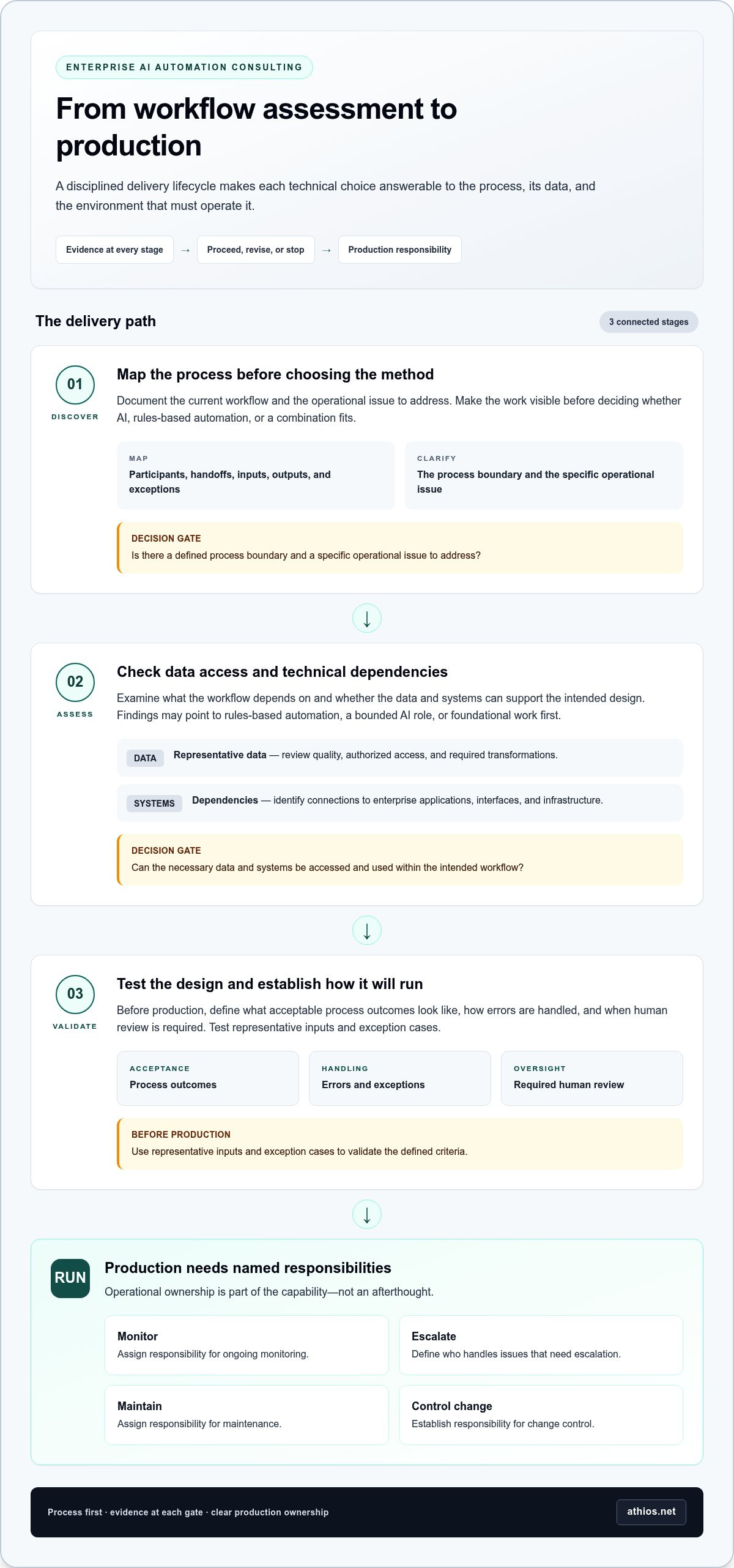
A disciplined delivery lifecycle makes the path from a process problem to a production capability explicit. Each stage should produce evidence for a decision: proceed, revise the design, or stop before committing more effort. This keeps technical choices grounded in how work is performed and what the operating environment can support.
Assessing process, data, and technical dependencies
Discovery should document the workflow’s inputs and outputs, transaction volumes, exception paths, and the decisions people currently make. The team then examines data quality, access controls, transformation needs, and dependencies on enterprise applications, interfaces, and infrastructure. These findings shape the design. They may show that rules-based automation is sufficient, that AI has a bounded role, or that foundational data and integration work must come first.
Validating and operationalizing an automation
Before production, define acceptance criteria for process outcomes, error handling, and required human review. Test with representative inputs and exception cases, then assign responsibility for monitoring, escalation, maintenance, and change control. The Harvard Business Review on AI's Impact on Consulting discusses how AI is changing consulting work and roles, underscoring the importance of clear accountability as organizations adopt AI-enabled processes.
- Discover the process. Map the current workflow, its participants, handoffs, inputs, outputs, and exceptions. Gate: Is there a defined process boundary and a specific operational issue to address?
- Assess data and dependencies. Review representative data, its quality and authorized access, required transformations, and connections to applications or infrastructure. Gate: Can the necessary data and systems be accessed and used within the intended workflow?
- Select the technical approach. Use process evidence to determine whether rules, AI, or a hybrid design fits the work. Specify system interfaces, decision points, security boundaries, and where people review results. Gate: Is the design feasible within the architecture and oversight requirements?
- Build and integrate. Develop the workflow and its data transformations, then connect it to the required systems in a controlled environment. Gate: Do the components exchange information as designed, with exceptions routed appropriately?
- Validate against operating conditions. Test normal cases, atypical inputs, failures, and human-review paths against agreed acceptance criteria. Gate: Does the evidence support the required process performance and safe handling of exceptions?
- Deploy and monitor. Establish production access, monitoring, escalation routes, maintenance responsibilities, and change control. Gate: Are operational owners prepared to support and govern the workflow after release?
Production readiness requires integration, validation, and assigned operational ownership. Enterprise AI automation consulting should carry those responsibilities through delivery rather than treat deployment as the final handoff. Organizations planning custom AI automation and enterprise engineering can review Athios's automation and engineering capabilities in relation to their environment and project scope.
How to Compare AI, Conventional Automation, and Hybrid Approaches
Selecting an automation method is an engineering decision, not a contest to use the most advanced technology. Compare how the workflow behaves, what decisions it requires, and how costly an incorrect result would be. The matrix below provides a starting point for matching process characteristics to an approach.
| Criterion | Rules-based automation | AI-assisted processing | Hybrid workflow |
|---|---|---|---|
| Input variability | Best when inputs follow known formats and fields. | Useful when language, documents, or patterns vary. | Rules handle standard inputs; AI interprets variable ones. |
| Decision complexity | Clear conditions produce predictable decisions. | Supports interpretation where fixed conditions are insufficient. | AI interprets a bounded part; rules govern next steps. |
| Explainability needs | Logic can be traced to explicit conditions. | Outputs may need review and validation. | Deterministic controls constrain AI-assisted decisions. |
| Exception handling | Exceptions follow defined branches or queues. | Uncertain results need thresholds and review paths. | Rules route exceptions; AI handles only assigned cases. |
| Integration burden | Depends on system connections and rule maintenance. | May add data preparation and model integration needs. | Coordinates rules, AI components, interfaces, and oversight. |
Decision rule: Match the method to process variability and the impact of errors. As the consequences of error rise, require stronger controls and human review.
When conventional automation is the stronger fit
Choose rules-based automation when inputs, conditions, and expected outputs are stable and explicitly defined. For example, a workflow that routes a complete record according to a known category may be handled with straightforward rules. Simpler logic is often easier to test against defined cases, inspect during troubleshooting, and maintain as system behavior changes. Reassess the design when process rules shift often or exceptions become frequent, since those changes can weaken the original fit.
When AI or a hybrid workflow is worth evaluating
Evaluate AI when variable language, document layouts, or patterns make fixed rules brittle. Keep its role bounded to a defined interpretation or classification task. Set confidence or review thresholds so uncertain outputs are checked rather than treated as authoritative. A hybrid design can combine that interpretation with explicit rules for permissions, routing, and downstream actions. Before expanding the scope, compare the proposed approach with a conventional baseline using representative cases and agreed criteria. Enterprise AI automation consulting should support this comparison with process evidence, not assume AI is preferable.
How to Reduce Enterprise AI Automation Risk Before Deployment
AI deployment requires explicit security, reliability, and integration controls. A model can perform as designed in isolation and still create operational risk if it receives data beyond its intended scope, returns uncertain results without review, or fails to connect safely with enterprise systems. Before deployment, map the policies and contractual requirements that apply to the specific environment, then translate them into workflow-level controls. Requirements may differ across commercial and federal settings, so a general framework should not be treated as proof of compliance.
Data protection, governance, and human oversight
Define which data the workflow may use, who or what can access it, where it may move, and how retention and audit expectations will be handled. The NIST AI Risk Management Framework can help structure discussion of risks and governance, but using it does not by itself establish compliance or certify a system. Enterprise AI automation consulting should make oversight operational by identifying which outputs require review and who is responsible for acting on them.
- Data use: Document permitted sources, access boundaries, transformation steps, retention expectations, and audit requirements.
- System boundaries: Specify connected applications, allowed data flows, permissions, and actions the automated workflow is authorized to take.
- Human review: Assign reviewers for consequential decisions, uncertain outputs, and exceptions that exceed defined thresholds.
- Failure handling: Define how the process detects incomplete, invalid, or unavailable inputs, where cases are routed, and how manual processing can resume.
Integration, validation, and operational readiness
Test the workflow in its intended operating environment, not only in a controlled demonstration. Validate interfaces and permissions, then exercise failure paths such as unavailable dependencies, malformed data, and interrupted processing. Set measurable acceptance criteria before comparing results with the current process. Criteria should cover task outcomes, exception routing, human review, and recovery behavior, with thresholds suited to the impact of errors in that workflow.
Readiness also depends on named operational responsibilities. Identify who monitors workflow behavior, reviews incidents, coordinates updates, and approves changes when connected systems or business processes shift. Document escalation routes and preserve a clear handoff between development and ongoing administration. If these responsibilities are unassigned, technical testing alone does not establish production readiness.
Use this checklist before authorizing deployment:
- Applicable organizational policies and contractual requirements are mapped to the deployment environment.
- Data access, system boundaries, and permitted workflow actions are documented.
- Human review and exception conditions have assigned owners.
- Representative cases, failure behavior, and recovery paths have been tested against acceptance criteria.
- Monitoring, incident escalation, maintenance, and change control have accountable owners.
For implementation that brings custom automation together with enterprise architecture and cybersecurity sustainment, review Athios's automation engineering capabilities.
How Athios Supports Enterprise AI Automation Consulting
Athios connects custom AI automation with the enterprise engineering required to scope, develop, and deploy it within client environments. This integrated approach suits automation efforts that depend not only on algorithm design, but also on data transformation, application interfaces, infrastructure, and ongoing technical operations. The work is shaped around a defined organizational workflow rather than treating AI as a stand-alone implementation.
Connecting custom AI development with enterprise engineering
Athios develops custom AI-driven automation and enterprise data automation algorithms, supported by architecture, infrastructure planning, custom development, system administration, and cybersecurity sustainment. Architecture and infrastructure inform how a capability fits its deployment environment. Administration and sustainment support the systems that remain in use after implementation. These capabilities can be brought together according to project needs, with commercial and federal environments addressed according to their distinct technical and operational requirements.
A tailored project can connect its workstreams in sequence: define a bounded workflow and its objective, assess relevant data and system dependencies, design an appropriate algorithm and data transformations, then develop and deploy the capability into the client environment. Scoping establishes what the work will address and where its boundaries lie. Algorithm design responds to the task and available data, while transformation and integration address how inputs and outputs fit surrounding systems.
Project structure can reflect the work. Athios engagements may use fixed-scope milestones, time-and-materials contracts, or retainers. A defined milestone structure can organize work around agreed deliverables; time-and-materials or retainer arrangements may suit other project scopes. The appropriate structure depends on the work and how the organization plans to manage it.
Defining a focused next step
Begin with one workflow, a clear operational objective, and known constraints. A concise process description helps establish an engineering discussion around evidence rather than a broad request to “add AI.” Include how the process works today, which systems and users are involved, and what a useful result would mean for the organization.
- Workflow: Which bounded process is under consideration, and what task or decision should it support?
- Data: What inputs are available, how are they accessed, and what transformation needs are known?
- Systems and users: Which applications, interfaces, infrastructure, and user roles are in scope?
- Exceptions: Where does the current process require judgment, and which cases need human handling?
- Measures and constraints: How will the organization evaluate the work, and what operational, security, or contractual requirements shape delivery?
These details give enterprise AI automation consulting a practical starting point, connecting project scope with architecture, development, and deployment considerations. Discuss an enterprise AI automation project with Athios to outline the workflow and its engineering requirements.
Set a Practical Direction for Your Next Workflow
Define one workflow in terms of its operational objective, constraints, and the decision your organization needs to make. This gives enterprise AI automation consulting a concrete basis for determining whether a focused assessment, a tailored build, or further engineering groundwork is appropriate. It also gives stakeholders a shared reference point for scope and ownership.
Athios brings custom AI-driven automation and enterprise data automation development together with enterprise architecture, infrastructure, systems administration, and cybersecurity sustainment. These capabilities help shape a proposed solution for its intended environment, with project scope and requirements guiding the approach.
Start with a process that has a clear owner and a well-defined operational need. A measured first step can establish a sound basis for future decisions without presuming that every workflow requires AI. Discuss your enterprise AI automation project with Athios and identify the engineering requirements that should guide your next move.
Frequently Asked Questions
How long does an enterprise AI automation consulting engagement take?
The schedule depends on the workflow’s scope, data readiness, system dependencies, and delivery structure. An assessment limited to one process has different requirements from custom development involving data transformation and deployment into an enterprise environment. Athios structures engagements around fixed-scope milestones, time-and-materials work, or retainers. Defining the workflow and identifying access, review, and integration needs early helps establish a realistic project plan.
Does enterprise AI automation consulting include software licenses?
No. Athios focuses on custom AI-driven automation and enterprise engineering, not the sale of off-the-shelf software licenses. A project can account for the software and systems already present in your environment, including how a custom capability may connect with them. Separate licensing decisions remain distinct from consulting and development, so include existing platform constraints in the project scope.
Can an organization begin with one workflow instead of an enterprise-wide AI program?
Yes. Starting with a single workflow gives stakeholders a defined basis for evaluating operational fit before considering broader adoption. For example, an organization might first assess one internal record-review process, document its users and dependencies, and agree on how performance will be judged. A bounded starting point also helps clarify which teams need to participate and what evidence would support expanding, revising, or ending the effort.
What should executives expect from an AI automation assessment?
Executives should expect a decision-oriented view of the candidate workflow, including its operational objective, key constraints, relevant systems, and data considerations. The assessment should clarify whether AI is appropriate or a simpler approach better fits the task, and identify assumptions that need validation. Useful outputs include a defined scope, material dependencies, evaluation measures, and the decisions or resources required to proceed, rather than a technology recommendation detached from operations.
Who should own an AI automation workflow after deployment?
Ownership should be shared across operational and technical roles, with one accountable process owner responsible for the workflow’s purpose and one technical owner responsible for its system operation. For example, a business unit may review whether exceptions are handled appropriately, while an IT administrator manages technical issues and changes. The organization should also assign who approves process updates and who coordinates escalation when outputs or connected systems require attention.
Can enterprise AI automation consulting support federal government workflows?
Yes. Athios serves federal government clients as well as commercial organizations. Federal workflows can involve specific mission, contractual, data-handling, and technical constraints, so project scope and engineering decisions should reflect the operating environment. An initial discussion can define the process boundary, participating users, relevant systems, and applicable requirements. The resulting approach should be tailored to those conditions rather than assume one control model fits every agency.

Article by
Kevin Torres


